Department of Psychology, University of Hong Kong, Hong Kong SAR, China.
Department of Social Sciences, School of Arts and Social Sciences, Hong Kong Metropolitan University, Hong Kong SAR, China.
Sci Rep. 2022 Jun 1;12(1):9144. doi: 10.1038/s41598-022-12978-9.
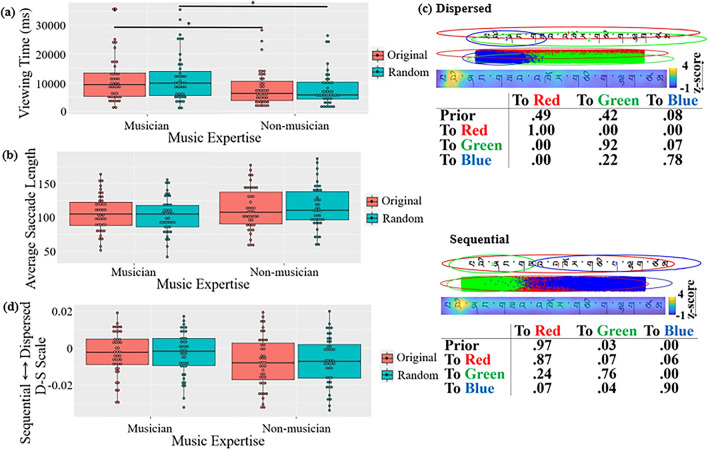
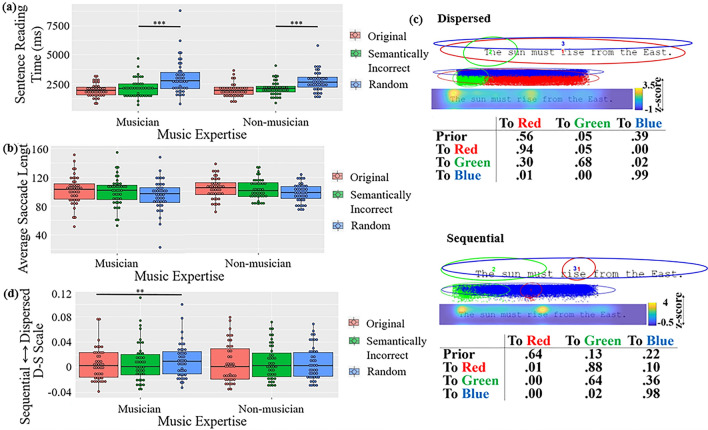
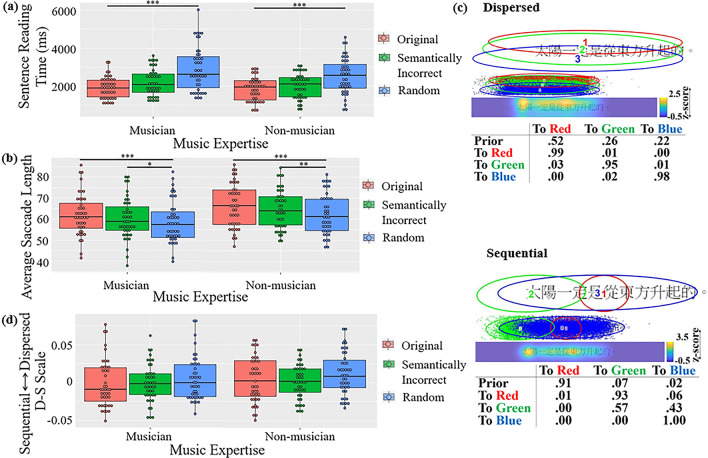
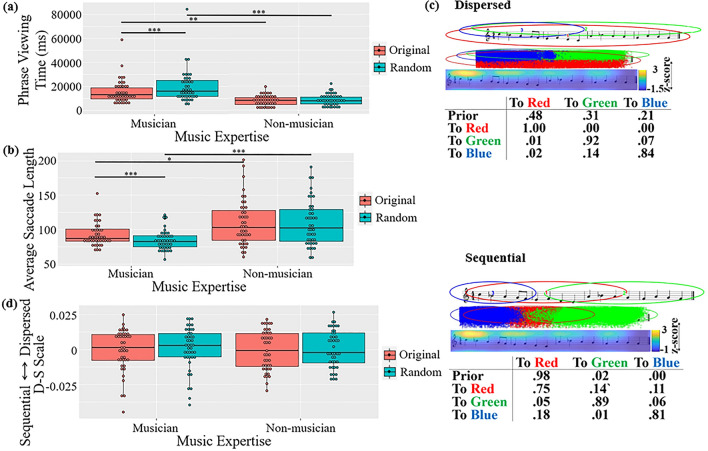
Here we tested the hypothesis that in Chinese-English bilinguals, music reading experience may modulate eye movement planning in reading English but not Chinese sentences due to the similarity in perceptual demands on processing sequential symbol strings separated by spaces between music notation and English sentence reading. Chinese-English bilingual musicians and non-musicians read legal, semantically incorrect, and syntactically (and semantically) incorrect sentences in both English and Chinese. In English reading, musicians showed more dispersed eye movement patterns in reading syntactically incorrect sentences than legal sentences, whereas non-musicians did not. This effect was not observed in Chinese reading. Musicians also had shorter saccade lengths when viewing syntactically incorrect than correct musical notations and sentences in an unfamiliar alphabetic language (Tibetan), whereas non-musicians did not. Thus, musicians' eye movement planning was disturbed by syntactic violations in both music and English reading but not in Chinese reading, and this effect was generalized to an unfamiliar alphabetic language. These results suggested that music reading experience may modulate perceptual processes in reading differentially in bilinguals' two languages, depending on their processing similarities.
在这里,我们检验了一个假设,即对于汉英双语者来说,由于音乐符号和英语句子之间的空格分隔了顺序符号串,在处理上具有相似的感知需求,因此音乐阅读经验可能会调节阅读英语句子时的眼球运动规划,但不会调节阅读汉语句子时的眼球运动规划。汉英双语音乐家和非音乐家分别用英语和汉语阅读合法的、语义错误的和句法(及语义)错误的句子。在英语阅读中,音乐家在阅读句法错误的句子时的眼球运动模式比阅读合法句子时更加分散,而非音乐家则没有这种情况。在汉语阅读中没有观察到这种现象。音乐家在观看陌生的字母语言(藏语)中的句法错误的音乐符号和句子时,其跳跃距离比观看正确的音乐符号和句子时要短,而非音乐家则没有这种情况。因此,音乐家的眼球运动规划在音乐和英语阅读中都会受到句法违规的干扰,但在汉语阅读中则不会,并且这种影响还会推广到陌生的字母语言。这些结果表明,音乐阅读经验可能会根据双语者两种语言的处理相似性,对阅读过程中的感知过程进行不同的调节。