Donders Institute for Brain, Cognition, and Behavior, Radboud University, Nijmegen, the Netherlands.
Department of Cognitive Neuroscience, Radboud University Medical Center, Nijmegen, the Netherlands.
Nat Protoc. 2022 Jul;17(7):1711-1734. doi: 10.1038/s41596-022-00696-5. Epub 2022 Jun 1.
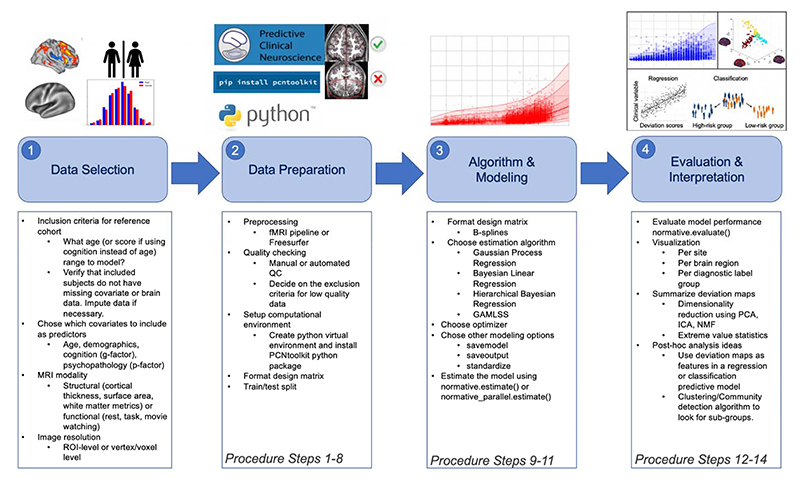
Normative modeling is an emerging and innovative framework for mapping individual differences at the level of a single subject or observation in relation to a reference model. It involves charting centiles of variation across a population in terms of mappings between biology and behavior, which can then be used to make statistical inferences at the level of the individual. The fields of computational psychiatry and clinical neuroscience have been slow to transition away from patient versus 'healthy' control analytic approaches, probably owing to a lack of tools designed to properly model biological heterogeneity of mental disorders. Normative modeling provides a solution to address this issue and moves analysis away from case-control comparisons that rely on potentially noisy clinical labels. Here we define a standardized protocol to guide users through, from start to finish, normative modeling analysis using the Predictive Clinical Neuroscience toolkit (PCNtoolkit). We describe the input data selection process, provide intuition behind the various modeling choices and conclude by demonstrating several examples of downstream analyses that the normative model may facilitate, such as stratification of high-risk individuals, subtyping and behavioral predictive modeling. The protocol takes ~1-3 h to complete.
规范建模是一种新兴的创新框架,用于针对单个个体或观察值相对于参考模型映射个体差异。它涉及在生物学和行为之间的映射中,绘制人群中变异的百分位数,然后可以在个体水平上进行统计推断。计算精神病学和临床神经科学领域一直难以摆脱患者与“健康”对照分析方法,这可能是由于缺乏旨在正确模拟精神障碍生物学异质性的工具。规范建模提供了解决该问题的方法,并将分析从依赖潜在嘈杂临床标签的病例对照比较中转移开。在这里,我们定义了一个标准化协议,使用 Predictive Clinical Neuroscience 工具包 (PCNtoolkit) 指导用户从头到尾进行规范建模分析。我们描述了输入数据选择过程,提供了各种建模选择背后的直观理解,并通过演示规范模型可能促进的几种下游分析示例(例如高风险个体分层、亚型和行为预测建模)来结束。该协议需要 1-3 小时才能完成。