Barkema Pieter, Rutherford Saige, Lee Hurng-Chun, Kia Seyed Mostafa, Savage Hannah, Beckmann Christian, Marquand Andre
Radboud University, Donders Institute for Brain, Cognition and Behaviour, Nijmegen, The Netherlands.
Department of Cognitive Neuroscience, Radboud University Medical Centre, Nijmegen, The Netherlands.
Wellcome Open Res. 2023 Nov 20;8:326. doi: 10.12688/wellcomeopenres.19591.1. eCollection 2023.
The neurobiology of mental disorders remains poorly understood despite substantial scientific efforts, due to large clinical heterogeneity and to a lack of tools suitable to map individual variability. Normative modeling is one recently successful framework that can address these problems by comparing individuals to a reference population. The methodological underpinnings of normative modelling are, however, relatively complex and computationally expensive. Our research group has developed the python-based normative modelling package Predictive Clinical Neuroscience toolkit (PCNtoolkit) which provides access to many validated algorithms for normative modelling. PCNtoolkit has since proven to be a strong foundation for large scale normative modelling, but still requires significant computation power, time and technical expertise to develop.
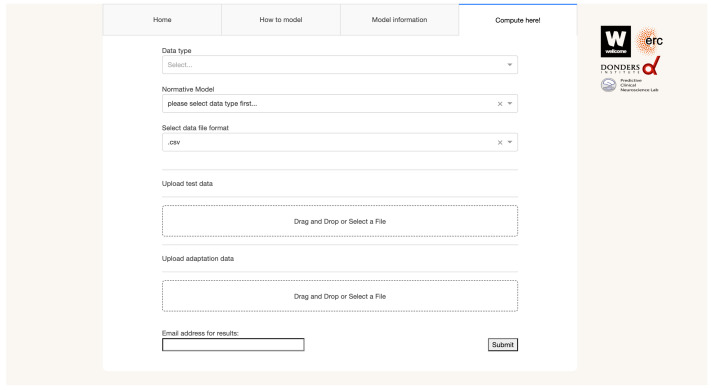
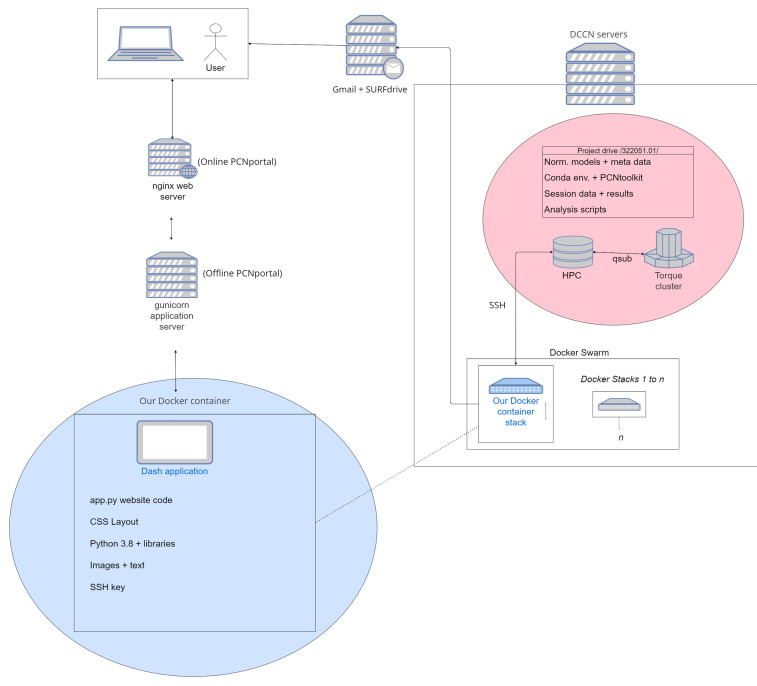
To address these problems, we introduce PCNportal. PCNportal is an online platform integrated with PCNtoolkit that offers access to pre-trained research-grade normative models estimated on tens of thousands of participants, without the need for computation power or programming abilities. PCNportal is an easy-to-use web interface that is highly scalable to large user bases as necessary. Finally, we demonstrate how the resulting normalized deviation scores can be used in a clinical application through a schizophrenia classification task applied to cortical thickness and volumetric data from the longitudinal Northwestern University Schizophrenia Data and Software Tool (NUSDAST) dataset.
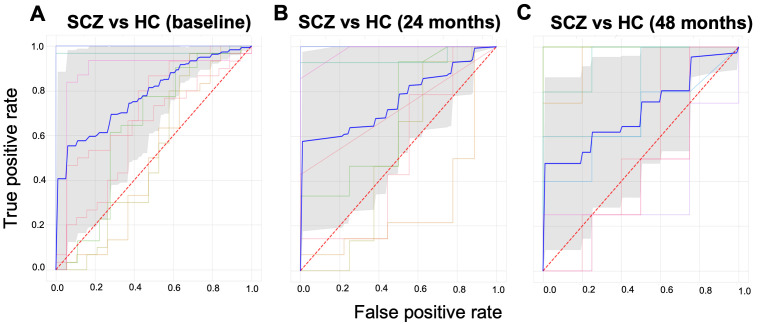
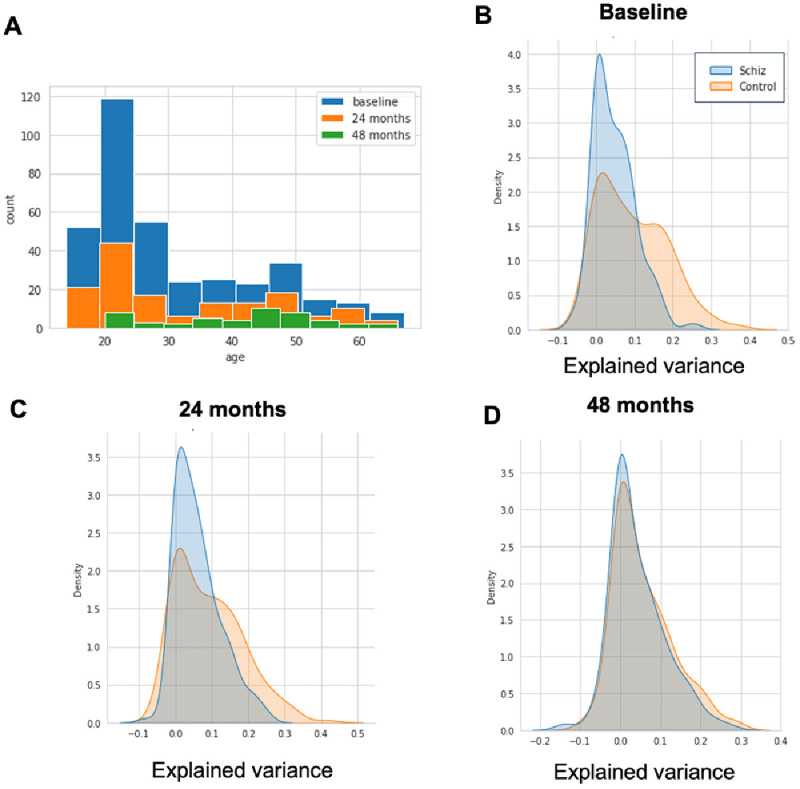
At each longitudinal timepoint, the transferred normative models achieved a mean[std. dev.] explained variance of 9.4[8.8]%, 9.2[9.2]%, 5.6[7.4]% respectively in the control group and 4.7[5.5]%, 6.0[6.2]%, 4.2[6.9]% in the schizophrenia group. Diagnostic classifiers achieved AUC of 0.78, 0.76 and 0.71 respectively.
This replicates the utility of normative models for diagnostic classification of schizophrenia and showcases the use of PCNportal for clinical neuroimaging. By facilitating and speeding up research with high-quality normative models, this work contributes to research in inter-individual variability, clinical heterogeneity and precision medicine.
尽管进行了大量科学研究,但由于临床异质性大以及缺乏适用于描绘个体差异的工具,精神障碍的神经生物学仍未得到很好的理解。规范建模是一个最近成功的框架,它可以通过将个体与参考人群进行比较来解决这些问题。然而,规范建模的方法基础相对复杂且计算成本高昂。我们的研究小组开发了基于Python的规范建模软件包预测性临床神经科学工具包(PCNtoolkit),该工具包提供了许多经过验证的规范建模算法。自那以后,PCNtoolkit已被证明是大规模规范建模的坚实基础,但开发它仍需要大量的计算能力、时间和技术专长。
为了解决这些问题,我们引入了PCNportal。PCNportal是一个与PCNtoolkit集成的在线平台,它提供了对在数万名参与者身上估计的预训练研究级规范模型的访问,而无需计算能力或编程能力。PCNportal是一个易于使用的网络界面,必要时可高度扩展以适应大量用户。最后,我们通过应用于来自西北大学精神分裂症纵向数据和软件工具(NUSDAST)数据集的皮质厚度和体积数据的精神分裂症分类任务,展示了如何将所得的标准化偏差分数用于临床应用。
在每个纵向时间点,转移的规范模型在对照组中分别实现了9.4[8.8]%、9.2[9.2]%、5.6[7.4]%的平均[标准差]解释方差,在精神分裂症组中分别为4.7[5.5]%、6.0[6.2]%、4.2[6.9]%。诊断分类器的AUC分别为0.78、0.76和0.71。
这重现了规范模型在精神分裂症诊断分类中的效用,并展示了PCNportal在临床神经影像学中的应用。通过促进和加速使用高质量规范模型的研究,这项工作有助于个体间差异、临床异质性和精准医学的研究。