Department of Critical Care Medicine, Beijing Tongren Hospital, Capital Medical University, Beijing, China.
BMC Anesthesiol. 2022 Jun 1;22(1):170. doi: 10.1186/s12871-022-01708-3.
Negative fluid balance (NFB) is associated with reduced extubation failure. However, whether achieving more NFB can further improve extubation outcome has not been investigated. This study aimed to investigate whether more NFB and restricted fluid intake were associated with extubation success.
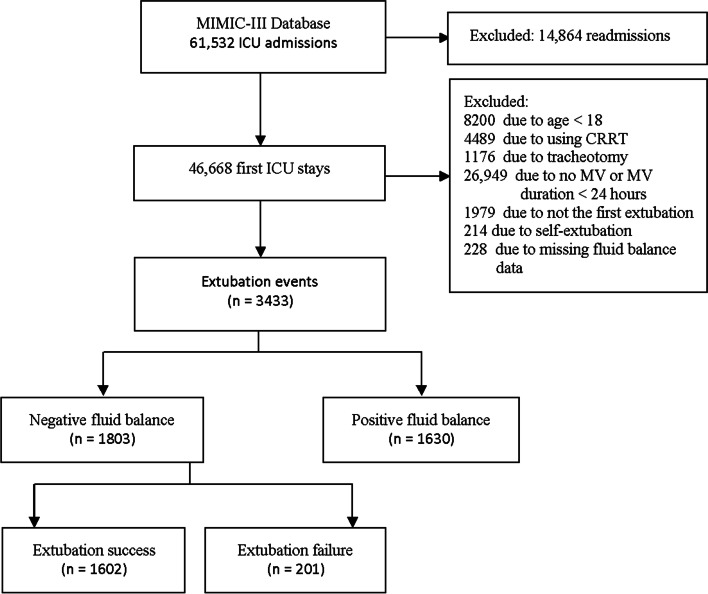
We performed a retrospective study of adult patients with mechanical ventilation (MV) admitted to Medical Information Mart for Intensive Care (MIMIC-III) from 2001 to 2012. Patients with duration of MV over 24 hours and NFB within 24 hours before extubation were included for analysis. The primary outcome was extubation failure, defined as reintubation within 72 hours after extubation. Association between fluid balance or fluid intake and extubation outcome were investigated with multivariable logistic models.
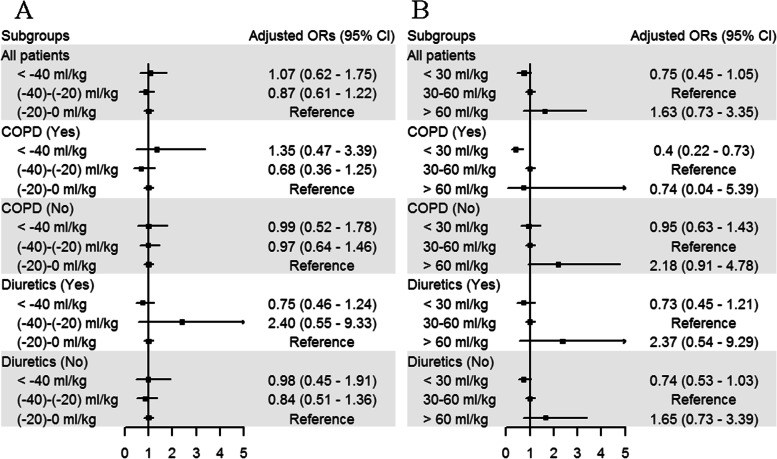
A total of 3433 extubation events were recorded. 1803 with NFB were included for the final analysis, of which 201(11.1%) were extubation failure. Compared with slight NFB (- 20 to 0 ml/kg), more NFB were not associated improved extubation outcome. Compared with moderate fluid intake (30 to 60 ml/kg), lower (< 30 ml/kg, OR 0.75, 95% CI [0.54, 1.05], p = 0.088) or higher (> 60 ml/kg, OR 1.63, 95% CI [0.73, 3.35], p = 0.206) fluid intake was not associated with extubation outcome. Duration of MV, chronic obstructive pulmonary disease (COPD), hypercapnia, use of diuretics, and SAPSIIscore were associated with extubation failure.
More NFB or restricted fluid intake were not associated with reduced extubation failure in patients with NFB. However, for COPD patients, restricted fluid intake was associated with extubation success.
负液体平衡(NFB)与减少拔管失败有关。然而,是否实现更多的 NFB 可以进一步改善拔管结果尚未得到研究。本研究旨在探讨更多的 NFB 和限制液体摄入是否与拔管成功相关。
我们对 2001 年至 2012 年期间在医疗信息集市重症监护(MIMIC-III)接受机械通气(MV)的成年患者进行了回顾性研究。纳入 MV 持续时间超过 24 小时且在拔管前 24 小时内有 NFB 的患者进行分析。主要结局是拔管失败,定义为拔管后 72 小时内重新插管。使用多变量逻辑模型探讨液体平衡或液体摄入与拔管结果之间的关系。
共记录了 3433 次拔管事件。纳入了 1803 次有 NFB 的事件进行最终分析,其中 201 次(11.1%)为拔管失败。与轻度 NFB(-20 至 0 ml/kg)相比,更多的 NFB 与改善拔管结果无关。与中等液体摄入(30 至 60 ml/kg)相比,较低(<30 ml/kg,OR 0.75,95%CI [0.54,1.05],p=0.088)或较高(>60 ml/kg,OR 1.63,95%CI [0.73,3.35],p=0.206)的液体摄入与拔管结果无关。MV 持续时间、慢性阻塞性肺疾病(COPD)、高碳酸血症、利尿剂使用和 SAPSII 评分与拔管失败相关。
在有 NFB 的患者中,更多的 NFB 或限制液体摄入与减少拔管失败无关。然而,对于 COPD 患者,限制液体摄入与拔管成功相关。