Singh Sheetu, Salvi Sundeep, Mangal Daya Krishan, Singh Meenu, Awasthi Shally, Mahesh Padukudru Anand, Kabra Sushil K, Mohammed Sabir, Sukumaran Thevaruparambil U, Ghoshal Aloke G, Barne Monica, Sinha Sanjeev, Kochar Sanjay K, Singh Nishtha, Singh Udaiveer, Patel Kamalesh Kumar, Sharma Arvind Kumar, Girase Bhushan, Chauhan Anil, Sit Niranjan, Siddaiah Jayaraj B, Singh Virendra
Dept of Pulmonary Medicine, Rajasthan Hospital, Jaipur, India.
Pulmocare Research and Education Foundation, Pune, India.
ERJ Open Res. 2022 May 30;8(2). doi: 10.1183/23120541.00528-2021. eCollection 2022 Apr.
The objective of this subanalysis of data from centres across urban areas in India of the Global Asthma Network (GAN) was to study 1) the prevalence of symptoms of asthma in children and adults, 2) the change in prevalence of asthma and its trigger factors since the International Study of Asthma and Allergies in Childhood (ISAAC), and 3) current asthma treatment practice.
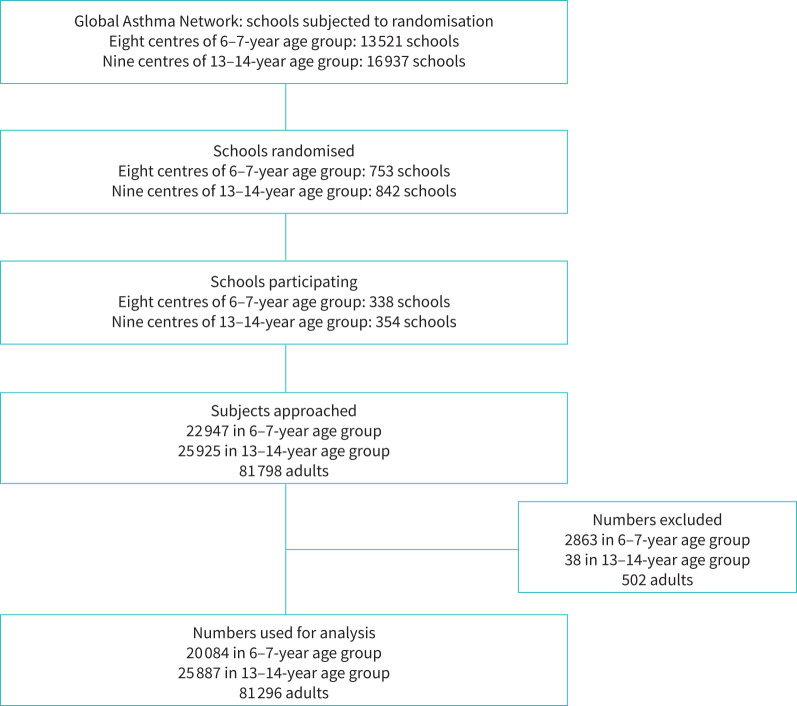
In this cross-sectional, multicentre, school-based and self-administered questionnaire, responses from children aged 6-7 years and 13-14 years, and their respective parents, were analysed.
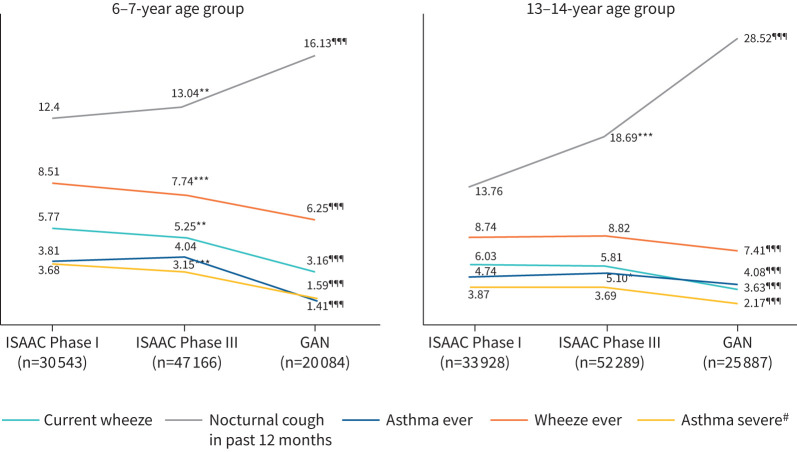
The GAN Phase I study included 20 084 children in the 6-7-year age group, 25 887 children in the 13-14-year age group and 81 296 parents. The prevalence of wheeze in the previous 12 months was 3.16%, 3.63% and 3.30% in the three groups, respectively. In comparison to the ISAAC studies, there was a significant reduction in the prevalence of current wheeze (p<0.001). Bivariate analysis revealed a significant reduction in the prevalence of trigger factors. Almost 82% of current wheezers and 70% of subjects with symptoms of severe asthma were not clinically diagnosed as having asthma. The daily use of inhaled corticosteroids (ICS) was less than 2.5% in subjects with current wheeze and those with symptoms of severe asthma but less than 1% used daily ICS when asthma remained undiagnosed.
The prevalence of current wheeze and its causal factors showed a significant reduction compared to previous ISAAC studies. Among subjects with current wheeze and symptoms of severe asthma, the problem of under-diagnosis and under-treatment was widespread.
本项对全球哮喘网络(GAN)印度城市地区各中心数据的亚分析旨在研究:1)儿童和成人哮喘症状的患病率;2)自儿童哮喘和过敏国际研究(ISAAC)以来哮喘及其触发因素患病率的变化;3)当前哮喘治疗实践。
在这项横断面、多中心、基于学校且自行填写问卷的研究中,分析了6至7岁和13至14岁儿童及其各自父母的回答。
GAN第一阶段研究纳入了6至7岁年龄组的20084名儿童、13至14岁年龄组的25887名儿童以及81296名家长。三组中前12个月喘息的患病率分别为3.16%、3.63%和3.30%。与ISAAC研究相比,当前喘息的患病率显著降低(p<0.001)。双变量分析显示触发因素的患病率显著降低。几乎82%的当前喘息者和70%有严重哮喘症状的受试者未被临床诊断为患有哮喘。当前喘息者和有严重哮喘症状的受试者中,吸入性糖皮质激素(ICS)的每日使用率低于2.5%,但哮喘未被诊断时,每日使用ICS的比例不到1%。
与之前的ISAAC研究相比,当前喘息及其病因的患病率显著降低。在当前喘息和有严重哮喘症状的受试者中,诊断不足和治疗不足的问题普遍存在。