Del-Rio-Navarro Blanca Estela, Navarrete-Rodríguez Elsy Maureen, Berber Arturo, Reyes-Noriega Nayely, García-Marcos Álvarez Luis
Servicio de Alergia e Inmunología, Hospital Infantil de México Federico Gómez, Mexico City, Mexico.
Asesor Externo, Hospital Infantil de México Federico Gómez, Mexico City, Mexico.
World Allergy Organ J. 2020 Jan 8;13(1):100092. doi: 10.1016/j.waojou.2019.100092. eCollection 2020 Jan.
According to the International Study of Asthma and Allergies in Childhood (ISAAC) methodology, in 2003, the prevalence of asthma symptoms in children 6-7 years old and adolescents 13-14 years old was 11.6% and 13.7%, respectively. Since then, the number of asthma cases has increased worldwide. The study was conducted in several districts in northern Mexico City to evaluate the prevalence of asthma in these age groups and examine possible risk factors. The data were compared to the 2003 results from the same area.
This was a comparative cross-sectional study following the official Global Asthma Network (GAN) methodology. The parents or guardians of participants completed a questionnaire that explored demographics, asthma symptoms, diagnoses, and possible risk factors. Central tendency measurements were determined for statistical analysis and chi-squared distribution for possible risk factors.
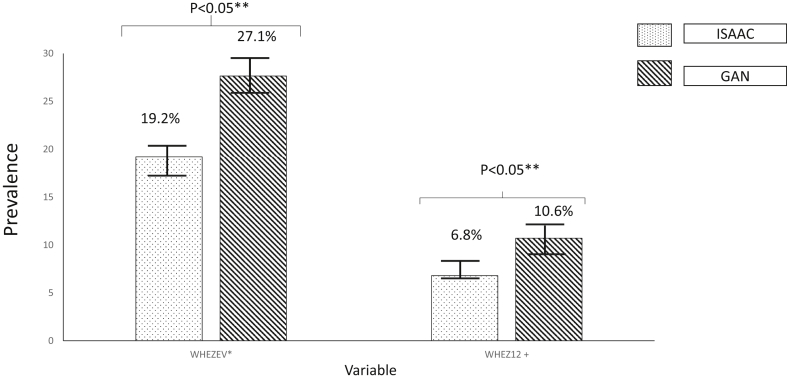
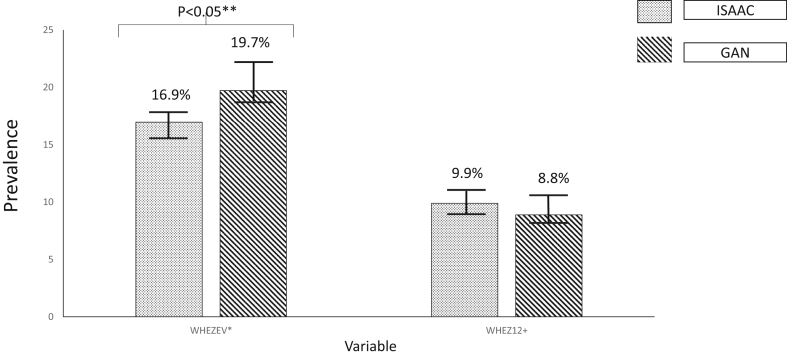
A total of 2515 children aged 6-7 years and 3375 adolescents aged 13-14 years participated in the study. Compared to the ISAAC results, we found a greater prevalence of wheezing in both children (at some time in life, 19.2% vs. 27.1%; over the last year, 6.8% vs. 10.6%) and adolescents (at some time in life, 16.9% vs. 19.7%), and for children with an asthma diagnosis (4.5% vs. 5.1%). For both groups, the most common risk factor associated with wheezing was the presence of rhinitis symptoms.
Asthma symptoms are highly prevalent in Mexico City, occurring in almost 20% of adolescents. Compared to a decade ago, there was a 7.9% increase in the prevalence of asthma symptoms in children. Almost half of the children and adolescents presenting with symptoms had experienced more than four episodes per year. However, less than 50% of children and adolescents with asthma symptoms had been diagnosed with this disorder, suggesting under-diagnosis.
根据儿童哮喘和过敏国际研究(ISAAC)方法,2003年,6至7岁儿童和13至14岁青少年的哮喘症状患病率分别为11.6%和13.7%。从那时起,全球哮喘病例数量有所增加。该研究在墨西哥城北部的几个区进行,以评估这些年龄组的哮喘患病率,并检查可能的风险因素。将数据与该地区2003年的结果进行比较。
这是一项遵循官方全球哮喘网络(GAN)方法的比较横断面研究。参与者的父母或监护人完成了一份问卷,该问卷探讨了人口统计学、哮喘症状、诊断和可能的风险因素。确定集中趋势测量值用于统计分析,并对可能的风险因素进行卡方分布分析。
共有2515名6至7岁儿童和3375名13至14岁青少年参与了该研究。与ISAAC结果相比,我们发现儿童(一生中的某个时候,19.2%对27.1%;过去一年中,6.8%对10.6%)和青少年(一生中的某个时候,16.