Center for Human Factors Engineering of Health Information Technology, eHealth Living & Learning Lab Amsterdam, Amsterdam Public Health Research Institute, Amsterdam UMC, Location AMC, Department of Medical Informatics, Amsterdam, the Netherlands.
Center for Human Factors Engineering of Health Information Technology, Amsterdam Public Health Research Institute, Department of Medical informatics, Amsterdam UMC, Location AMC, Amsterdam, the Netherlands.
Yearb Med Inform. 2022 Aug;31(1):74-81. doi: 10.1055/s-0042-1742499. Epub 2022 Jun 2.
Involving representative users in usability testing of health information technology (HIT) is central to user-centered design. However, (vulnerable) older adults as representative users have unique requirements. Aging processes may affect physical capabilities and cognitive skills, which can hamper testing with this demographic and may require special attention and revised protocols. This study was performed to provide expert-based recommendations for HIT user-testing with (vulnerable) older adults to support inclusive HIT design and evaluation.
First, we conducted a structured workshop with ten experts in HIT implementation and research, recruited through purposeful sampling, to generate insights into how characteristics of older adults may influence user-testing. Next, five Human Factor researchers experienced in HIT user-testing with (vulnerable) older adults validated the results and provided additional textual insights to gain consensus on the most important recommendations. A thematic analysis was performed on the resulting inquiries. Applied codes were based on the User-Centered Design framework.
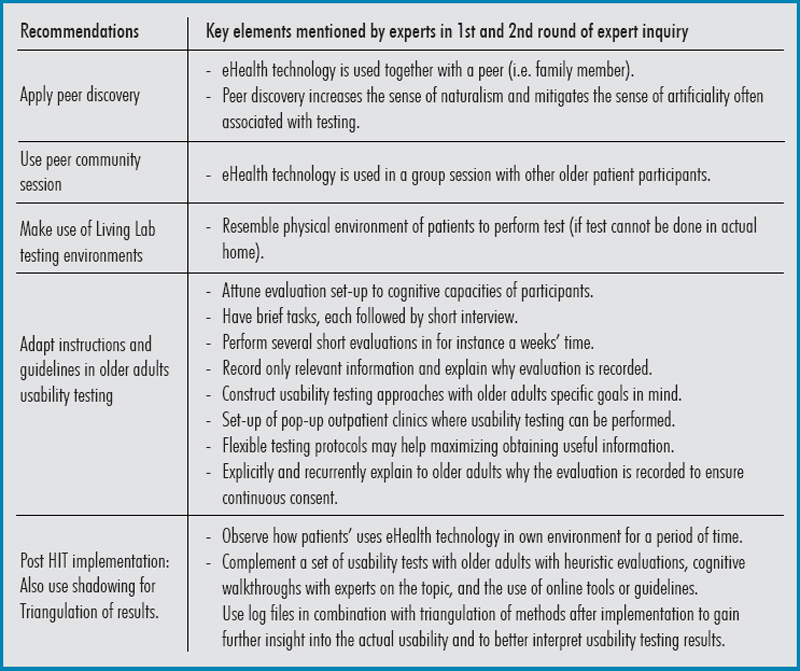
The analysis resulted in nine recommendations for user-testing of HIT with older adults, divided into three main themes: (1) empathetic approach and trust-building, (2) new requirements for testing and study design, and (3) adjustments to usability evaluation methods. For each theme a checklist of relevant items to follow-up on the recommendation is provided.
The recommendations generated through expert inquiry contribute to more effective usability testing of HIT with older adults. This provides an important step towards improved accessibility of HIT amongst older adults through inclusive user-centered design.
让有代表性的用户参与健康信息技术(HIT)的可用性测试是以用户为中心的设计的核心。然而,作为代表性用户的(脆弱的)老年人有独特的需求。衰老过程可能会影响身体能力和认知技能,这可能会妨碍对这一年龄段的测试,并可能需要特别注意和修订协议。本研究旨在为 HIT 与(脆弱的)老年人的用户测试提供基于专家的建议,以支持包容性 HIT 设计和评估。
首先,我们通过有针对性的抽样,邀请了十名 HIT 实施和研究方面的专家参加了一个结构化的研讨会,以了解老年人的特征如何可能影响用户测试。接下来,五名在 HIT 与(脆弱的)老年人的用户测试方面有经验的人类因素研究人员验证了结果,并提供了额外的文本见解,以就最重要的建议达成共识。对产生的问题进行了主题分析。应用的代码基于以用户为中心的设计框架。
分析产生了九条关于 HIT 与老年人用户测试的建议,分为三个主要主题:(1)同理心方法和建立信任,(2)测试和研究设计的新要求,以及(3)调整可用性评估方法。对于每个主题,都提供了一个检查表,列出了与建议相关的需要跟进的项目。
通过专家调查产生的建议有助于更有效地对 HIT 进行老年人用户测试。这通过包容性的以用户为中心的设计为提高老年人对 HIT 的可及性迈出了重要的一步。