Department of Infectious Diseases, Istituto Superiore di Sanità, Rome, Italy.
National Centre for the Control and Evaluation of Medicines, Istituto Superiore di Sanità, Rome, Italy.
Euro Surveill. 2022 Jun;27(22). doi: 10.2807/1560-7917.ES.2022.27.22.2100516.
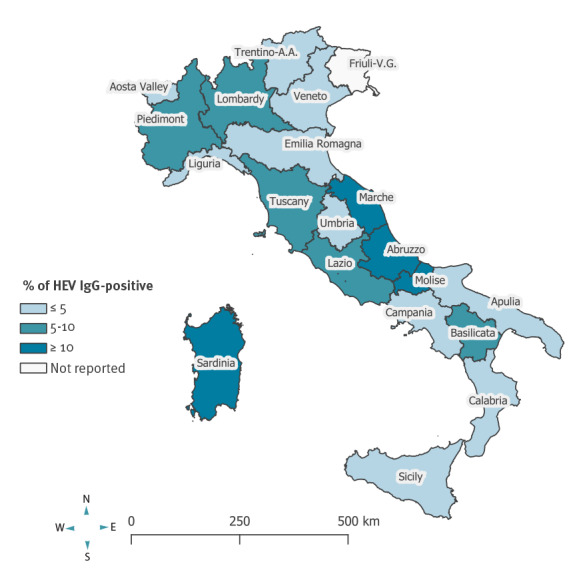
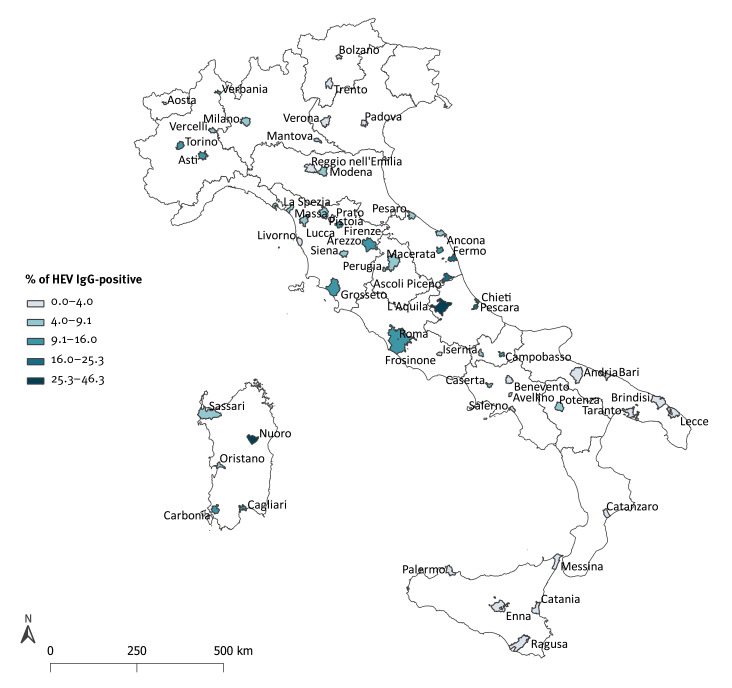
BackgroundIn high-income countries, hepatitis E virus (HEV) infection is mainly a zoonosis. However, it is also transfusion-transmissible and some countries, but not Italy, have introduced HEV screening for blood donations.AimWe assessed HEV infection prevalence and risk factors in a nationwide sample of Italian blood donors.MethodsWe selected 107 blood establishments (BE) distributed in the 20 Italian regions by a stratified two-stage design and invited them to participate in the study. Donors were tested for anti-HEV IgG and IgM and HEV RNA. Sociodemographic data and risk factors were collected through a questionnaire.ResultsOverall, 60 BE from 60 provinces in 19 Italian regions joined the study. We assessed HEV markers in 7,172 blood donors, of whom 6,235 completed the questionnaire. Overall crude and adjusted anti-HEV IgG prevalences were 8.3% and 5.5%, respectively. Overall anti-HEV IgM prevalence was 0.5%, while no blood donor was HEV RNA-positive. Anti-HEV IgG prevalence varied widely among regions (range: 1.3%-27.20%) and hyperendemic prevalences (> 40%) were detected in some provinces in two regions. Older age (AOR = 1.81; 95% CI: 1.36-2.41), foreign nationality (AOR = 2.77; 95% CI: 1.06-7.24), eating raw pork liver sausages (AOR = 2.23; 95% CI: 1.55-3.20) and raw homemade sausages (AOR = 3.63; 95% CI: 2.50-5.24) were independent infection predictors.ConclusionItalian blood donors showed a low to moderate HEV seroprevalence. High levels in some regions and/or provinces were mainly attributable to eating habits. Prevention should include avoiding consumption of raw or undercooked meat and safe production of commercial pork products.
背景
在高收入国家,戊型肝炎病毒(HEV)感染主要是一种动物源性疾病。然而,它也可通过输血传播,一些国家(但意大利不在其中)已对献血者进行 HEV 筛查。
目的
我们评估了意大利全国性献血者样本中的 HEV 感染流行率和危险因素。
方法
我们采用分层两阶段设计选择了分布在意大利 20 个地区的 107 个采血机构(BE),并邀请他们参与研究。对献血者进行抗-HEV IgG 和 IgM 以及 HEV RNA 检测。通过问卷收集社会人口统计学数据和危险因素。
结果
总体而言,来自意大利 19 个地区的 60 个 BE 参与了研究。我们评估了 7172 名献血者的 HEV 标志物,其中 6235 名完成了问卷。总粗率和调整后抗-HEV IgG 流行率分别为 8.3%和 5.5%。总抗-HEV IgM 流行率为 0.5%,而没有献血者为 HEV RNA 阳性。抗-HEV IgG 流行率在各地区差异很大(范围:1.3%-27.20%),在两个地区的一些省份检测到高流行率(>40%)。年龄较大(AOR=1.81;95%CI:1.36-2.41)、外国国籍(AOR=2.77;95%CI:1.06-7.24)、食用生猪肝香肠(AOR=2.23;95%CI:1.55-3.20)和生自制香肠(AOR=3.63;95%CI:2.50-5.24)是独立的感染预测因素。
结论
意大利献血者的 HEV 血清流行率较低至中等。一些地区和/或省份的高流行率主要归因于饮食习惯。预防措施应包括避免食用生的或未煮熟的肉类和安全生产商业猪肉产品。