Department of Chemical and Biomolecular Engineering, Johns Hopkins University, Baltimore, MD 21218, USA.
The Institute for NanoBioTechnology, Physical Sciences-Oncology Center, Johns Hopkins University, Baltimore, MD 21218, USA.
Adv Sci (Weinh). 2022 Aug;9(22):e2201483. doi: 10.1002/advs.202201483. Epub 2022 Jun 3.
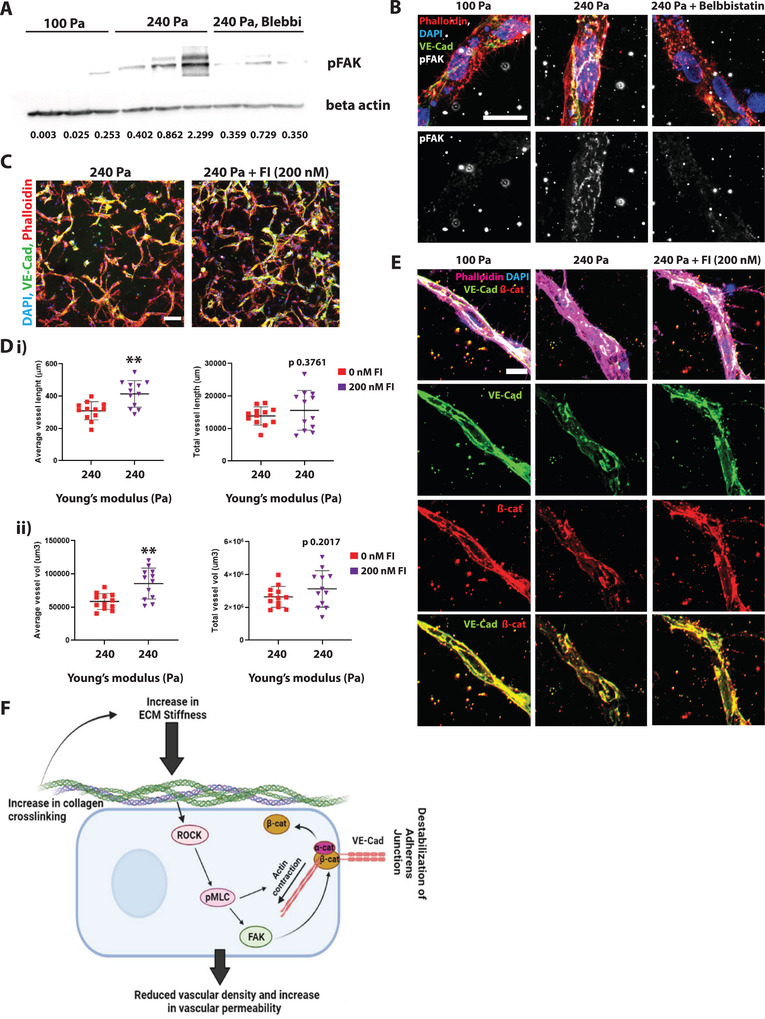
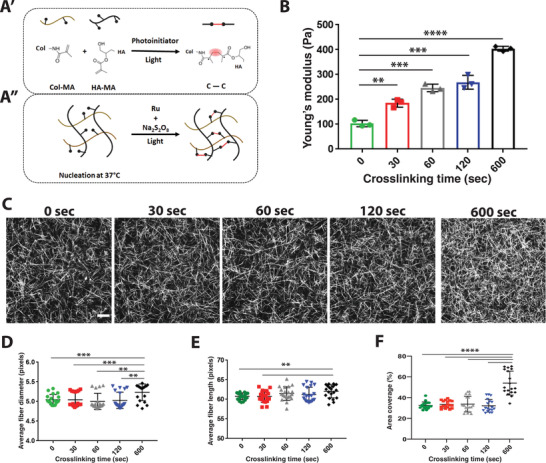
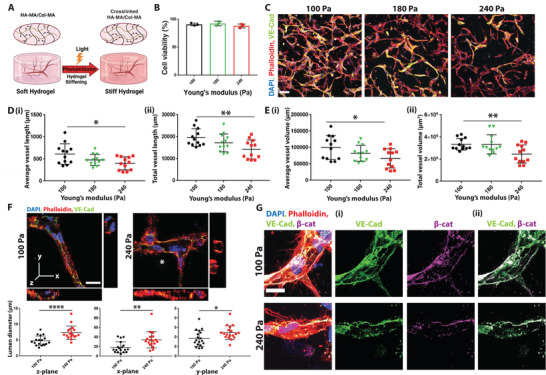
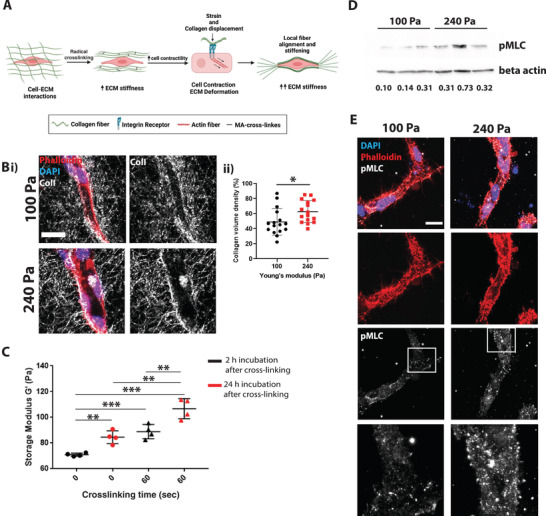
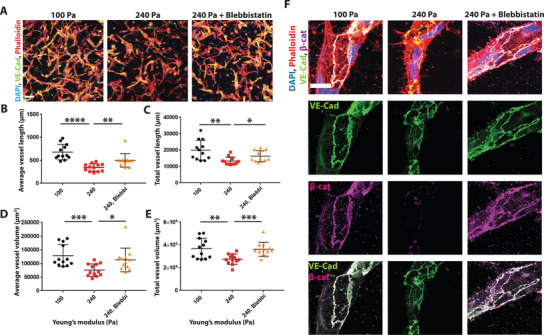
Aging is a major risk factor in microvascular dysfunction and disease development, but the underlying mechanism remains largely unknown. As a result, age-mediated changes in the mechanical properties of tissue collagen have gained interest as drivers of endothelial cell (EC) dysfunction. 3D culture models that mimic age-mediated changes in the microvasculature can facilitate mechanistic understanding. A fibrillar hydrogel capable of changing its stiffness after forming microvascular networks is established. This hydrogel model is used to form vascular networks from induced pluripotent stem cells under soft conditions that mimic young tissue mechanics. Then matrix stiffness is gradually increased, thus exposing the vascular networks to the aging-mimicry process in vitro. It is found that upon dynamic matrix stiffening, EC contractility is increased, resulting in the activation of focal adhesion kinase and subsequent dissociation of β-catenin from VE-Cadherin mediated adherens junctions, leading to the abruption of the vascular networks. Inhibiting cell contractility impedes the dissociation of β-catenin, thereby preventing the deconstruction of adherens junctions, thus partially rescuing the age-mediated vascular phenotype. The findings provide the first direct evidence of matrix's dynamic mechano-changes in compromising microvasculature with aging and highlight the importance of hydrogel systems to study tissue-level changes with aging in basic and translational studies.
衰老是微血管功能障碍和疾病发展的一个主要危险因素,但其中的潜在机制在很大程度上仍然未知。因此,组织胶原机械性能的年龄介导变化作为内皮细胞(EC)功能障碍的驱动因素引起了关注。模拟微血管中年龄介导变化的 3D 培养模型可以促进对机制的理解。建立了一种纤维状水凝胶,在形成微血管网络后能够改变其硬度。该水凝胶模型用于在模拟年轻组织力学的软条件下从诱导多能干细胞形成血管网络。然后逐渐增加基质硬度,从而使血管网络在体外经历衰老模拟过程。结果发现,在动态基质变硬时,EC 的收缩性增加,导致粘着斑激酶的激活以及随后 β-连环蛋白从 VE-钙粘蛋白介导的粘着连接的解离,导致血管网络的突然中断。抑制细胞收缩性会阻碍 β-连环蛋白的解离,从而防止粘着连接的解构,从而部分挽救与年龄相关的血管表型。这些发现提供了基质动态力学变化在衰老过程中损害微血管的第一个直接证据,并强调了水凝胶系统在基础和转化研究中研究组织水平随年龄变化的重要性。