Urtnasan Erdenebayar, Lee Jung Hun, Moon Byungjin, Lee Hee Young, Lee Kyuhee, Youk Hyun
Artificial Intelligence Big Data Medical Center, Wonju College of Medicine, Yonsei University, Wonju, Republic of Korea.
Bigdata Platform Business Group, Yonsei Wonju Health System, Wonju, Republic of Korea.
JMIR Med Inform. 2022 Jun 3;10(6):e34724. doi: 10.2196/34724.
Hyperkalemia monitoring is very important in patients with chronic kidney disease (CKD) in emergency medicine. Currently, blood testing is regarded as the standard way to diagnose hyperkalemia (ie, using serum potassium levels). Therefore, an alternative and noninvasive method is required for real-time monitoring of hyperkalemia in the emergency medicine department.
This study aimed to propose a novel method for noninvasive screening of hyperkalemia using a single-lead electrocardiogram (ECG) based on a deep learning model.
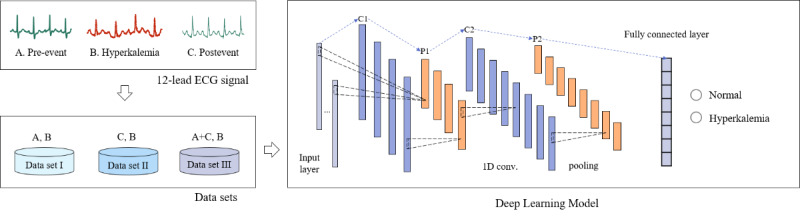
For this study, 2958 patients with hyperkalemia events from July 2009 to June 2019 were enrolled at 1 regional emergency center, of which 1790 were diagnosed with chronic renal failure before hyperkalemic events. Patients who did not have biochemical electrolyte tests corresponding to the original 12-lead ECG signal were excluded. We used data from 855 patients (555 patients with CKD, and 300 patients without CKD). The 12-lead ECG signal was collected at the time of the hyperkalemic event, prior to the event, and after the event for each patient. All 12-lead ECG signals were matched with an electrolyte test within 2 hours of each ECG to form a data set. We then analyzed the ECG signals with a duration of 2 seconds and a segment composed of 1400 samples. The data set was randomly divided into the training set, validation set, and test set according to the ratio of 6:2:2 percent. The proposed noninvasive screening tool used a deep learning model that can express the complex and cyclic rhythm of cardiac activity. The deep learning model consists of convolutional and pooling layers for noninvasive screening of the serum potassium level from an ECG signal. To extract an optimal single-lead ECG, we evaluated the performances of the proposed deep learning model for each lead including lead I, II, and V1-V6.
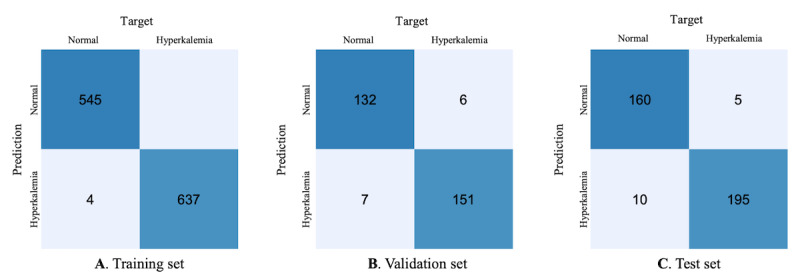
The proposed noninvasive screening tool using a single-lead ECG shows high performances with F1 scores of 100%, 96%, and 95% for the training set, validation set, and test set, respectively. The lead II signal was shown to have the highest performance among the ECG leads.
We developed a novel method for noninvasive screening of hyperkalemia using a single-lead ECG signal, and it can be used as a helpful tool in emergency medicine.
在急诊医学中,对慢性肾脏病(CKD)患者进行高钾血症监测非常重要。目前,血液检测被视为诊断高钾血症的标准方法(即使用血清钾水平)。因此,急诊医学科需要一种替代的非侵入性方法来实时监测高钾血症。
本研究旨在提出一种基于深度学习模型的单导联心电图(ECG)无创筛查高钾血症的新方法。
本研究纳入了2009年7月至2019年6月期间在1个区域急诊中心发生高钾血症事件的2958例患者,其中1790例在高钾血症事件发生前被诊断为慢性肾衰竭。排除没有与原始12导联心电图信号相对应的生化电解质检测结果的患者。我们使用了855例患者的数据(555例CKD患者和300例非CKD患者)。在高钾血症事件发生时、事件发生前和事件发生后,为每位患者采集12导联心电图信号。所有12导联心电图信号均与每次心电图后2小时内的电解质检测结果进行匹配,以形成一个数据集。然后,我们分析了持续时间为2秒且由1400个样本组成的一段心电图信号。根据6:2:2的比例将数据集随机分为训练集、验证集和测试集。所提出的无创筛查工具使用了一种能够表达心脏活动复杂和周期性节律的深度学习模型。该深度学习模型由卷积层和池化层组成,用于从心电图信号中无创筛查血清钾水平。为了提取最佳单导联心电图,我们评估了所提出的深度学习模型对包括I导联、II导联和V1 - V6导联在内的每个导联的性能。
所提出的使用单导联心电图的无创筛查工具表现出高性能,训练集、验证集和测试集的F1分数分别为100%、96%和95%。II导联信号在心电图导联中表现出最高性能。
我们开发了一种使用单导联心电图信号无创筛查高钾血症的新方法,它可作为急诊医学中的一种有用工具。