Lin Chin-Sheng, Lin Chin, Fang Wen-Hui, Hsu Chia-Jung, Chen Sy-Jou, Huang Kuo-Hua, Lin Wei-Shiang, Tsai Chien-Sung, Kuo Chih-Chun, Chau Tom, Yang Stephen Jh, Lin Shih-Hua
Division of Cardiology, Department of Medicine, Tri-Service General Hospital, National Defense Medical Center, Taipei, Taiwan.
Graduate Institute of Life Sciences, National Defense Medical Center, Taipei, Taiwan.
JMIR Med Inform. 2020 Mar 5;8(3):e15931. doi: 10.2196/15931.
The detection of dyskalemias-hypokalemia and hyperkalemia-currently depends on laboratory tests. Since cardiac tissue is very sensitive to dyskalemia, electrocardiography (ECG) may be able to uncover clinically important dyskalemias before laboratory results.
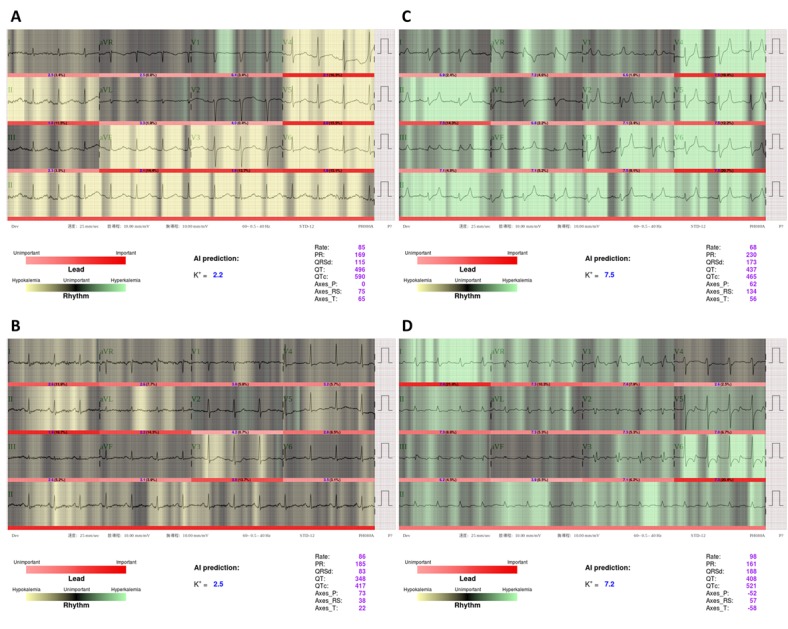
Our study aimed to develop a deep-learning model, ECG12Net, to detect dyskalemias based on ECG presentations and to evaluate the logic and performance of this model.
Spanning from May 2011 to December 2016, 66,321 ECG records with corresponding serum potassium (K) concentrations were obtained from 40,180 patients admitted to the emergency department. ECG12Net is an 82-layer convolutional neural network that estimates serum K concentration. Six clinicians-three emergency physicians and three cardiologists-participated in human-machine competition. Sensitivity, specificity, and balance accuracy were used to evaluate the performance of ECG12Net with that of these physicians.
In a human-machine competition including 300 ECGs of different serum K+ concentrations, the area under the curve for detecting hypokalemia and hyperkalemia with ECG12Net was 0.926 and 0.958, respectively, which was significantly better than that of our best clinicians. Moreover, in detecting hypokalemia and hyperkalemia, the sensitivities were 96.7% and 83.3%, respectively, and the specificities were 93.3% and 97.8%, respectively. In a test set including 13,222 ECGs, ECG12Net had a similar performance in terms of sensitivity for severe hypokalemia (95.6%) and severe hyperkalemia (84.5%), with a mean absolute error of 0.531. The specificities for detecting hypokalemia and hyperkalemia were 81.6% and 96.0%, respectively.
A deep-learning model based on a 12-lead ECG may help physicians promptly recognize severe dyskalemias and thereby potentially reduce cardiac events.
目前,血钾异常(低钾血症和高钾血症)的检测依赖实验室检查。由于心脏组织对血钾异常非常敏感,心电图(ECG)或许能够在实验室检查结果出来之前发现具有临床意义的血钾异常情况。
我们的研究旨在开发一种深度学习模型ECG12Net,用于根据心电图表现检测血钾异常,并评估该模型的逻辑性和性能。
从2011年5月至2016年12月,从40180名急诊科住院患者中获取了66321份带有相应血清钾(K)浓度的心电图记录。ECG12Net是一个82层的卷积神经网络,用于估算血清钾浓度。六位临床医生(三位急诊科医生和三位心脏病专家)参与了人机竞赛。使用敏感性、特异性和平衡准确性来评估ECG12Net与这些医生的表现。
在一场包含300份不同血清钾离子浓度心电图的人机竞赛中,ECG12Net检测低钾血症和高钾血症的曲线下面积分别为0.926和0.958,显著优于我们最优秀的临床医生。此外,在检测低钾血症和高钾血症时,敏感性分别为96.7%和83.3%,特异性分别为93.3%和97.8%。在一个包含13222份心电图的测试集中,ECG12Net在检测严重低钾血症(95.6%)和严重高钾血症(84.5%)的敏感性方面表现相似,平均绝对误差为0.531。检测低钾血症和高钾血症的特异性分别为81.6%和96.0%。
基于12导联心电图的深度学习模型可能有助于医生及时识别严重的血钾异常情况,从而有可能减少心脏事件的发生。