Zarezadeh Meysam, Dehghani Azadeh, Faghfouri Amir Hossein, Radkhah Nima, Naemi Kermanshahi Mohammad, Hamedi Kalajahi Fatemeh, Mohammadzadeh Honarvar Niyaz, Ghoreishi Zohreh, Ostadrahimi Alireza, Ebrahimi Mamaghani Mehrangiz
Student Research Committee Tabriz University of Medical Sciences Tabriz Iran.
Department of Clinical Nutrition Faculty of Nutrition and Food Science Nutrition Research Center Tabriz University of Medical Sciences Tabriz Iran.
Obes Sci Pract. 2021 Oct 22;8(3):387-397. doi: 10.1002/osp4.569. eCollection 2022 Jun.
Inositol is a sugar-alcohol and recognized as a key component of cell membrane phospholipids. It has crucial role in the cell signaling pathways and contribute to improving glycemic responses. Although some earlier studies have revealed the effect of inositol mediating glucose uptake by improving insulin sensitivity, the benefit of inositol supplementation in patients with overweight and obesity is not completely understood. This study aimed to assess the impact of inositol supplementation on body mass index (BMI) through a systematic review and meta-analysis of controlled clinical trials.
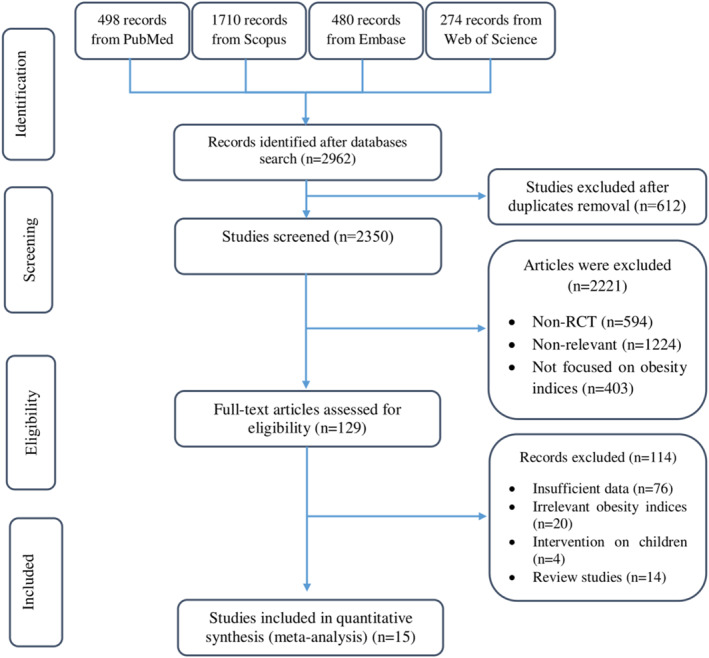
A systematic search was performed to August 2021 in the following databases: PubMed-Medline, Embase, Web of Science and Scopus. Fifteen controlled clinical trials investigating the effect of inositol on adult's BMI were finally included in the study. A random-effects model was employed to estimate the effect size. Subgroup analysis was performed by dose, duration, age, type of inositol. Meta-regression was used to investigate presence of any linear relationship. Begg's and Egger's tests were carried out to detect small study effect.
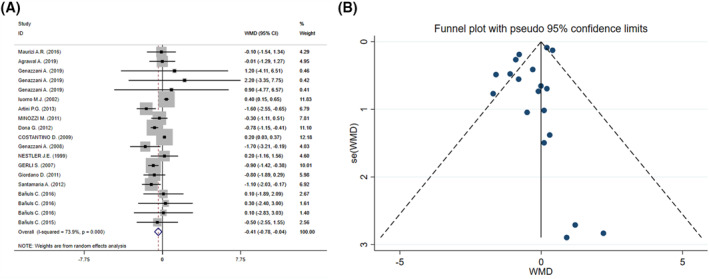
The results of pooled analysis showed that inositol supplementation significantly decreased BMI scores (WMD = -0.41 kg/m; 95% CI: -0.78, -0.04; = 0.028). Subgroup analysis was performed to identify the source of heterogeneity among studies ( = 73.9%, < 0.001), demonstrating supplementation duration, baseline BMI, mean age of participants, type of inositol and dosage were potential sources of heterogeneity. The effect of intervention was more clinically significant in participants with polycystic ovary syndrome (PCOS) and overweight/obesity. Inositol in the form of myo-inositol (MI) had stronger effect on BMI reduction.
The meta-analysis suggests that oral inositol supplementation has positive effect on BMI reduction. Inositol supplementation could be considered as an adjunct treatment to improve body mass index.
肌醇是一种糖醇,被认为是细胞膜磷脂的关键成分。它在细胞信号通路中起着至关重要的作用,并有助于改善血糖反应。尽管一些早期研究已经揭示了肌醇通过提高胰岛素敏感性介导葡萄糖摄取的作用,但对于超重和肥胖患者补充肌醇的益处尚未完全了解。本研究旨在通过对对照临床试验的系统评价和荟萃分析,评估补充肌醇对体重指数(BMI)的影响。
截至2021年8月,在以下数据库中进行了系统检索:PubMed-Medline、Embase、Web of Science和Scopus。最终纳入了15项研究肌醇对成人BMI影响的对照临床试验。采用随机效应模型估计效应大小。按剂量、持续时间、年龄、肌醇类型进行亚组分析。采用Meta回归研究是否存在线性关系。进行Begg检验和Egger检验以检测小研究效应。
汇总分析结果显示,补充肌醇显著降低了BMI评分(加权均数差=-0.41kg/m²;95%置信区间:-0.78,-0.04;P=0.028)。进行亚组分析以确定研究间异质性的来源(I²=73.9%,P<0.001),表明补充持续时间、基线BMI、参与者平均年龄、肌醇类型和剂量是潜在的异质性来源。在多囊卵巢综合征(PCOS)和超重/肥胖参与者中,干预效果在临床上更显著。肌醇形式的肌醇(MI)对降低BMI的作用更强。
荟萃分析表明,口服补充肌醇对降低BMI有积极作用。补充肌醇可被视为改善体重指数的辅助治疗方法。