Hockham Carinna, Bao Lexia, Tiku Anushree, Badve Sunil V, Bello Aminu K, Jardine Meg J, Jha Vivekanand, Toyama Tadashi, Woodward Mark, Jun Min
George Institute for Global Health, School of Public Health, Imperial College London, London, UK.
George Institute for Global Health, University of New South Wales, Sydney, NSW, Australia.
Clin Kidney J. 2022 Jan 31;15(6):1144-1151. doi: 10.1093/ckj/sfac030. eCollection 2022 Jun.
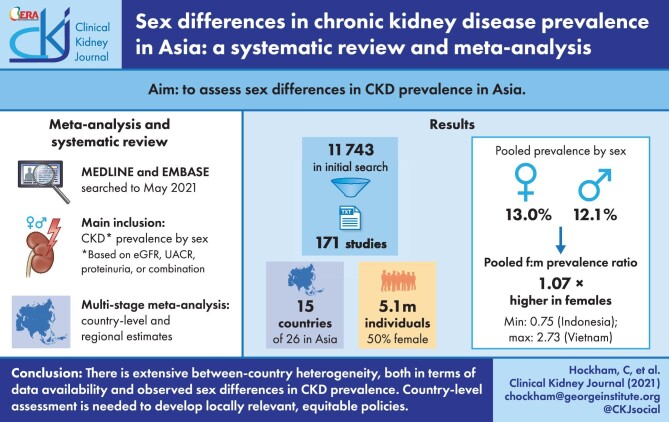
Previous reports on the prevalence of chronic kidney disease (CKD) in Asia have suggested important sex disparities but have been inconsistent in nature. We sought to synthesize available sex-disaggregated CKD prevalence data in Asia to quantify sex disparities in the region.
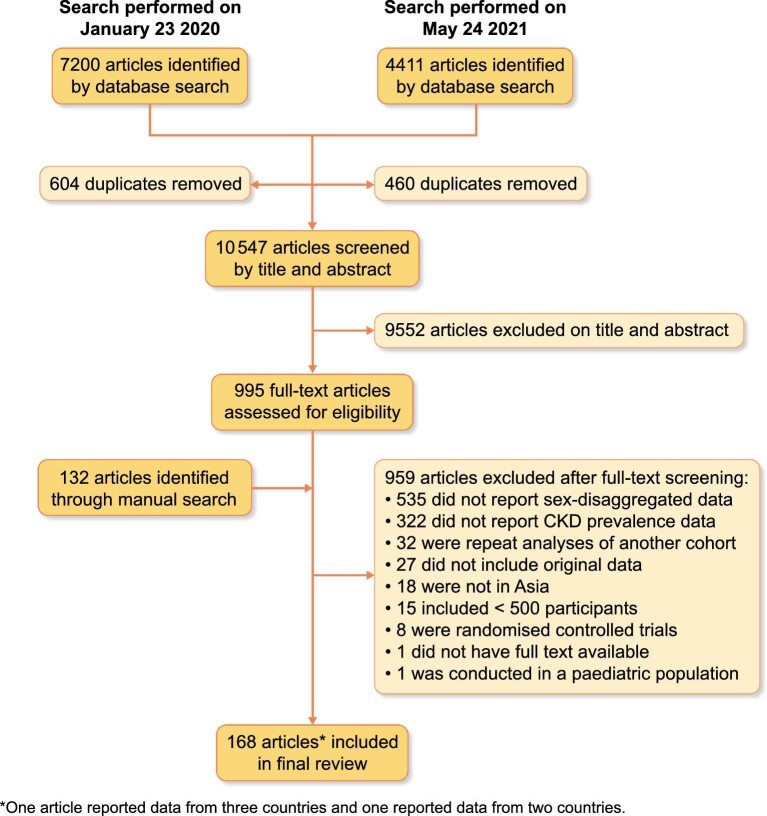
We systematically searched MEDLINE and Embase for observational studies involving ≥500 adults who reported sex-disaggregated CKD prevalence data in any of the 26 countries in East, Southeast and South Asia. For each study we calculated the female:male prevalence ratio (PR), with a ratio >1 indicating a higher female prevalence. For each country, log-transformed PRs were pooled using random effects meta-analysis. These were then combined using a fixed effects model, weighting by population size, to estimate a pooled PR for each of East, Southeast and South Asia and Asia overall.
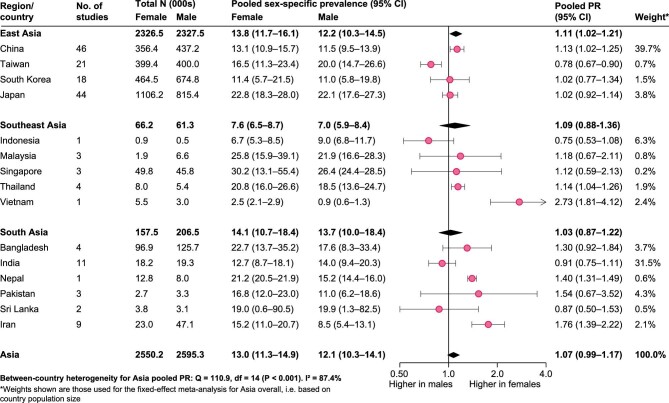
Sex-disaggregated data were available from 171 cohorts, spanning 15 countries and comprising 2 550 169 females and 2 595 299 males. Most studies (75.4%) came from East Asia (China, Taiwan, Japan and South Korea). Across Asia, CKD prevalence was higher in females {pooled prevalence 13.0% [95% confidence interval (CI) 11.3-14.9]} compared with males [pooled prevalence 12.1% (95% CI 10.3-14.1)], with a pooled PR of 1.07 (95% CI 0.99-1.17). Substantial heterogeneity was observed between countries. The pooled PRs for East, Southeast and South Asia were 1.11 (95% CI 1.02-1.21), 1.09 (0.88-1.36) and 1.03 (0.87-1.22), respectively.
Current evidence suggests considerable between-country and -region heterogeneity in the female:male PR of CKD. However, there remains a large part of the region where data on sex-specific CKD prevalence are absent or limited. Country-level assessment of the differential burden of CKD in females and males is needed to define locally relevant policies that address the needs of both sexes.
先前关于亚洲慢性肾脏病(CKD)患病率的报告显示存在重要的性别差异,但本质上并不一致。我们试图综合亚洲现有的按性别分类的CKD患病率数据,以量化该地区的性别差异。
我们系统检索了MEDLINE和Embase数据库,查找涉及东亚、东南亚和南亚26个国家中任何一个国家报告了按性别分类的CKD患病率数据的≥500名成年人的观察性研究。对于每项研究,我们计算女性:男性患病率比值(PR),比值>1表明女性患病率较高。对于每个国家,使用随机效应荟萃分析汇总对数转换后的PR值。然后使用固定效应模型,按人口规模加权,对东亚、东南亚和南亚以及整个亚洲的每项汇总PR值进行估计。
有来自171个队列的按性别分类的数据,涵盖15个国家,包括2550169名女性和2595299名男性。大多数研究(75.4%)来自东亚(中国、台湾、日本和韩国)。在亚洲,女性的CKD患病率更高{汇总患病率13.0%[95%置信区间(CI)11.3 - 14.9]},而男性的汇总患病率为12.1%(95% CI 10.3 - 14.1),汇总PR值为1.07(95% CI 0.99 - 1.17)。各国之间观察到显著的异质性。东亚、东南亚和南亚的汇总PR值分别为1.11(95% CI 1.02 - 1.21)、1.09(0.88 - 1.36)和1.03(0.87 - 1.22)。
当前证据表明,CKD的女性:男性PR值在国家和地区之间存在相当大的异质性。然而,该地区仍有很大一部分地区缺乏或仅有有限的特定性别CKD患病率数据。需要对国家层面女性和男性CKD的不同负担进行评估,以制定满足两性需求的地方相关政策。