Yue Xipeng, Zhang Ge, Li Xiaochen, Shen Yu, Wei Wei, Bai Yan, Luo Yu, Wei Huanhuan, Li Ziqiang, Zhang Xianchang, Wang Meiyun
Department of Medical Imaging, Zhengzhou University People's Hospital & Henan Provincial People's Hospital, Zhengzhou, China.
Academy of Medical Sciences, Zhengzhou University, Zhengzhou, China.
Front Hum Neurosci. 2022 May 19;16:891965. doi: 10.3389/fnhum.2022.891965. eCollection 2022.
Abnormal brain function in ASD patients changes dynamically across developmental stages. However, no one has studied the brain function of prepubertal children with ASD. Prepuberty is an important stage for children's socialization. This study aimed to investigate alterations in local spontaneous brain activity in prepubertal boys with ASD.
Measures of the amplitude of low-frequency fluctuations (ALFF) and regional homogeneity (ReHo) acquired from resting-state functional magnetic resonance imaging (RS-fMRI) database, including 34 boys with ASD and 49 typically developing (TD) boys aged 7 to 10 years, were used to detect regional brain activity. Pearson correlation analyses were conducted on the relationship between abnormal ALFF and ReHo values and Autism Diagnostic Observation Schedule (ADOS) and Autism Diagnostic Interview-Revised (ADI-R) scores.
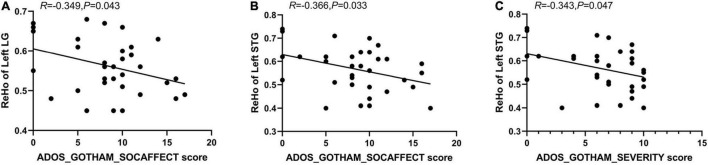
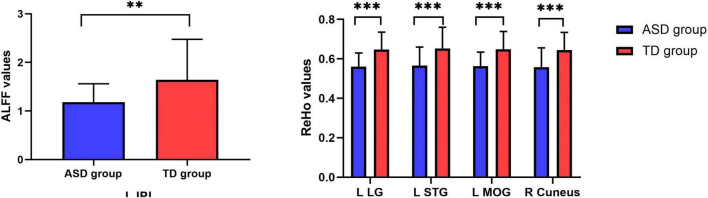
In the ASD group, we found decreased ALFF in the left inferior parietal lobule (IPL) and decreased ReHo in the left lingual gyrus (LG), left superior temporal gyrus (STG), left middle occipital gyrus (MOG), and right cuneus ( < 0.05, FDR correction). There were negative correlations between ReHo values in the left LG and left STG and the ADOS social affect score and a negative correlation between ReHo values in the left STG and the calibrated severity total ADOS score.
Brain regions with functional abnormalities, including the left IPL, left LG, left STG, left MOG, and right cuneus may be crucial in the neuropathology of prepubertal boys with ASD. Furthermore, ReHo abnormalities in the left LG and left STG were correlated with sociality. These results will supplement the study of neural mechanisms in ASD at different developmental stages, and be helpful in exploring the neural mechanisms of prepubertal boys with ASD.
自闭症谱系障碍(ASD)患者的大脑功能异常在发育阶段会动态变化。然而,尚未有人对青春期前ASD儿童的大脑功能进行研究。青春期前是儿童社交化的重要阶段。本研究旨在调查青春期前ASD男孩局部自发脑活动的改变。
从静息态功能磁共振成像(RS-fMRI)数据库中获取低频波动幅度(ALFF)和局部一致性(ReHo)测量值,该数据库包括34名ASD男孩和49名7至10岁的发育正常(TD)男孩,用于检测局部脑活动。对异常ALFF和ReHo值与自闭症诊断观察量表(ADOS)和自闭症诊断访谈修订版(ADI-R)评分之间的关系进行Pearson相关分析。
在ASD组中,我们发现左侧顶下小叶(IPL)的ALFF降低,左侧舌回(LG)、左侧颞上回(STG)、左侧枕中回(MOG)和右侧楔叶的ReHo降低(<0.05,FDR校正)。左侧LG和左侧STG的ReHo值与ADOS社交情感评分之间存在负相关,左侧STG的ReHo值与校准后的ADOS严重程度总分之间存在负相关。
包括左侧IPL、左侧LG、左侧STG、左侧MOG和右侧楔叶在内的功能异常脑区可能在青春期前ASD男孩的神经病理学中起关键作用。此外,左侧LG和左侧STG的ReHo异常与社交性相关。这些结果将补充不同发育阶段ASD神经机制的研究,并有助于探索青春期前ASD男孩的神经机制。