Harrison Phillippa, Lawrence Andrew J, Wang Shu, Liu Sixun, Xie Guangrong, Yang Xinhua, Zahn Roland
Centre for Affective Disorders, Psychological Medicine, Institute of Psychiatry, Psychology and Neuroscience, King's College London, London, United Kingdom.
Department of Psychology, Institute of Education, Hunan Agricultural University, Changsha, China.
Front Psychiatry. 2022 May 19;13:818542. doi: 10.3389/fpsyt.2022.818542. eCollection 2022.
Despite common dissatisfaction with the syndromic heterogeneity of major depression, investigations into its symptom structure are scarce. Self-worthlessness/inadequacy is a distinctive and consistent symptom of major depression across cultures.
We investigated whether self-worthlessness is associated with self-blaming attribution-related symptoms or is instead an expression of reduced positive feelings overall, as would be implied by reduced positive affect accounts of depression.
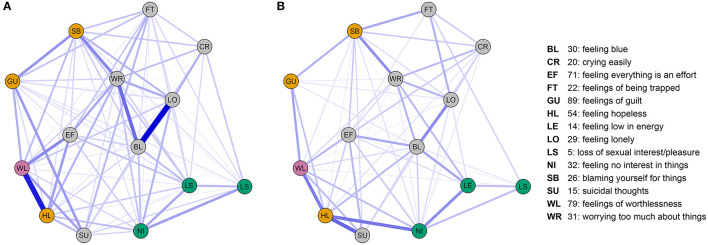
44,161 undergraduate students in Study 1, and 215 patients with current Major Depressive Disorder (MDD) and 237 age-matched healthy control participants in Study 2 completed the well-validated Symptom Check List-90. Depression-relevant items were used to construct regularized partial correlation networks with bootstrap estimates of network parameter variability.
Worthlessness co-occurred more strongly with other symptoms linked to self-blaming attributions (hopelessness, and self-blame), displaying a combined edge weight with these symptoms which was significantly stronger than the edge weight representing its connection with reduced positive emotion symptoms (such as reduced pleasure/interest/motivation, difference in edge weight sum in Study 1 = 2.95, in Study 2 = 1.64; 95% confidence intervals: Study 1: 2.6-3.4; Study 2: 0.02-3.5; Bonferroni-corrected < 0.05).
This confirms the prediction of the revised learned helplessness model that worthlessness is most strongly linked to hopelessness and self-blame. In contrast, we did not find a strong and direct link between anhedonia items and a reduction in self-worth in either study. This supports worthlessness as a primary symptom rather than resulting from reduced positive affect.
尽管人们普遍对重度抑郁症的症状异质性不满,但对其症状结构的研究却很少。自我无价值感/不足感是跨文化背景下重度抑郁症的一个独特且一致的症状。
我们调查了自我无价值感是否与自责归因相关症状有关,或者相反,它是否是总体积极情绪减少的一种表现,正如抑郁症的积极情绪减少理论所暗示的那样。
研究1中的44161名本科生,以及研究2中的215名当前患有重度抑郁症(MDD)的患者和237名年龄匹配的健康对照参与者完成了经过充分验证的症状自评量表90。使用与抑郁相关的项目构建正则化偏相关网络,并对网络参数变异性进行自助估计。
无价值感与其他与自责归因相关的症状(绝望和自责)同时出现的情况更为强烈,与这些症状的组合边权重明显强于代表其与积极情绪减少症状(如愉悦/兴趣/动机降低)联系的边权重(研究1中边权重总和的差异 = 2.95,研究2中 = 1.64;95%置信区间:研究1:[2.6, 3.4];研究2:[0.02, 3.5];经邦费罗尼校正 < 0.05)。
这证实了修正后的习得性无助模型的预测,即无价值感与绝望和自责联系最为紧密。相比之下,在两项研究中,我们均未发现快感缺失项目与自我价值降低之间存在强烈的直接联系。这支持了无价值感是一种主要症状,而非由积极情绪减少所致的观点。