Pitaloka Dian Ayu Eka, Syamsunarno Mas Rizky Anggun A A, Abdulah Rizky, Chaidir Lidya
Department of Pharmacology and Clinical Pharmacy, Faculty of Pharmacy, Universitas Padjadjaran, Sumedang, West Java, 45363, Indonesia.
Center for Translational Biomarker Research, Universitas Padjadjaran, Bandung, West Java, 40132, Indonesia.
Infect Drug Resist. 2022 May 28;15:2703-2711. doi: 10.2147/IDR.S366580. eCollection 2022.
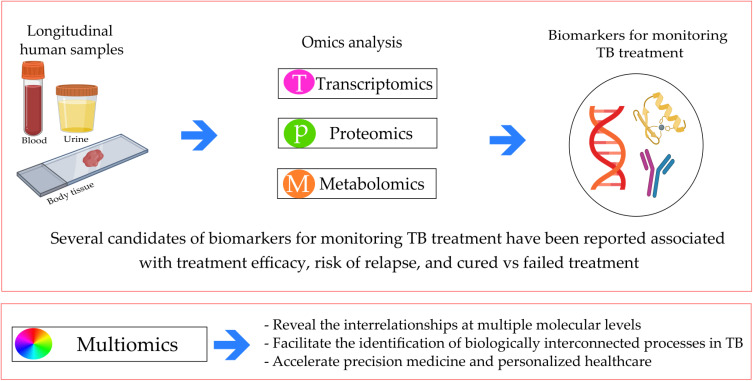
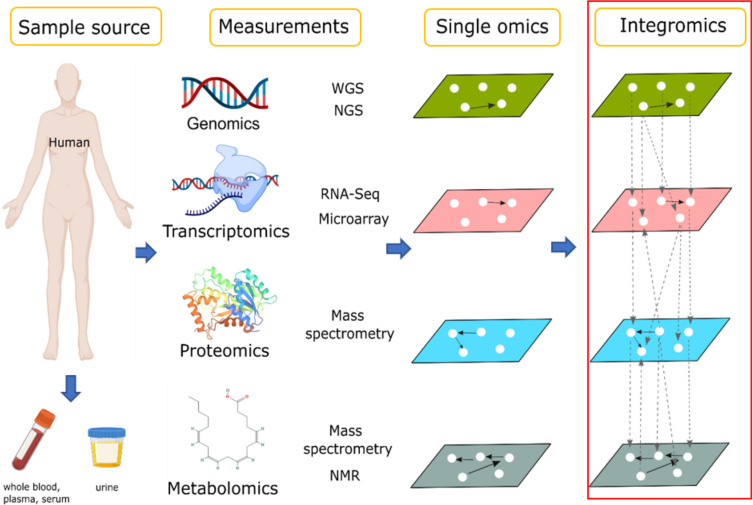
Poor sensitivity of sputum conversion for monitoring tuberculosis (TB) treatment that makes identification of a non-sputum-based biomarker is urgently needed. Monitoring biomarkers in TB treatment is used to decide whether critical thresholds have been reached and helps clinicians to conclude the therapeutic success. In this mini review, we highlight recent studies on omics-related contributes to identifying of a novel biomarker as surrogate markers for the cure and predicting future reactivation risk following TB treatment. We catalogue the studies published to seek the progress made in transcriptomics, proteomics, and metabolomics in pulmonary TB. We also discuss how integrative multi-omics data will provide further understanding and effective TB treatment, such as revealing the interrelationships at multiple molecular levels, facilitating the identification of biologically interconnected processes, and accelerating precision medicine in TB treatment. However, proper validation in prospective longitudinal studies with long-term follow-up and outcome assessment must be conducted before the biomarkers are utilized in clinical practice.
痰液转阴对监测结核病(TB)治疗的敏感性较差,因此迫切需要确定一种非痰液生物标志物。在结核病治疗中监测生物标志物用于判断是否已达到关键阈值,并帮助临床医生得出治疗成功的结论。在这篇小型综述中,我们重点介绍了近期与组学相关的研究,这些研究有助于确定一种新型生物标志物作为结核病治愈的替代标志物,并预测结核病治疗后未来复发的风险。我们梳理已发表的研究,以探寻肺结核在转录组学、蛋白质组学和代谢组学方面取得的进展。我们还讨论了整合多组学数据将如何为结核病的进一步理解和有效治疗提供帮助,例如揭示多个分子水平的相互关系、促进对生物相互关联过程的识别,以及加速结核病治疗的精准医学发展。然而,在将这些生物标志物应用于临床实践之前,必须在前瞻性纵向研究中进行适当的验证,并进行长期随访和结果评估。