INSERM, UMRS1158 Neurophysiologie Respiratoire Expérimentale et Clinique, Sorbonne Université, 75005, Paris, France.
APHP, Groupe Hospitalier Universitaire APHP-Sorbonne Université, site Pitié-Salpêtrière, Service Médecine Intensive et Réanimation (Département R3S), 75013, Paris, France.
Crit Care. 2022 Jun 6;26(1):162. doi: 10.1186/s13054-022-04028-7.
Whether dyspnea is present before starting a spontaneous breathing trial (SBT) and whether it may affect the outcome of the SBT is unknown. Mechanical Ventilation-Respiratory Distress Observation Scale (MV-RDOS) has been proposed as a reliable surrogate of dyspnea in non-communicative intubated patients. In the present study, we sought (1) to describe the evolution of the MV-RDOS during a SBT and (2) to investigate whether MV-RDOS can predict the outcome of the SBT.
Prospective, single-center study in a twenty-two bed ICU in a tertiary center. Patients intubated since more 48 h who had failed a first SBT were eligible if they meet classical readiness to wean criteria. The MV-RDOS was assessed before, at 2-min, 15-min and 30-min (end) of the SBT. The presence of clinically important dyspnea was inferred by a MV-RDOS value ≥ 2.6.
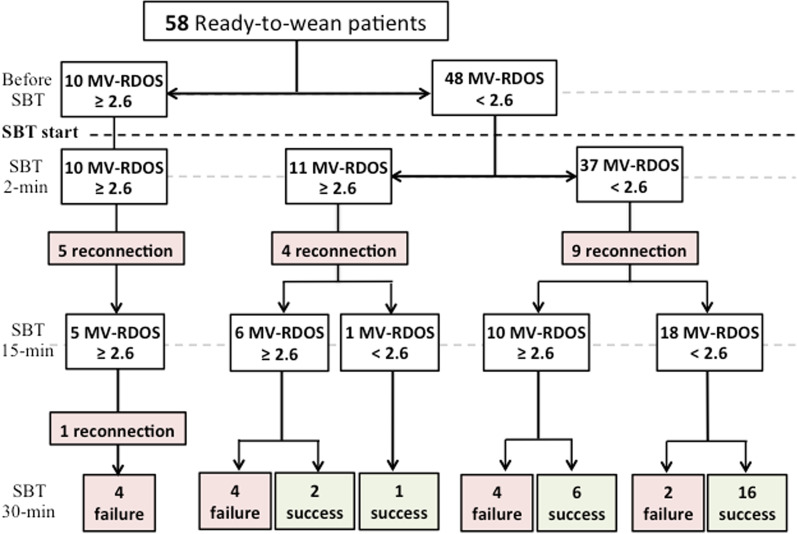
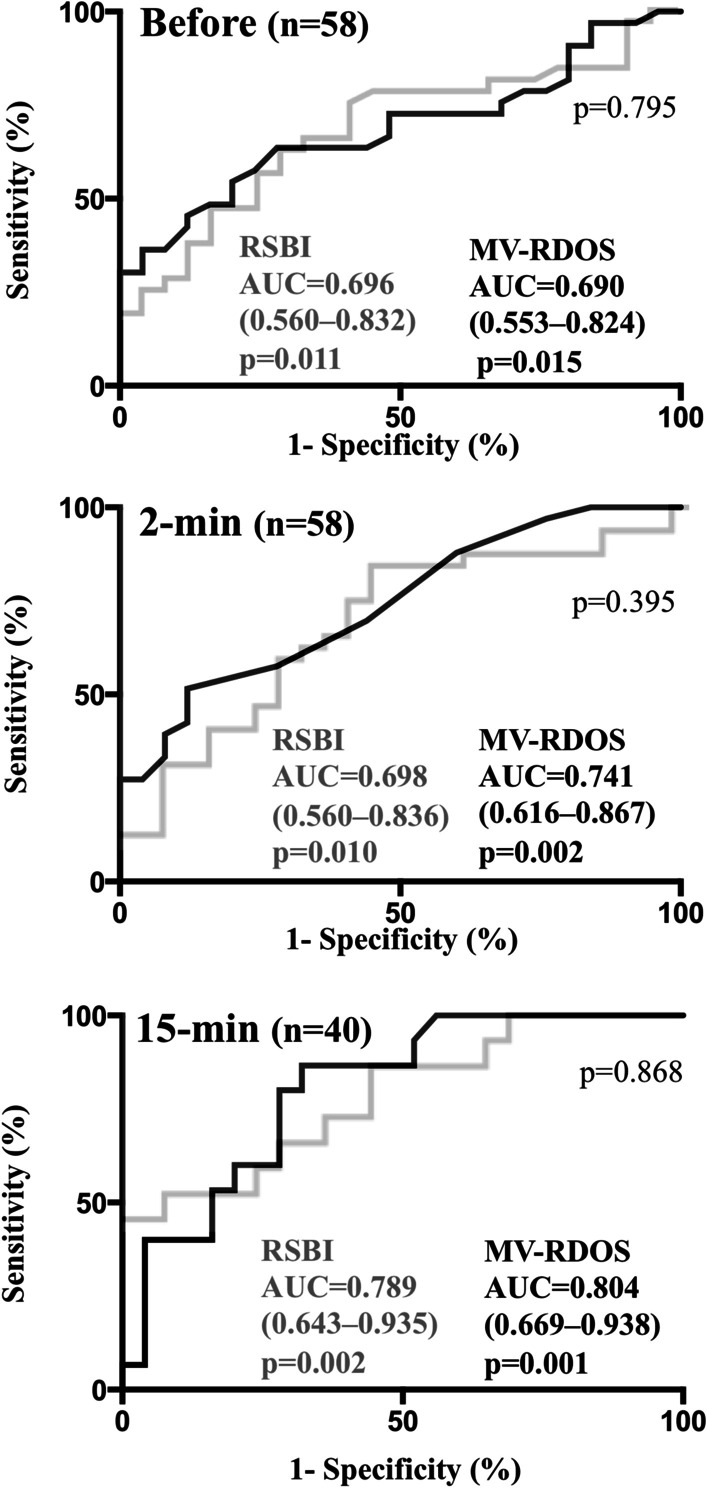
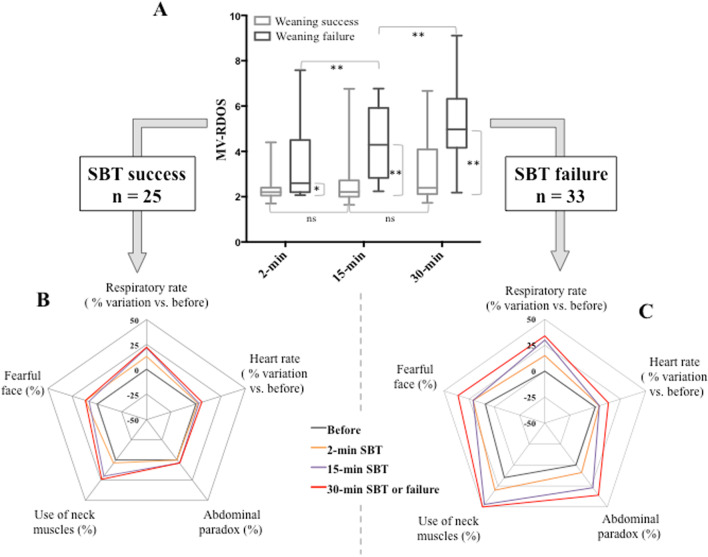
Fifty-eight patients (age 63 [51-70], SAPS II 66 [51-76]; med [IQR]) were included. Thirty-three (57%) patients failed the SBT, whose 18 (55%) failed before 15-min. Twenty-five (43%) patients successfully passed the SBT. A MV-RDOS ≥ 2.6 was present in ten (17%) patients before to start the SBT. All these ten patients subsequently failed the SBT. A MV-RDOS ≥ 2.6 at 2-min predicted a SBT failure with a 51% sensibility and a 88% specificity (AUC 0.741 95% confidence interval [CI] 0.616-0.866, p = 0.002). Best cut-off value at 2-min was 4.3 and predicted SBT failure with a 27% sensibility and a 96% specificity.
Despite patients met classical readiness to wean criteria, respiratory distress assessed with the MV-RDOS was frequent at the beginning of SBT. Measuring MV-RDOS before to initiate a SBT could avoid undue procedure and reduce patient's exposure to unnecessary mechanical ventilation weaning failure and distress.
在开始自主呼吸试验(SBT)之前是否存在呼吸困难,以及呼吸困难是否会影响 SBT 的结果尚不清楚。机械通气-呼吸窘迫观察量表(MV-RDOS)已被提出作为非交流插管患者呼吸困难的可靠替代指标。在本研究中,我们旨在:(1)描述 SBT 期间 MV-RDOS 的演变;(2)研究 MV-RDOS 是否可以预测 SBT 的结果。
这是一项在一家三级中心的 22 张床位 ICU 中进行的前瞻性单中心研究。如果满足经典撤机准备标准,自 48 小时以上插管且首次 SBT 失败的患者即可入组。在 SBT 之前、2 分钟、15 分钟和 30 分钟(结束时)评估 MV-RDOS。MV-RDOS 值≥2.6 提示存在临床显著呼吸困难。
共纳入 58 例患者(年龄 63 [51-70]岁,SAPS II 66 [51-76]分;中位数 [IQR])。33 例(57%)患者 SBT 失败,其中 18 例(55%)在 15 分钟前失败。25 例(43%)患者成功通过 SBT。在开始 SBT 前,有 10 例(17%)患者的 MV-RDOS 值≥2.6。所有这 10 例患者随后均 SBT 失败。2 分钟时 MV-RDOS 值≥2.6 预测 SBT 失败的敏感性为 51%,特异性为 88%(AUC 0.741 [95%置信区间:0.616-0.866],p=0.002)。2 分钟时最佳截断值为 4.3,预测 SBT 失败的敏感性为 27%,特异性为 96%。
尽管患者符合经典撤机准备标准,但在 SBT 开始时,MV-RDOS 评估的呼吸窘迫仍很常见。在开始 SBT 之前测量 MV-RDOS 可以避免不必要的程序,并减少患者遭受不必要的机械通气撤机失败和窘迫的风险。