Gál Éva, Tóth-Király István, Orosz Gábor
Evidence-Based Assessment and Psychological Interventions Doctoral School, Babeş-Bolyai University, Cluj-Napoca, Romania.
Substantive-Methodological Synergy Research Laboratory, Department of Psychology, Concordia University, Montreal, QC, Canada.
Front Psychol. 2022 May 20;13:852638. doi: 10.3389/fpsyg.2022.852638. eCollection 2022.
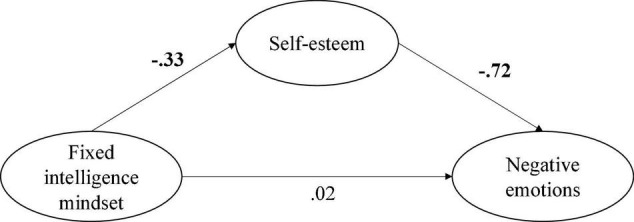
A growing body of literature supports that fixed intelligence mindset promotes the emergence of maladaptive emotional reactions, especially when self-threat is imminent. Previous studies have confirmed that in adverse academic situations, students endorsing fixed intelligence mindset experience higher levels of negative emotions, although little is known about the mechanisms through which fixed intelligence mindset exerts its influence. Thus, the present study ( = 398) proposed to investigate self-esteem as a mediator of this relationship in two different cultural contexts, in Hungary and the United States. Structural equation modeling revealed that self-esteem fully mediated the relationship between fixed intelligence mindset and negative emotions. Furthermore, results of the invariance testing conferred preliminary evidence for the cross-cultural validity of the mediation model. These findings suggest that, students adhering to fixed intelligence beliefs tend to experience greater self-esteem loss when experiencing academic failure, which leads to higher levels of negative emotions.
越来越多的文献支持这样的观点,即固定智力思维模式会促使适应不良的情绪反应出现,尤其是当自我威胁迫在眉睫时。先前的研究已经证实,在不利的学术情境中,认同固定智力思维模式的学生经历更高水平的负面情绪,尽管对于固定智力思维模式发挥其影响的机制知之甚少。因此,本研究(N = 398)提议在匈牙利和美国这两种不同的文化背景下,将自尊作为这种关系的一个中介变量进行调查。结构方程模型显示,自尊完全中介了固定智力思维模式与负面情绪之间的关系。此外,不变性检验的结果为中介模型的跨文化有效性提供了初步证据。这些发现表明,坚持固定智力信念的学生在经历学业失败时往往会经历更大的自尊丧失,这导致更高水平的负面情绪。