Wang Yuefu, Huang Weiqin, Han Jiange, Tian Yu, Wang Chunrong, Li Lihuan
Department of Anesthesiology, Fuwai Hospital, Chinese Academy of Medical Sciences and Peking Union Medical College, Beijing, China.
Department of Anaesthesiology and Surgical Critical Care Medicine, Beijing Shijitan Hospital, Capital Medical University, Beijing, China.
Perioper Med (Lond). 2022 Jun 9;11(1):24. doi: 10.1186/s13741-022-00248-1.
The ClearSight system measures blood pressure non-invasively and determines cardiac output by analyzing the continuous pressure waveform. We performed a multi-center clinical study in China to test the equivalence of cardiac output measured with the ClearSight system (CSCO) and cardiac output measured with the pulmonary artery catheter bolus thermodilution (TDCO) method.
We included adult patients undergoing cardiac surgery in three Chinese hospitals and measured TDCO and CSCO simultaneously after induction of anesthesia. Hemodynamic stability was required during measurement of TDCO and CSCO. At least four TDCO determinations were performed. The corresponding CSCO was determined as the average over a 30-s period following the injection of each bolus. A data pair for the comparison included the average of three or four accepted TDCO values and the average of the matching CSCO values. Main outcomes included Bland-Altman analysis of bias and standard deviation (SD) and the percentage error (PE).
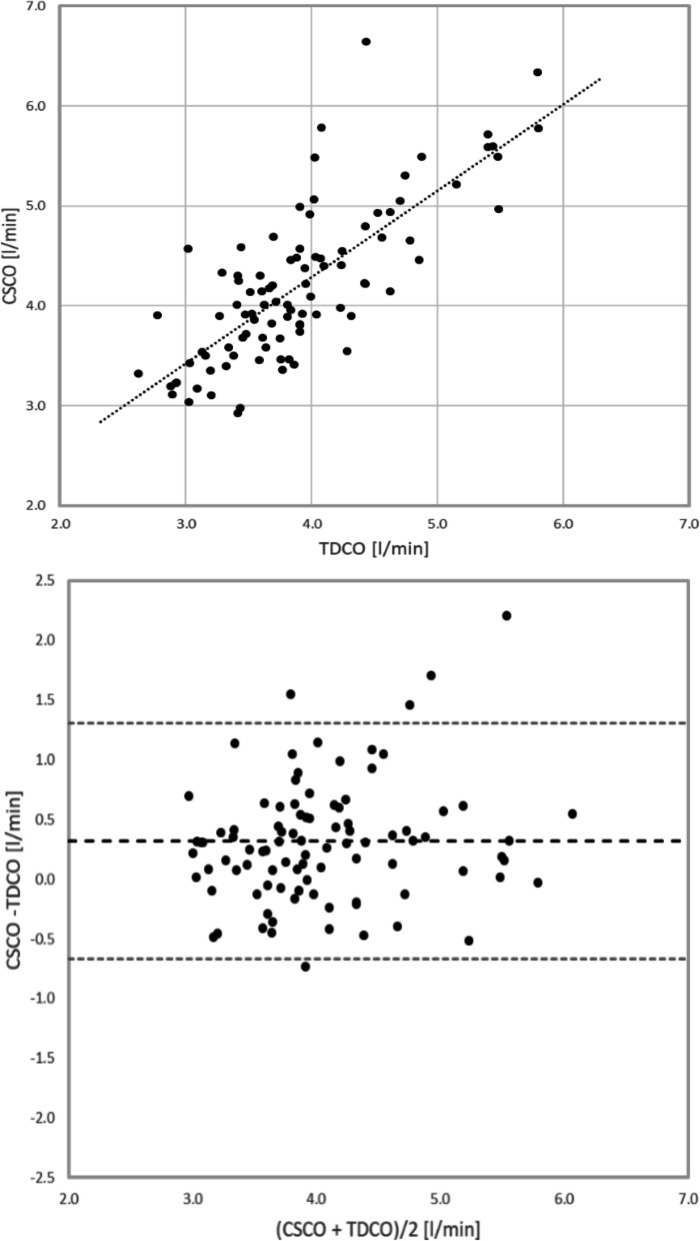
One hundred twenty-five subjects were enrolled, and 122 TDCO and CSCO data pairs were available for analysis. Ninety-five (75.4%) data pairs were collected in hemodynamically stable conditions, mean (SD) CSCO was 4.21 (0.78) l/min, and mean TDCO was 3.90 (0.67) l/min. Bias was 0.32 (0.51) l/min, and PE was 25.2%. Analyzing all 122 data pairs resulted in a mean CSCO of 4.19 (0.82) l/min and a mean TDCO of 3.83 (0.71) l/min. Resulting bias was 0.36 (0.53) l/min, and PE was 26.4%.
CSCO and TDCO agreed with a low systematic bias. Besides, mean PE was well below the pre-defined 30%. Hemodynamic stability only had a small impact on the analysis. We conclude that CSCO is equivalent to TDCO in cardiac surgery patients. The trial was retrospectively registered in ClinicalTrials.gov, identifier NCT03807622 ; January 17, 2019.
ClearSight系统可无创测量血压,并通过分析连续压力波形来测定心输出量。我们在中国开展了一项多中心临床研究,以检验用ClearSight系统测量的心输出量(CSCO)与用肺动脉导管团注热稀释法(TDCO)测量的心输出量是否等效。
我们纳入了中国三家医院接受心脏手术的成年患者,在麻醉诱导后同时测量TDCO和CSCO。在测量TDCO和CSCO期间需要血流动力学稳定。至少进行四次TDCO测定。相应的CSCO被确定为每次团注注射后30秒内的平均值。用于比较的数据对包括三个或四个可接受的TDCO值的平均值以及匹配的CSCO值的平均值。主要结果包括Bland-Altman偏差分析、标准差(SD)和百分比误差(PE)。
共纳入125名受试者,有122对TDCO和CSCO数据可供分析。95对(75.4%)数据是在血流动力学稳定的情况下收集的,CSCO的平均值(标准差)为4.2l/分钟),TDCO的平均值为3.90(0.67)l/min。偏差为0.32(0.51)l/min,PE为25.2%。分析所有122对数据得出,CSCO的平均值为4.19(0.82)l/min,TDCO的平均值为3.83(0.71)l/min。得出的偏差为0.36(0.53)l/min,PE为26.4%。
CSCO和TDCO的一致性较好,系统偏差较小。此外,平均PE远低于预先定义的30%。血流动力学稳定性对分析的影响很小。我们得出结论,在心脏手术患者中,CSCO与TDCO等效。该试验已在ClinicalTrials.gov上进行回顾性注册,标识符为NCT03807622;2019年1月17日。