Deng Ying-Hao, Yan Ping, Zhang Ning-Ya, Luo Xiao-Qin, Wang Xiu-Fen, Duan Shao-Bin
Department of Nephrology, The Second Xiangya Hospital of Central South University, Hunan Key Laboratory of Kidney Disease and Blood Purification, Changsha, China.
Information Center, The Second Xiangya Hospital of Central South University, Changsha, China.
Front Pediatr. 2022 May 23;10:885055. doi: 10.3389/fped.2022.885055. eCollection 2022.
The epidemiology and outcomes of acute kidney disease (AKD) after acute kidney injury (AKI) in hospitalized children are poorly described. The aim of this study is to investigate the prevalence, predictive factors, and clinical outcomes of AKD in hospitalized children with AKI.
Children (1 month-18 years) with AKI during hospitalization in the Second Xiangya Hospital from January 2015 to December 2020 were identified. AKD was defined based on the consensus report of the Acute Disease Quality Initiative 16 workgroup. The endpoints include adverse outcomes in 30 and 90 days. Multivariable logistic regression analyses were used to estimate the odds ratio of 30- and 90-day adverse outcomes associated with AKD and identify the risk factors of AKD.
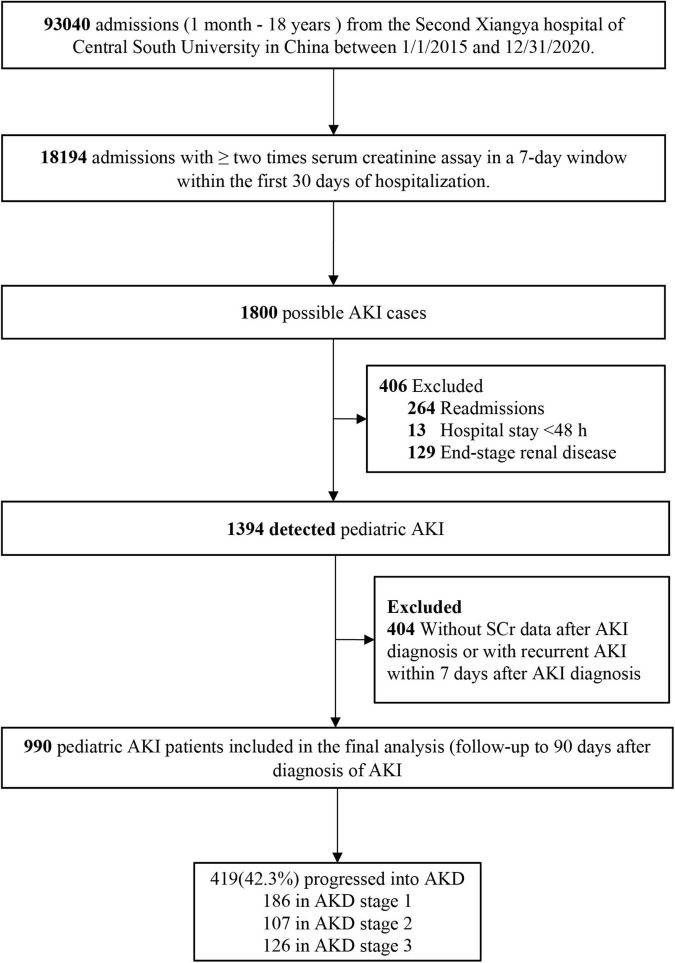
AKD was developed in 42.3% (419/990) of the study patients, with 186 in AKD stage 1, 107 in AKD stage 2, and 126 in AKD stage 3. Pediatric patients with AKD stages 2-3 had significantly higher rates of developing 30- and 90-day adverse outcomes than those with AKD stage 0 and 1. The adjusted odds ratio of AKD stage 2-3 was 12.18 (95% confidence interval (CI), 7.38 - 20.09) for 30-day adverse outcomes and decreased to 2.49 (95% CI, 1.26 - 4.91) for 90-day adverse outcomes. AKI stages 2 and 3, as well as glomerulonephritis, were the only predictive factors for AKD stage 2-3.
AKD is frequent among hospitalized pediatric AKI patients. AKD stage 2-3 represents a high-risk subpopulation among pediatric AKI survivors and is independently associated with 30- and 90-day adverse outcomes. Awareness of the potential risks associated with AKD stage 2-3 and its risk factors may help improve outcomes through careful monitoring and timely intervention.
住院儿童急性肾损伤(AKI)后急性肾病(AKD)的流行病学及转归情况鲜有描述。本研究旨在调查住院AKI儿童中AKD的患病率、预测因素及临床转归。
确定2015年1月至2020年12月在中南大学湘雅二医院住院期间发生AKI的儿童(1个月至18岁)。AKD根据急性疾病质量改进计划16工作组的共识报告定义。终点包括30天和90天的不良转归。采用多变量逻辑回归分析评估与AKD相关的30天和90天不良转归的比值比,并确定AKD的危险因素。
42.3%(419/990)的研究患者发生了AKD,其中186例为AKD 1期,107例为AKD 2期,126例为AKD 3期。AKD 2 - 3期的儿科患者发生30天和90天不良转归的发生率显著高于AKD 0期和1期患者。AKD 2 - 3期30天不良转归的调整后比值比为12.18(95%置信区间(CI),7.38 - 20.09),90天不良转归的调整后比值比降至2.49(95% CI,1.26 - 4.91)。AKI 2期和3期以及肾小球肾炎是AKD 2 - 3期的唯一预测因素。
AKD在住院的儿科AKI患者中很常见。AKD 2 - 3期是儿科AKI幸存者中的高危亚组,且与30天和90天的不良转归独立相关。认识到与AKD 2 - 3期相关的潜在风险及其危险因素可能有助于通过仔细监测和及时干预改善转归。