Zhong Guihua, Wei Wei, Liao Wei, Wang Rong, Peng Yingpeng, Zhou Yuling, Huang Xiaotao, Xian Shiping, Peng Shunli, Zhang Zhaoyuan, Feng Shaoyan, Liu Ye, Hong Haiyu, Xia Yunfei, Yan Yan, Liu Qiaodan, Liu Zhigang
Cancer Center, The Fifth Affiliated Hospital of Sun Yat-sen University, Zhuhai, China.
Guangdong Provincial Key Laboratory of Biomedical Imaging, The Fifth Affiliated Hospital of Sun Yat-sen University, Zhuhai, China.
Front Oncol. 2022 May 23;12:859721. doi: 10.3389/fonc.2022.859721. eCollection 2022.
Previous studies have reported a close relationship between cancer and microbes, particularly gut and tumor microbiota; however, the presence of tumor microbiome in nasopharyngeal carcinoma (NPC) and its role in the prognosis of NPC remain unclear.
We collected 64 samples including tissues from 50 patients with NPC (NPC group) and 14 patients with chronic nasopharyngitis (control group) receiver operating characteristics and we applied 16S ribosome RNA gene sequencing of all samples to assess microbiome profiles and immunohistochemistry to detect tumor microbiome in NPC.
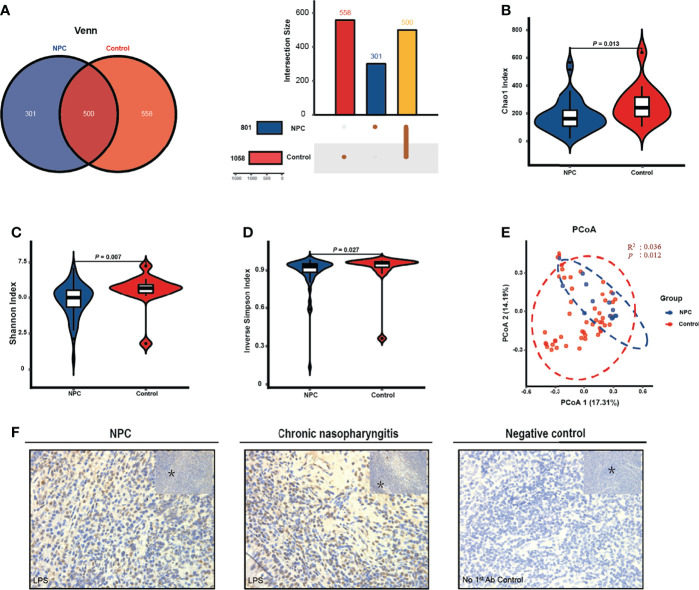
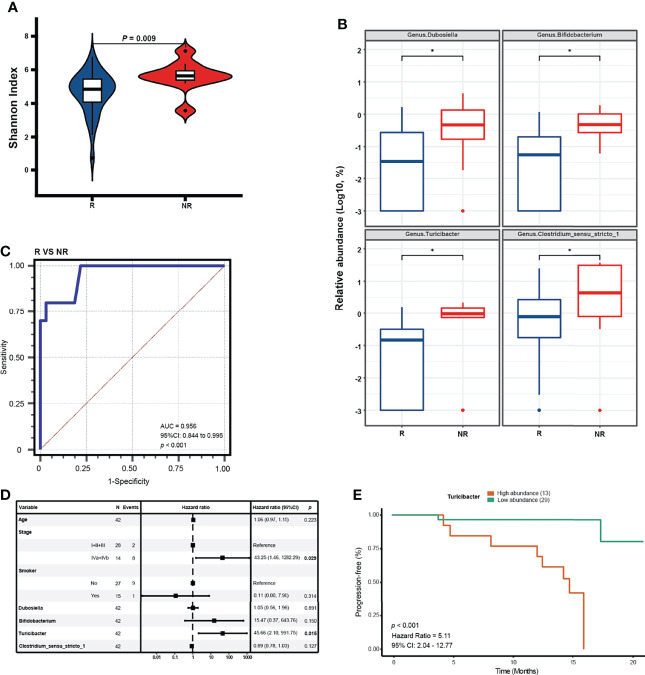
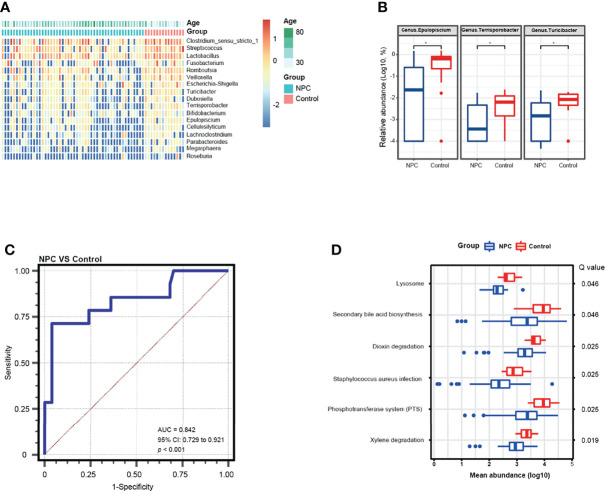
Patients in the control group harbored higher species diversity than those in the NPC group; however, the beta diversity was more distinct in the NPC group. In total, three genera with statistically significant differences between the two groups were identified. The area under the receiver operating characteristics (ROC) curve (AUC) was calculated using the relative abundance of these three significant genera, and a value of 0.842 was achieved. Furthermore, was confirmed as a potentially independent prognostic factor for NPC patients, and the progression-free survival (PFS) was markedly prolonged in patients with a low relative abundance of compared to patients with a high relative abundance of this genus (cutoff: 0.0046, hazard ratio: 5.10, 95% confidence interval: 2.04-12.77, = 0.004).
The present study provided strong evidence of a correlation between tumor microbiome and NPC; the tumor microbiome may be considered a biomarker for early NPC diagnosis. potentially served as a independently prognostic indicator for NPC patients.
先前的研究报道了癌症与微生物之间的密切关系,尤其是肠道微生物群和肿瘤微生物群;然而,鼻咽癌(NPC)中肿瘤微生物组的存在及其在NPC预后中的作用仍不清楚。
我们收集了64份样本,包括50例NPC患者的组织(NPC组)和14例慢性鼻咽炎患者的组织(对照组),并应用所有样本的16S核糖体RNA基因测序来评估微生物组谱,以及用免疫组织化学检测NPC中的肿瘤微生物组。
对照组患者的物种多样性高于NPC组患者;然而,NPC组的β多样性更为明显。总共确定了两组之间具有统计学显著差异的三个属。使用这三个显著属的相对丰度计算受试者工作特征(ROC)曲线下面积(AUC),得出的值为0.842。此外,已被确认为NPC患者的一个潜在独立预后因素,与该属相对丰度高的患者相比,该属相对丰度低的患者无进展生存期(PFS)明显延长(临界值:0.0046,风险比:5.10,95%置信区间:2.04 - 12.77,P = 0.004)。
本研究提供了肿瘤微生物组与NPC之间存在相关性的有力证据;肿瘤微生物组可被视为早期NPC诊断的生物标志物。 可能作为NPC患者的独立预后指标。