• 文献检索
  • 文档翻译
  • 深度研究
  • 学术资讯
  • Suppr Zotero 插件Zotero 插件
  • 邀请有礼
  • 套餐&价格
  • 历史记录
应用&插件
Suppr Zotero 插件Zotero 插件浏览器插件Mac 客户端Windows 客户端微信小程序
定价
高级版会员购买积分包购买API积分包
服务
文献检索文档翻译深度研究API 文档MCP 服务
关于我们
关于 Suppr公司介绍联系我们用户协议隐私条款
关注我们

Suppr 超能文献

核心技术专利:CN118964589B侵权必究
粤ICP备2023148730 号-1Suppr @ 2026

文献检索

告别复杂PubMed语法,用中文像聊天一样搜索,搜遍4000万医学文献。AI智能推荐,让科研检索更轻松。

立即免费搜索

文件翻译

保留排版,准确专业,支持PDF/Word/PPT等文件格式,支持 12+语言互译。

免费翻译文档

深度研究

AI帮你快速写综述,25分钟生成高质量综述,智能提取关键信息,辅助科研写作。

立即免费体验

深度MHADTA:使用多头自注意力和卷积神经网络预测药物-靶点结合亲和力

DeepMHADTA: Prediction of Drug-Target Binding Affinity Using Multi-Head Self-Attention and Convolutional Neural Network.

作者信息

Deng Lei, Zeng Yunyun, Liu Hui, Liu Zixuan, Liu Xuejun

机构信息

School of Computer Science and Engineering, Central South University, Changsha 410083, China.

School of Computer Science and Technology, Nanjing Tech University, Nanjing 211816, China.

出版信息

Curr Issues Mol Biol. 2022 May 19;44(5):2287-2299. doi: 10.3390/cimb44050155.

DOI:10.3390/cimb44050155
PMID:35678684
原文链接:https://pmc.ncbi.nlm.nih.gov/articles/PMC9164023/
Abstract

Drug-target interactions provide insight into the drug-side effects and drug repositioning. However, wet-lab biochemical experiments are time-consuming and labor-intensive, and are insufficient to meet the pressing demand for drug research and development. With the rapid advancement of deep learning, computational methods are increasingly applied to screen drug-target interactions. Many methods consider this problem as a binary classification task (binding or not), but ignore the quantitative binding affinity. In this paper, we propose a new end-to-end deep learning method called DeepMHADTA, which uses the multi-head self-attention mechanism in a deep residual network to predict drug-target binding affinity. On two benchmark datasets, our method outperformed several current state-of-the-art methods in terms of multiple performance measures, including mean square error (MSE), consistency index (CI), rm2, and PR curve area (AUPR). The results demonstrated that our method achieved better performance in predicting the drug-target binding affinity.

摘要

药物-靶点相互作用有助于深入了解药物副作用和药物重新定位。然而,湿实验室生化实验既耗时又费力,且不足以满足药物研发的迫切需求。随着深度学习的快速发展,计算方法越来越多地应用于筛选药物-靶点相互作用。许多方法将此问题视为二元分类任务(结合或不结合),但忽略了定量结合亲和力。在本文中,我们提出了一种名为DeepMHADTA的新型端到端深度学习方法,该方法在深度残差网络中使用多头自注意力机制来预测药物-靶点结合亲和力。在两个基准数据集上,我们的方法在包括均方误差(MSE)、一致性指数(CI)、rm2和PR曲线面积(AUPR)在内的多个性能指标方面优于当前几种最先进的方法。结果表明,我们的方法在预测药物-靶点结合亲和力方面取得了更好的性能。
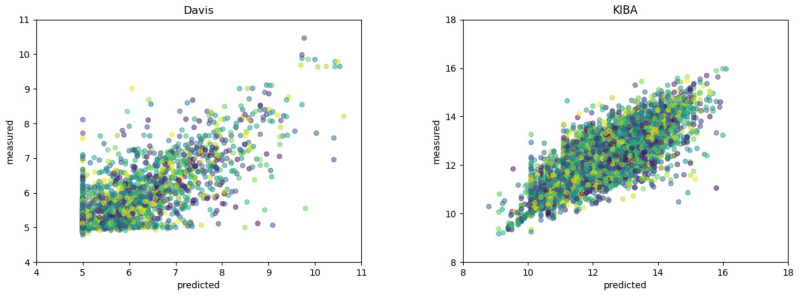
https://cdn.ncbi.nlm.nih.gov/pmc/blobs/0f2c/9164023/47174672ae67/cimb-44-00155-g004.jpg
https://cdn.ncbi.nlm.nih.gov/pmc/blobs/0f2c/9164023/401619ebf9ce/cimb-44-00155-g001.jpg
https://cdn.ncbi.nlm.nih.gov/pmc/blobs/0f2c/9164023/85823b38f0d8/cimb-44-00155-g002.jpg
https://cdn.ncbi.nlm.nih.gov/pmc/blobs/0f2c/9164023/01f08ced9061/cimb-44-00155-g003a.jpg
https://cdn.ncbi.nlm.nih.gov/pmc/blobs/0f2c/9164023/47174672ae67/cimb-44-00155-g004.jpg
https://cdn.ncbi.nlm.nih.gov/pmc/blobs/0f2c/9164023/401619ebf9ce/cimb-44-00155-g001.jpg
https://cdn.ncbi.nlm.nih.gov/pmc/blobs/0f2c/9164023/85823b38f0d8/cimb-44-00155-g002.jpg
https://cdn.ncbi.nlm.nih.gov/pmc/blobs/0f2c/9164023/01f08ced9061/cimb-44-00155-g003a.jpg
https://cdn.ncbi.nlm.nih.gov/pmc/blobs/0f2c/9164023/47174672ae67/cimb-44-00155-g004.jpg

相似文献

1
DeepMHADTA: Prediction of Drug-Target Binding Affinity Using Multi-Head Self-Attention and Convolutional Neural Network.深度MHADTA:使用多头自注意力和卷积神经网络预测药物-靶点结合亲和力
Curr Issues Mol Biol. 2022 May 19;44(5):2287-2299. doi: 10.3390/cimb44050155.
2
TeM-DTBA: time-efficient drug target binding affinity prediction using multiple modalities with Lasso feature selection.TeM-DTBA:使用具有套索特征选择的多模态进行高效药物靶点结合亲和力预测。
J Comput Aided Mol Des. 2023 Dec;37(12):573-584. doi: 10.1007/s10822-023-00533-1. Epub 2023 Sep 30.
3
Drug-Target Interaction Prediction Using Multi-Head Self-Attention and Graph Attention Network.基于多头自注意力机制和图注意力网络的药物-靶标相互作用预测
IEEE/ACM Trans Comput Biol Bioinform. 2022 Jul-Aug;19(4):2208-2218. doi: 10.1109/TCBB.2021.3077905. Epub 2022 Aug 8.
4
AttentionDTA: Drug-Target Binding Affinity Prediction by Sequence-Based Deep Learning With Attention Mechanism.AttentionDTA:基于序列的深度学习与注意力机制预测药物-靶点结合亲和力
IEEE/ACM Trans Comput Biol Bioinform. 2023 Mar-Apr;20(2):852-863. doi: 10.1109/TCBB.2022.3170365. Epub 2023 Apr 3.
5
MultiscaleDTA: A multiscale-based method with a self-attention mechanism for drug-target binding affinity prediction.多尺度 DTA:一种基于多尺度的方法,具有自注意力机制,用于预测药物-靶标结合亲和力。
Methods. 2022 Nov;207:103-109. doi: 10.1016/j.ymeth.2022.09.006. Epub 2022 Sep 23.
6
ColdDTA: Utilizing data augmentation and attention-based feature fusion for drug-target binding affinity prediction.ColdDTA:利用数据增强和基于注意力的特征融合进行药物-靶标结合亲和力预测。
Comput Biol Med. 2023 Sep;164:107372. doi: 10.1016/j.compbiomed.2023.107372. Epub 2023 Aug 13.
7
Affinity2Vec: drug-target binding affinity prediction through representation learning, graph mining, and machine learning.Affinity2Vec:通过表示学习、图挖掘和机器学习进行药物-靶标结合亲和力预测。
Sci Rep. 2022 Mar 19;12(1):4751. doi: 10.1038/s41598-022-08787-9.
8
Learning long- and short-term dependencies for improving drug-target binding affinity prediction using transformer and edge contraction pooling.使用 Transformer 和边收缩池学习长短期依赖关系,以提高药物-靶标结合亲和力预测。
J Bioinform Comput Biol. 2024 Feb;22(1):2350030. doi: 10.1142/S0219720023500300.
9
MDF-SA-DDI: predicting drug-drug interaction events based on multi-source drug fusion, multi-source feature fusion and transformer self-attention mechanism.MDF-SA-DDI:基于多源药物融合、多源特征融合和 Transformer 自注意力机制预测药物-药物相互作用事件。
Brief Bioinform. 2022 Jan 17;23(1). doi: 10.1093/bib/bbab421.
10
Dipeptide Frequency of Word Frequency and Graph Convolutional Networks for DTA Prediction.用于药物-靶点亲和力预测的词频二肽频率和图卷积网络
Front Bioeng Biotechnol. 2020 Apr 3;8:267. doi: 10.3389/fbioe.2020.00267. eCollection 2020.

引用本文的文献

1
SMFF-DTA: using a sequential multi-feature fusion method with multiple attention mechanisms to predict drug-target binding affinity.SMFF-DTA:使用具有多种注意力机制的序列多特征融合方法来预测药物-靶点结合亲和力。
BMC Biol. 2025 May 9;23(1):120. doi: 10.1186/s12915-025-02222-x.
2
Trends of Artificial Intelligence (AI) Use in Drug Targets, Discovery and Development: Current Status and Future Perspectives.人工智能在药物靶点、发现与开发中的应用趋势:现状与未来展望
Curr Drug Targets. 2025;26(4):221-242. doi: 10.2174/0113894501322734241008163304.
3
MIFAM-DTI: a drug-target interactions predicting model based on multi-source information fusion and attention mechanism.

本文引用的文献

1
Deep learning in target prediction and drug repositioning: Recent advances and challenges.深度学习在靶标预测和药物重定位中的应用:最新进展与挑战。
Drug Discov Today. 2022 Jul;27(7):1796-1814. doi: 10.1016/j.drudis.2021.10.010. Epub 2021 Oct 27.
2
Exploration of potential inhibitors for tuberculosis via structure-based drug design, molecular docking, and molecular dynamics simulation studies.基于结构的药物设计、分子对接和分子动力学模拟研究探索结核病的潜在抑制剂。
J Comput Chem. 2021 Sep 15;42(24):1736-1749. doi: 10.1002/jcc.26712. Epub 2021 Jul 2.
3
Use of molecular docking computational tools in drug discovery.
MIFAM-DTI:一种基于多源信息融合和注意力机制的药物-靶点相互作用预测模型。
Front Genet. 2024 May 6;15:1381997. doi: 10.3389/fgene.2024.1381997. eCollection 2024.
4
Advancing Drug Safety in Drug Development: Bridging Computational Predictions for Enhanced Toxicity Prediction.推进药物研发中的药物安全性:弥合计算预测差距,提高毒性预测能力。
Chem Res Toxicol. 2024 Jun 17;37(6):827-849. doi: 10.1021/acs.chemrestox.3c00352. Epub 2024 May 17.
5
AMMVF-DTI: A Novel Model Predicting Drug-Target Interactions Based on Attention Mechanism and Multi-View Fusion.AMMVF-DTI:一种基于注意力机制和多视图融合的新型药物-靶标相互作用预测模型。
Int J Mol Sci. 2023 Sep 15;24(18):14142. doi: 10.3390/ijms241814142.
6
New Sight: Enzymes as Targets for Drug Development.新视野:作为药物开发靶点的酶
Curr Issues Mol Biol. 2023 Sep 20;45(9):7650-7652. doi: 10.3390/cimb45090482.
7
AiKPro: deep learning model for kinome-wide bioactivity profiling using structure-based sequence alignments and molecular 3D conformer ensemble descriptors.AiKPro:一种基于结构序列比对和分子 3D 构象集合描述符的激酶组全范围生物活性预测的深度学习模型。
Sci Rep. 2023 Jun 24;13(1):10268. doi: 10.1038/s41598-023-37456-8.
8
Design and Prediction of Aptamers Assisted by In Silico Methods.计算机辅助方法辅助的适配体设计与预测
Biomedicines. 2023 Jan 26;11(2):356. doi: 10.3390/biomedicines11020356.
9
Self- and cross-attention accurately predicts metabolite-protein interactions.自注意力机制和交叉注意力机制能够准确预测代谢物与蛋白质的相互作用。
NAR Genom Bioinform. 2023 Jan 31;5(1):lqad008. doi: 10.1093/nargab/lqad008. eCollection 2023 Mar.
在药物发现中使用分子对接计算工具。
Prog Med Chem. 2021;60:273-343. doi: 10.1016/bs.pmch.2021.01.004. Epub 2021 May 27.
4
Drug-Target Interaction Prediction Using Multi-Head Self-Attention and Graph Attention Network.基于多头自注意力机制和图注意力网络的药物-靶标相互作用预测
IEEE/ACM Trans Comput Biol Bioinform. 2022 Jul-Aug;19(4):2208-2218. doi: 10.1109/TCBB.2021.3077905. Epub 2022 Aug 8.
5
PreDTIs: prediction of drug-target interactions based on multiple feature information using gradient boosting framework with data balancing and feature selection techniques.PreDTIs:基于梯度提升框架使用数据平衡和特征选择技术,基于多种特征信息预测药物-靶标相互作用。
Brief Bioinform. 2021 Sep 2;22(5). doi: 10.1093/bib/bbab046.
6
An end-to-end heterogeneous graph representation learning-based framework for drug-target interaction prediction.基于端到端异质图表示学习的药物-靶标相互作用预测框架。
Brief Bioinform. 2021 Sep 2;22(5). doi: 10.1093/bib/bbaa430.
7
MolTrans: Molecular Interaction Transformer for drug-target interaction prediction.MolTrans:用于药物-靶标相互作用预测的分子相互作用转换器。
Bioinformatics. 2021 May 5;37(6):830-836. doi: 10.1093/bioinformatics/btaa880.
8
MDeePred: novel multi-channel protein featurization for deep learning-based binding affinity prediction in drug discovery.MDeePred:用于药物发现中基于深度学习的结合亲和力预测的新型多通道蛋白质特征化。
Bioinformatics. 2021 May 5;37(5):693-704. doi: 10.1093/bioinformatics/btaa858.
9
DeepCDA: deep cross-domain compound-protein affinity prediction through LSTM and convolutional neural networks.DeepCDA:通过 LSTM 和卷积神经网络进行深度跨域化合物-蛋白质亲和力预测。
Bioinformatics. 2020 Nov 1;36(17):4633-4642. doi: 10.1093/bioinformatics/btaa544.
10
Identifying drug-target interactions based on graph convolutional network and deep neural network.基于图卷积网络和深度神经网络的药物-靶标相互作用识别。
Brief Bioinform. 2021 Mar 22;22(2):2141-2150. doi: 10.1093/bib/bbaa044.