Department of General Surgery, State Key Laboratory of Complex Severe and Rare Diseases, Peking Union Medical College Hospital, Chinese Academy of Medical Sciences & Peking Union Medical College, Beijing 100730, China.
Department of Clinical Nutrition, State Key Laboratory of Complex Severe and Rare Diseases, Peking Union Medical College Hospital, Chinese Academy of Medical Sciences & Peking Union Medical College, Beijing 100730, China.
Int J Environ Res Public Health. 2022 May 25;19(11):6426. doi: 10.3390/ijerph19116426.
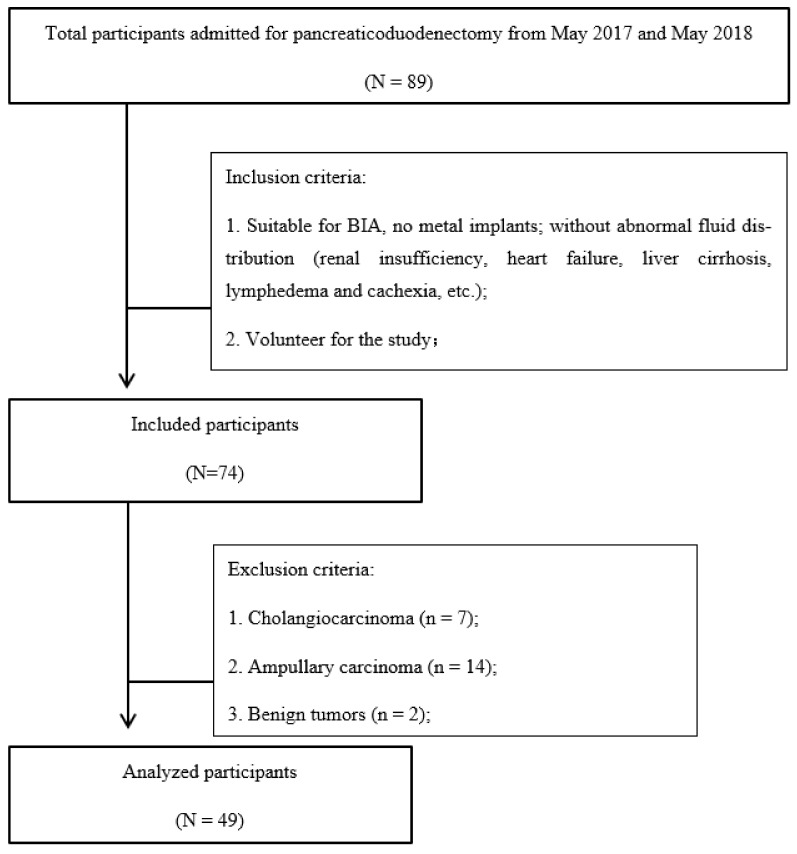
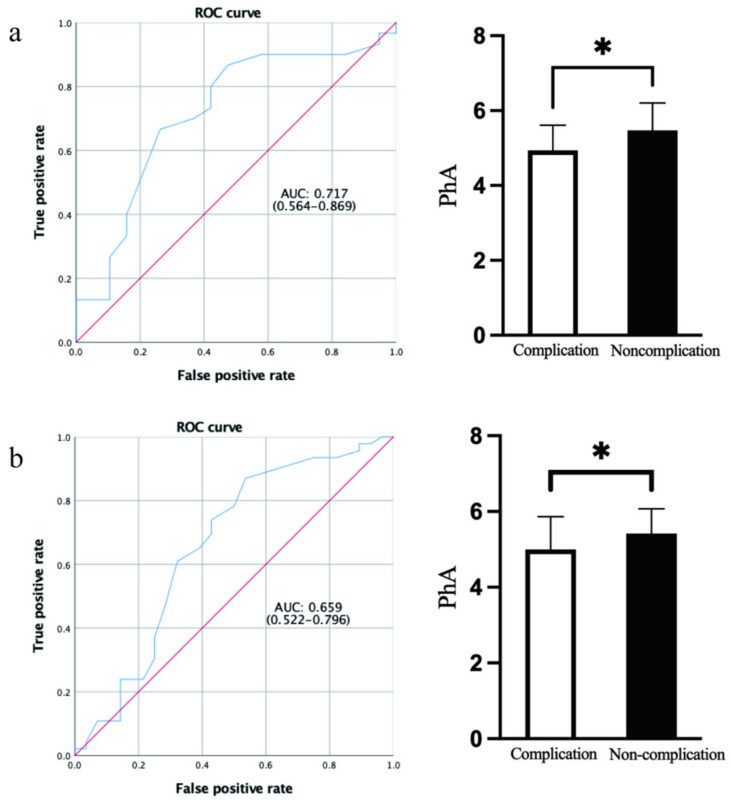
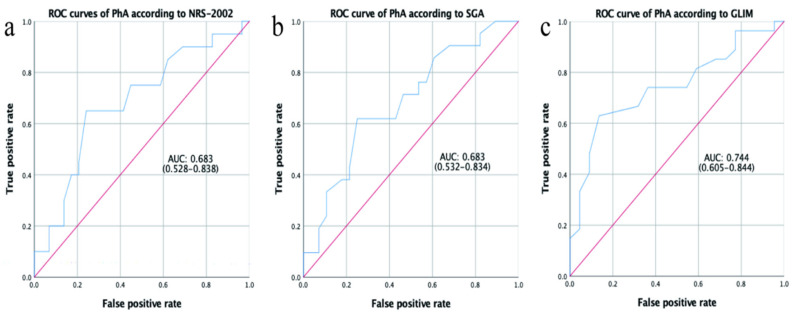
Phase angle (PhA), a bioimpedance parameter, is used to assess the nutrition status and body composition of patients. Patients with pancreatic head cancer often present with body composition changes that relate to adverse outcomes. PhA may be useful to evaluate prognosis in these patients, but data are deficient. We aim to explore the effects of PhA on nutrition evaluation and short-term outcome prediction in these patients. This prospective study included 49 participants with pancreatic head cancer who underwent pancreaticoduodenectomy (PD). All participants’ nutritional status and postoperative complications were assessed using nutrition assessment tools and the Clavien−Dindo classification method, respectively. Spearman correlation analyses were used to evaluate the association between PhA, nutrition status, and postoperative complications. ROC curves were generated to evaluate the ability of PhA to predict malnutrition and complications and to determine the cutoff value. The PhA values of the nutritional risk group and the malnourished group were significantly lower than those of the well-nourished group (p < 0.05). PhA positively correlated with patients’ nutrition status. Nineteen patients had postoperative complications, and the PhA value of the complication group was significantly lower than that of the non-complication group (4.94 vs. 5.47, p = 0.013). ROC curves showed that the cutoff point of PhA to predict malnutrition was 5.45 (AUC: 0.744), and the cutoff point of PhA to predict postoperative complications was 5.35 (AUC: 0.717). Our study indicates that PhA was associated with nutrition status and could be considered a nutrition assessment tool for pancreatic head cancer patients and predict the postoperative complications of these patients who have undergone PD.
相位角(PhA)是一种生物阻抗参数,用于评估患者的营养状况和身体成分。胰头癌患者常出现与不良结局相关的身体成分改变。PhA 可能有助于评估这些患者的预后,但数据不足。我们旨在探讨 PhA 对这些患者营养评估和短期预后预测的影响。这项前瞻性研究纳入了 49 例接受胰十二指肠切除术(PD)的胰头癌患者。所有患者的营养状况和术后并发症分别采用营养评估工具和 Clavien-Dindo 分类方法进行评估。采用 Spearman 相关分析评估 PhA 与营养状况和术后并发症之间的关系。绘制 ROC 曲线评估 PhA 预测营养不良和并发症的能力,并确定截断值。营养风险组和营养不良组的 PhA 值明显低于营养良好组(p < 0.05)。PhA 与患者的营养状况呈正相关。19 例患者发生术后并发症,并发症组的 PhA 值明显低于无并发症组(4.94 比 5.47,p = 0.013)。ROC 曲线显示 PhA 预测营养不良的截断值为 5.45(AUC:0.744),预测术后并发症的截断值为 5.35(AUC:0.717)。本研究表明 PhA 与营养状况相关,可作为胰头癌患者的营养评估工具,并预测接受 PD 的这些患者的术后并发症。