School of Nursing, Jilin University, Changchun 130021, China.
Nutrients. 2022 Dec 22;15(1):50. doi: 10.3390/nu15010050.
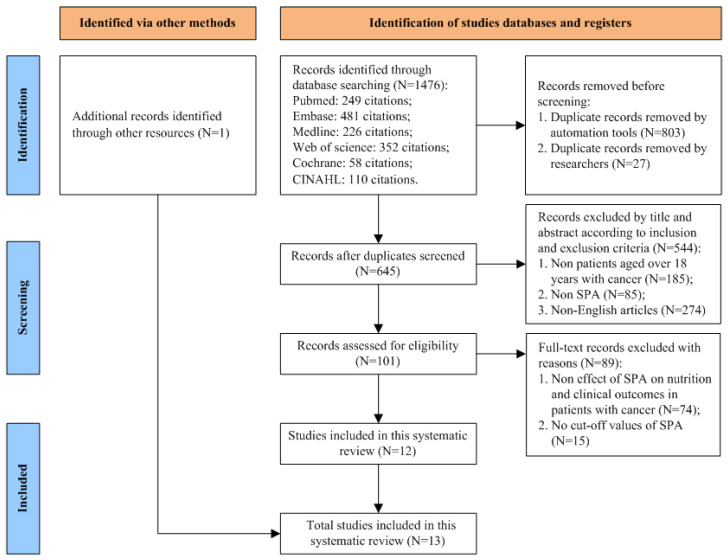
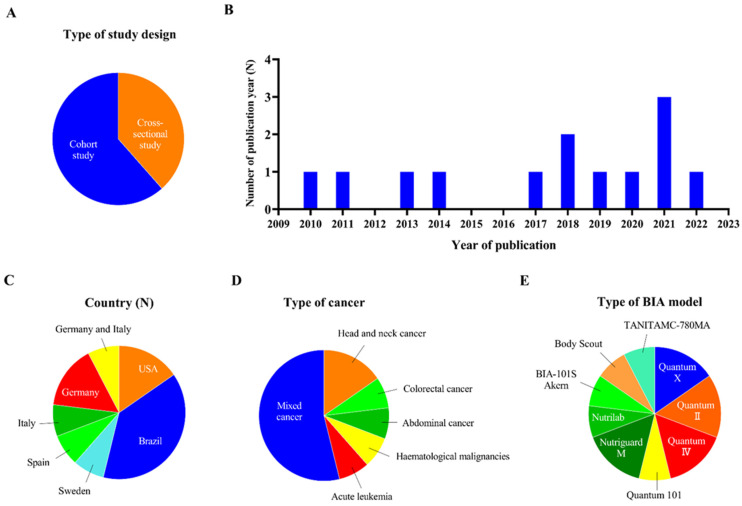
Compared with the phase angle (PA), the predictive ability of the standardized phase angle (SPA) in assessing nutritional status and clinical outcomes in cancer patients remains uncertain. This review aimed to assess (1) the relationship between SPA and nutritional status and clinical outcomes (including complications and survival) in cancer patients; (2) the predictive ability of SPA alone and in comparison with the predictive ability of PA; and (3) the cut-off value of SPA in cancer patients. Studies that addressed the relationship of SPA use to nutritional status, complications, and survival in cancer patients were searched and identified from six electronic databases (PubMed, Medline, CINAHL, Embase, Web of Science, and the Cochrane Library). The included studies were considered to meet the following criteria: English studies with original data that reflected the effects of SPA on nutritional status and clinical outcomes (including complications and survival) and reported a cut-off value of SPA in cancer patients aged ≥18. Thirteen studies that included a total of 2787 participants were evaluated. Five studies assessed the relationship between SPA and nutritional status, and four of them reported a positive relationship between SPA and nutritional status in cancer patients, even considering SPA as a predictor. Twelve studies assessed the relationship between SPA and clinical outcomes in cancer patients. Two-thirds of the studies that evaluated complications reported the predictive ability of SPA; 30% of survival studies reported a positive relationship, 40% reported SPA as a predictor, and 30% reported no relationship. The standard cut-off value for SPA has not yet been determined. Data from the selected studies suggest that SPA might be a predictor of nutritional status. Further studies are needed to determine the value of SPA in predicting nutritional status and clinical outcomes in cancer patients.
与相位角 (PA) 相比,标准化相位角 (SPA) 在评估癌症患者的营养状况和临床结局方面的预测能力尚不确定。本综述旨在评估:(1) SPA 与癌症患者营养状况和临床结局(包括并发症和生存)之间的关系;(2) SPA 单独和与 PA 预测能力的比较;以及 (3) SPA 在癌症患者中的临界值。从六个电子数据库(PubMed、Medline、CINAHL、Embase、Web of Science 和 Cochrane Library)中搜索并确定了探讨 SPA 使用与癌症患者营养状况、并发症和生存关系的研究。纳入的研究被认为符合以下标准:使用 SPA 对营养状况和临床结局(包括并发症和生存)产生影响的英文研究,且报告了 SPA 在年龄≥18 岁的癌症患者中的临界值。共评估了 13 项纳入了总计 2787 名参与者的研究。有 5 项研究评估了 SPA 与营养状况之间的关系,其中 4 项研究报告 SPA 与癌症患者的营养状况之间存在正相关,甚至考虑 SPA 作为预测因子。有 12 项研究评估了 SPA 与癌症患者临床结局之间的关系。评估并发症的研究中,有三分之二报告了 SPA 的预测能力;30%的生存研究报告 SPA 呈正相关,40%报告 SPA 是预测因子,30%报告无相关性。SPA 的标准临界值尚未确定。选定研究的数据表明 SPA 可能是营养状况的预测因子。需要进一步的研究来确定 SPA 在预测癌症患者营养状况和临床结局方面的价值。