Department of Cell and Molecular Sciences, Faculty of Biological Sciences, Kharazmi University, Tehran 15719-14911, Iran.
Research and Development, Science and Emerging Technologies, Aerogen Limited, IDA Business Park, H91 HE94 Galway, Ireland.
Int J Mol Sci. 2022 Jun 3;23(11):6273. doi: 10.3390/ijms23116273.
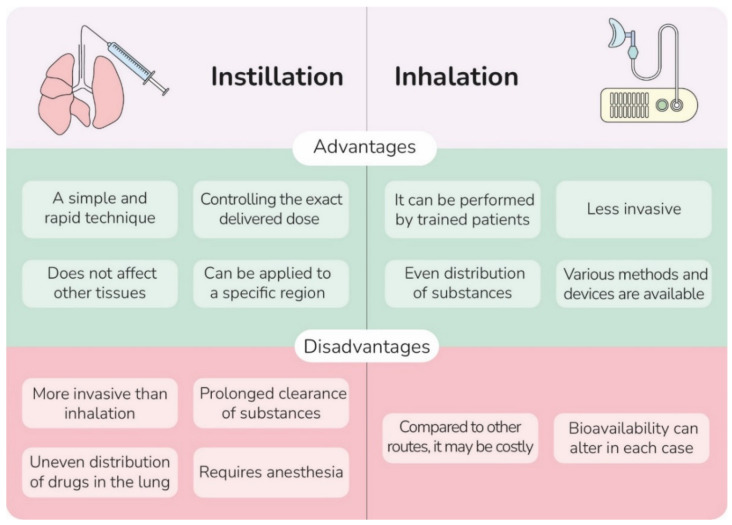
Respiratory diseases are the cause of millions of deaths annually around the world. Despite the recent growth of our understanding of underlying mechanisms contributing to the pathogenesis of lung diseases, most therapeutic approaches are still limited to symptomatic treatments and therapies that only delay disease progression. Several clinical and preclinical studies have suggested stem cell (SC) therapy as a promising approach for treating various lung diseases. However, challenges such as the potential tumorigenicity, the low survival rate of the SCs in the recipient body, and difficulties in cell culturing and storage have limited the applicability of SC therapy. SC-derived extracellular vesicles (SC-EVs), particularly SC-derived exosomes (SC-Exos), exhibit most therapeutic properties of stem cells without their potential drawbacks. Similar to SCs, SC-Exos exhibit immunomodulatory, anti-inflammatory, and antifibrotic properties with the potential to be employed in the treatment of various inflammatory and chronic respiratory diseases. Furthermore, recent studies have demonstrated that the microRNA (miRNA) content of SC-Exos may play a crucial role in the therapeutic potential of these exosomes. Several studies have investigated the administration of SC-Exos via the pulmonary route, and techniques for SCs and SC-Exos delivery to the lungs by intratracheal instillation or inhalation have been developed. Here, we review the literature discussing the therapeutic effects of SC-Exos against respiratory diseases and advances in the pulmonary route of delivery of these exosomes to the damaged tissues.
呼吸系统疾病是全球每年导致数百万人死亡的原因。尽管我们最近对导致肺部疾病发病机制的潜在机制的理解有所增加,但大多数治疗方法仍仅限于对症治疗和只能延缓疾病进展的疗法。几项临床前和临床研究表明,干细胞 (SC) 疗法是治疗各种肺部疾病的一种很有前途的方法。然而,SC 疗法的适用性受到了一些挑战的限制,例如潜在的致瘤性、SC 在受体体内的存活率低,以及细胞培养和储存困难。SC 衍生的细胞外囊泡 (SC-EV),特别是 SC 衍生的外泌体 (SC-Exo),具有干细胞的大多数治疗特性,而没有其潜在的缺点。与 SC 类似,SC-Exo 具有免疫调节、抗炎和抗纤维化特性,有潜力用于治疗各种炎症和慢性呼吸系统疾病。此外,最近的研究表明,SC-Exo 的 microRNA (miRNA) 含量可能在这些外泌体的治疗潜力中发挥关键作用。一些研究已经研究了通过肺途径给予 SC-Exo,并且已经开发了通过气管内滴注或吸入将 SC 和 SC-Exo 递送到肺部的技术。在这里,我们回顾了讨论 SC-Exo 对呼吸系统疾病的治疗作用以及这些外泌体通过肺部途径递送到受损组织的进展的文献。