The Fifth Affiliated Hospital, School of Public Health, Zhengzhou University, Zhengzhou 450000, China.
School of Public Health, Hangzhou Medical College, Hangzhou 310013, China.
Nutrients. 2022 May 27;14(11):2253. doi: 10.3390/nu14112253.
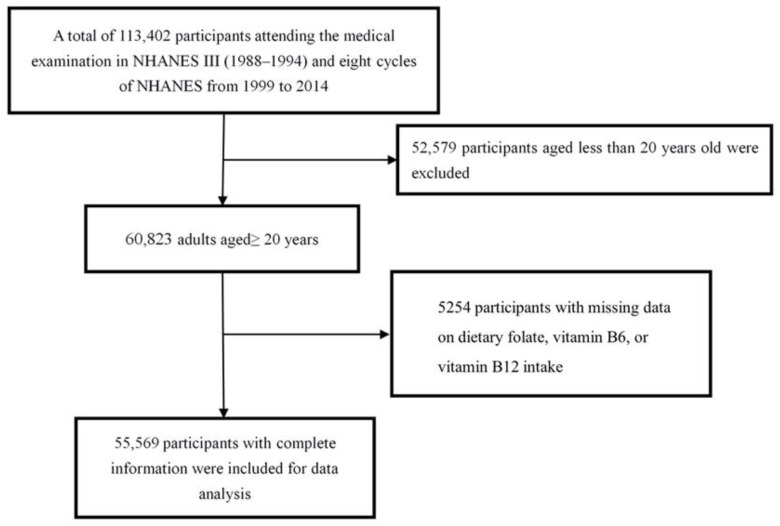
The evidence regarding the intake of dietary folate, vitamin B6, and vitamin B12 in relation to mortality in the general population is limited. This study aimed to examine the relationship between dietary intakes of folate, vitamin B6, and vitamin B12 in relation to all-cause and cause-specific mortality in a large U.S. cohort. This study included a total of 55,569 adults from the Third National Health and Nutrition Examination Survey (NHANES III) and NHANES 1999-2014. Vital data were determined by linking with the National Death Index records through 31 December 2015. Cox proportional hazards models were used to investigate the relationships of all-cause and cause-specific mortality with dietary folate, vitamin B6, and vitamin B12 intake. Dietary intakes of folate and vitamin B6 were inversely associated with mortality from all-cause, cardiovascular disease, and cancer for men and with mortality from all-cause and cardiovascular disease for women. In men, the multivariable hazard ratios (95% confidence intervals) for the highest versus lowest quintiles of folate and vitamin B6 were 0.77 (0.71-0.85) and 0.79 (0.71-0.86) for all-cause mortality, 0.59 (0.48-0.72) and 0.69 (0.56-0.85) for CVD mortality, and 0.68 (0.56-0.84) and 0.73 (0.60-0.90) for cancer mortality, respectively. Among women, the multivariable hazard ratios (95% confidence intervals) for the highest versus lowest quintiles of folate and vitamin B6 were 0.86 (0.78-0.95) and 0.88 (0.80-0.97) for all-cause mortality and 0.53 (0.41-0.69) and 0.56 (0.44-0.73) for CVD mortality, respectively. No significant associations between dietary vitamin B12 and all-cause and cause-specific mortality were observed. In conclusion, higher dietary intakes of folate and vitamin B6 were significantly associated with lower all-cause and cardiovascular mortality. Our findings suggest that increasing the intake of folate and vitamin B6 may lower the mortality risk among U.S. adults.
有关一般人群中膳食叶酸、维生素 B6 和维生素 B12 摄入量与死亡率之间关系的证据有限。本研究旨在探讨美国大型队列中膳食叶酸、维生素 B6 和维生素 B12 摄入量与全因和特定原因死亡率之间的关系。这项研究共纳入了来自第三次全国健康和营养调查(NHANES III)和 1999-2014 年 NHANES 的 55569 名成年人。通过与国家死亡指数记录的链接,确定了截止到 2015 年 12 月 31 日的重要数据。使用 Cox 比例风险模型来研究膳食叶酸、维生素 B6 和维生素 B12 摄入量与全因死亡率、心血管疾病死亡率和癌症死亡率之间的关系。男性中,叶酸和维生素 B6 摄入量最高五分位数与最低五分位数相比,全因死亡率、心血管疾病死亡率和癌症死亡率的多变量危险比(95%置信区间)分别为 0.77(0.71-0.85)和 0.79(0.71-0.86)、0.59(0.48-0.72)和 0.69(0.56-0.85)、0.68(0.56-0.84)和 0.73(0.60-0.90)。对于女性,叶酸和维生素 B6 摄入量最高五分位数与最低五分位数相比,全因死亡率和心血管疾病死亡率的多变量危险比(95%置信区间)分别为 0.86(0.78-0.95)和 0.88(0.80-0.97)、0.53(0.41-0.69)和 0.56(0.44-0.73)。膳食维生素 B12 与全因和特定原因死亡率之间无显著关联。总之,较高的膳食叶酸和维生素 B6 摄入量与全因和心血管死亡率的降低显著相关。我们的研究结果表明,增加叶酸和维生素 B6 的摄入量可能会降低美国成年人的死亡风险。