Essono Mintsa Morel, Otogo N'nang Elvis, Choque Élodie, Siah Ali, Jacquin Justine, Muchembled Jerome, Molinié Roland, Roulard Romain, Cailleu Dominique, Beniddir Mehdi A, Sima Obiang Cédric, Ondo Joseph-Privat, Kumulungui Brice, Mesnard François
UMRt BioEcoAgro 1158-INRAE, BIOPI, Université de Picardie Jules Verne, 1 Rue des Louvels, F-80000 Amiens, France.
Laboratoire de Substances Naturelles, Université des Sciences et Techniques de Masuku, Franceville P.O. Box 943, Gabon.
Plants (Basel). 2022 Jun 3;11(11):1505. doi: 10.3390/plants11111505.
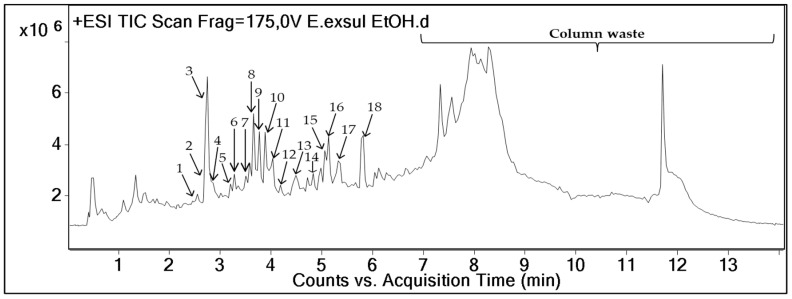
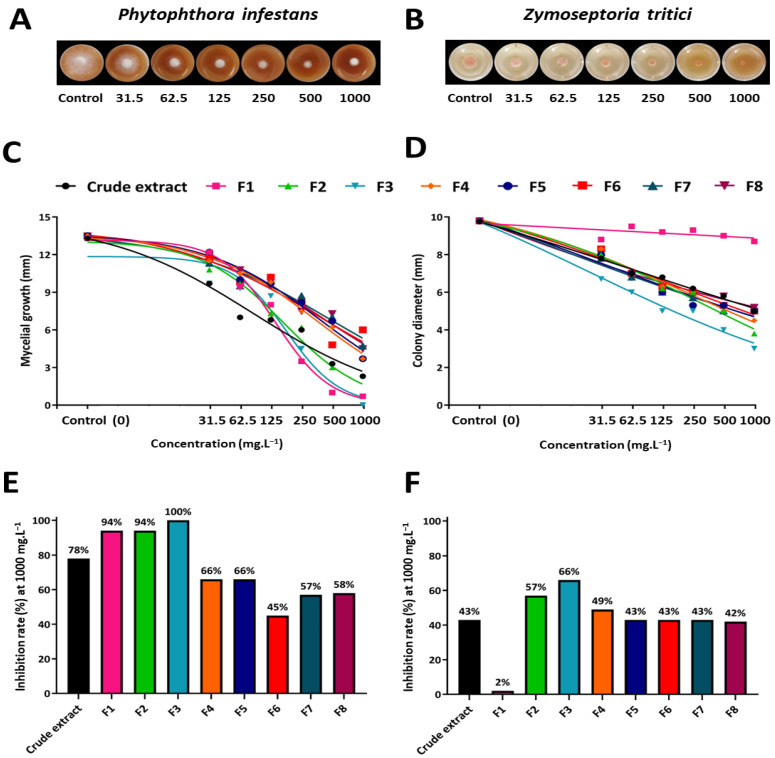
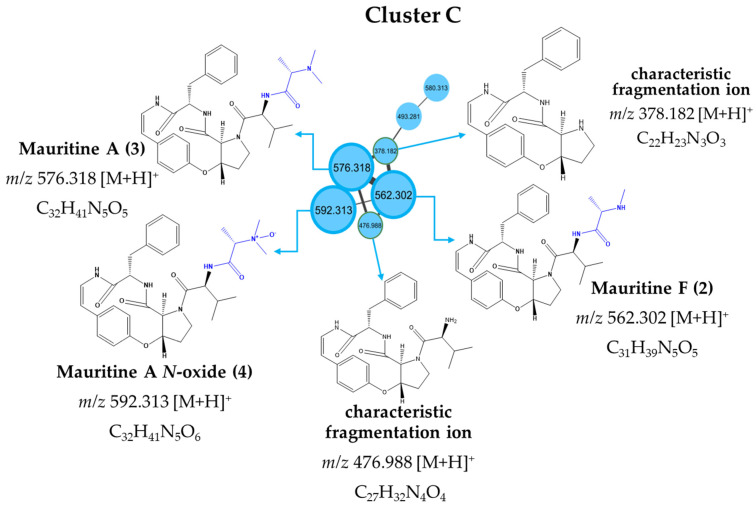
Erismadelphus exsul Mildbr bark is widely used in Gabonese folk medicine. However, little is known about the active compounds associated with its biological activities. In the present study, phytochemical profiling of the ethanolic extract of Erismadelphus exsul was performed using a de-replication strategy by coupling HPLC-ESI-Q/TOF with a molecular network approach. Eight families of natural compounds were putatively identified, including cyclopeptide alkaloids, esterified amino acids, isoflavonoid- and flavonoid-type polyphenols, glycerophospholipids, steroids and their derivatives, and quinoline alkaloids. All these compounds were identified for the first time in this plant. The use of molecular networking obtained a detailed phytochemical overview of this species. Furthermore, antioxidant (2,2-diphenyl-1-picryl-hydrazylhydrate (DPPH) and ferric reducing capacity (FRAP)) and in vitro antimicrobial activities were assessed. The crude extract, as well as fractions obtained from Erismadelphus exsul, showed a better reactivity to FRAP than DPPH. The fractions were two to four times more antioxidant than ascorbic acid while reacting to FRAP, and there was two to nine times less antioxidant than this reference while reacting to DPPH. In addition, several fractions and the crude extract exhibited a significant anti-oomycete activity towards the Solanaceae phytopathogen Phytophthora infestans in vitro, and, at a lower extent, the antifungal activity against the wheat pathogen Zymoseptoria tritici had growth inhibition rates ranging from 0 to 100%, depending on the tested concentration. This study provides new insights into the phytochemical characterization and the bioactivities of ethanolic extract from Erismadelphus exsul bark.
埃氏马岛樟(Erismadelphus exsul Mildbr)树皮在加蓬民间医学中被广泛使用。然而,关于与其生物活性相关的活性化合物却知之甚少。在本研究中,采用液相色谱-电喷雾电离-四极杆/飞行时间质谱联用(HPLC-ESI-Q/TOF)与分子网络方法相结合的去重复策略,对埃氏马岛樟乙醇提取物进行了植物化学分析。初步鉴定出八个天然化合物家族,包括环肽生物碱、酯化氨基酸、异黄酮类和黄酮类多酚、甘油磷脂、甾体及其衍生物以及喹啉生物碱。所有这些化合物均首次在该植物中被鉴定出来。分子网络的应用使我们对该物种的植物化学特征有了详细的了解。此外,还评估了其抗氧化活性(2,2-二苯基-1-苦基肼自由基(DPPH)和铁还原能力(FRAP))以及体外抗菌活性。粗提物以及从埃氏马岛樟中得到的各馏分对FRAP的反应性比对DPPH的反应性更好。各馏分在与FRAP反应时的抗氧化能力是抗坏血酸的两到四倍,而在与DPPH反应时的抗氧化能力比该对照物低两到九倍。此外,几个馏分和粗提物在体外对茄科植物病原菌致病疫霉(Phytophthora infestans)表现出显著的抗卵菌活性,并且在较低程度上对小麦病原菌小麦黄斑叶枯病菌(Zymoseptoria tritici)具有抗真菌活性,其生长抑制率在0%至100%之间,具体取决于测试浓度。本研究为埃氏马岛樟树皮乙醇提取物的植物化学特征和生物活性提供了新的见解。