Liu Xilin, Nawaz Zeeshan, Guo Caixia, Ali Sultan, Naeem Muhammad Ahsan, Jamil Tariq, Ahmad Waqas, Siddiq Muhammad Usman, Ahmed Sarfraz, Asif Idrees Muhammad, Ahmad Ali
Department of Hand Surgery, Presidents' Office of China-Japan Union Hospital of Jilin University, Changchun, China.
Department of Microbiology, Government College University Faisalabad, Faisalabad, Pakistan.
Front Vet Sci. 2022 May 13;9:889873. doi: 10.3389/fvets.2022.889873. eCollection 2022.
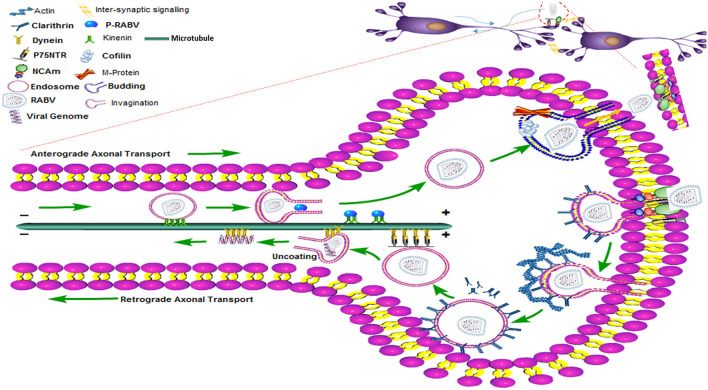
Rabies virus (RABV) is a cunning neurotropic pathogen and causes top priority neglected tropical diseases in the developing world. The genome of RABV consists of nucleoprotein (N), phosphoprotein (P), matrix protein (M), glycoprotein (G), and RNA polymerase L protein (L), respectively. The virus causes neuronal dysfunction instead of neuronal cell death by deregulating the polymerization of the actin and microtubule cytoskeleton and subverts the associated binding and motor proteins for efficient viral progression. These binding proteins mainly maintain neuronal structure, morphology, synaptic integrity, and complex neurophysiological pathways. However, much of the exact mechanism of the viral-cytoskeleton interaction is yet unclear because several binding proteins of the actin-microtubule cytoskeleton are involved in multifaceted pathways to influence the retrograde and anterograde axonal transport of RABV. In this review, all the available scientific results regarding cytoskeleton elements and their possible interactions with RABV have been collected through systematic methodology, and thereby interpreted to explain sneaky features of RABV. The aim is to envisage the pathogenesis of RABV to understand further steps of RABV progression inside the cells. RABV interacts in a number of ways with the cell cytoskeleton to produce degenerative changes in the biochemical and neuropathological trails of neurons and other cell types. Briefly, RABV changes the gene expression of essential cytoskeleton related proteins, depolymerizes actin and microtubules, coordinates the synthesis of inclusion bodies, manipulates microtubules and associated motors proteins, and uses actin for clathrin-mediated entry in different cells. Most importantly, the P is the most intricate protein of RABV that performs complex functions. It artfully operates the dynein motor protein along the tracks of microtubules to assist the replication, transcription, and transport of RABV until its egress from the cell. New remedial insights at subcellular levels are needed to counteract the destabilization of the cytoskeleton under RABV infection to stop its life cycle.
狂犬病病毒(RABV)是一种狡猾的嗜神经病原体,在发展中世界导致了最受关注的被忽视热带病。RABV的基因组分别由核蛋白(N)、磷蛋白(P)、基质蛋白(M)、糖蛋白(G)和RNA聚合酶L蛋白(L)组成。该病毒通过破坏肌动蛋白和微管细胞骨架的聚合来导致神经元功能障碍而非神经元细胞死亡,并颠覆相关的结合蛋白和运动蛋白以实现高效的病毒进展。这些结合蛋白主要维持神经元结构、形态、突触完整性以及复杂的神经生理途径。然而,病毒与细胞骨架相互作用的确切机制仍不清楚,因为肌动蛋白 - 微管细胞骨架的几种结合蛋白参与了多方面途径来影响RABV的逆行和顺行轴突运输。在本综述中,通过系统方法收集了所有关于细胞骨架成分及其与RABV可能相互作用的现有科学结果,并据此进行解释以阐明RABV的狡猾特性。目的是设想RABV的发病机制,以了解其在细胞内进展的进一步步骤。RABV以多种方式与细胞骨架相互作用,从而在神经元和其他细胞类型的生化和神经病理学轨迹中产生退行性变化。简而言之,RABV改变与细胞骨架相关的必需蛋白的基因表达,使肌动蛋白和微管解聚,协调包涵体的合成,操纵微管和相关的运动蛋白,并利用肌动蛋白通过网格蛋白介导进入不同细胞。最重要的是,P是RABV中最复杂的蛋白,具有复杂的功能。它巧妙地沿着微管轨道操纵动力蛋白,以协助RABV的复制、转录和运输,直至其从细胞中释放。需要在亚细胞水平上获得新的治疗见解,以对抗RABV感染下细胞骨架的不稳定,从而阻止其生命周期。