Leng Qingyang, Zhou Jianhua, Li Chang, Xu Yanhong, Liu Lu, Zhu Yi, Yang Ying, Zhang Hongli, Li Xiaohua
Department of Endocrinology, Seventh People's Hospital of Shanghai University of Traditional Chinese Medicine, Shanghai, China.
Department of Endocrinology and Metabolism, Shanghai Clinical Center for Diabetes, Shanghai Key Clinical Center for Metabolic Disease, Shanghai Diabetes Institute, Shanghai Key Laboratory of Diabetes Mellitus, Shanghai Jiao Tong University Affiliated Sixth People's Hospital, Shanghai, China.
Nutr Metab (Lond). 2022 Jun 11;19(1):38. doi: 10.1186/s12986-022-00672-6.
Promoting the browning of white adipose tissue (WAT) is a promising approach for the treatment of obesity and related comorbidities because it increases energy expenditure. In this study, we investigated whether Dihydromyricetin (DHM), a flavonoid component, could ameliorate diet-induced obesity through promoting the browning of WAT.
Male C57BL/6 J mice were received a high-fat diet (HFD) to induce obesity and subsequently were treated with DHM (100 mg/kg/day) or vehicle for 4 weeks. The effects of DHM on weight reduction and metabolic phenotype improvement were observed in the mice. The expression of genes and protein involved in browning of WAT were assessed in inguinal WAT (iWAT) of the mice. Then, the effect of DHM on the inducing browning program was verified in adipocytes differentiated from stromal vascular fraction (SVF) cells of mouse iWAT. Finally, the mechanism by which DHM improves the browning of WAT was explored using RNA-seq and luciferase reporter assay.
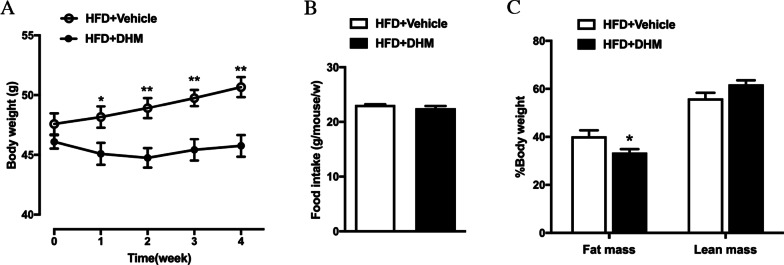
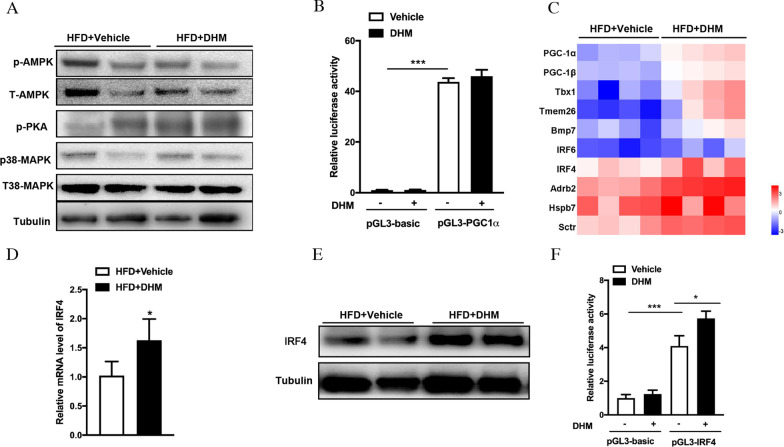
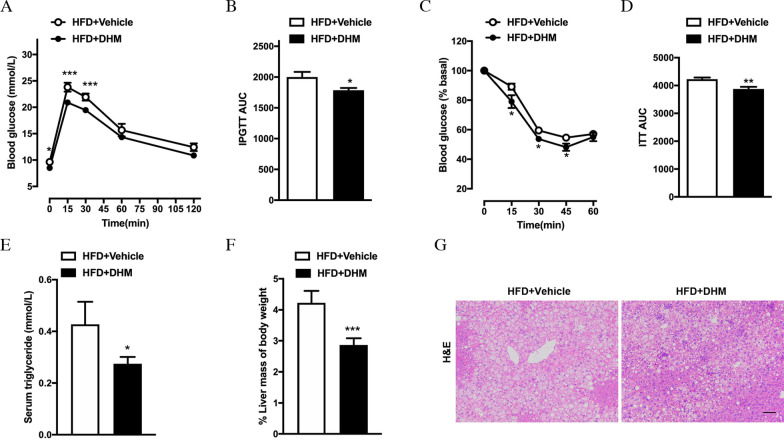
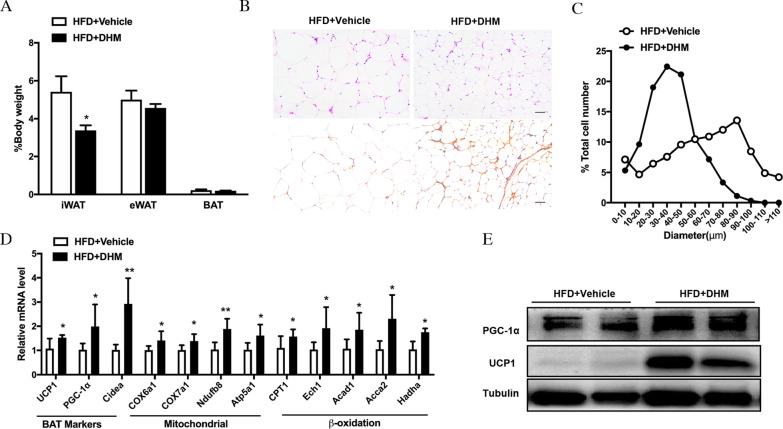
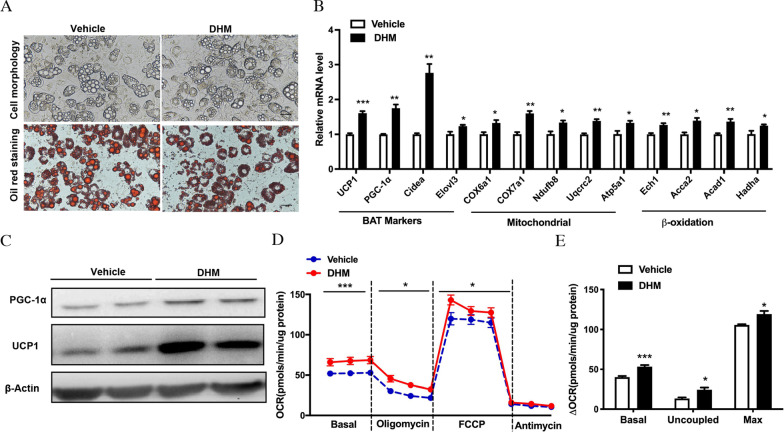
We find that DHM reduces body weight, decreases WAT mass, improves glucose and lipid metabolic disorders, and ameliorates hepatic steatosis in diet-induced obese (DIO) mice. Further studies show that DHM induces WAT browning, which is manifested by increased expression of uncoupling protein 1 (UCP1) and peroxisome proliferator-activated receptor gamma coactivator (PGC)-1α and enhanced mitochondrial activity in iWAT and primary adipocytes. In addition, we also find that DHM enhances interferon regulatory factor 4 (IRF4) expression, which is a key transcriptional regulator of PGC-1α.
Our findings identify that DHM prevents obesity by inducing the browning of WAT through the upregulation of IRF4/PGC-1α, which may have potential therapeutic implications for the treatment of obesity.
促进白色脂肪组织(WAT)褐变是治疗肥胖症及相关合并症的一种有前景的方法,因为它能增加能量消耗。在本研究中,我们调查了黄酮类成分二氢杨梅素(DHM)是否能通过促进WAT褐变来改善饮食诱导的肥胖。
雄性C57BL/6 J小鼠接受高脂饮食(HFD)以诱导肥胖,随后用DHM(100毫克/千克/天)或溶剂处理4周。观察DHM对小鼠体重减轻和代谢表型改善的影响。评估小鼠腹股沟白色脂肪组织(iWAT)中与WAT褐变相关的基因和蛋白质表达。然后,在从小鼠iWAT的基质血管成分(SVF)细胞分化而来的脂肪细胞中验证DHM对诱导褐变程序的影响。最后,使用RNA测序和荧光素酶报告基因检测探究DHM改善WAT褐变的机制。
我们发现DHM可减轻饮食诱导的肥胖(DIO)小鼠的体重,减少WAT量,改善葡萄糖和脂质代谢紊乱,并减轻肝脂肪变性。进一步研究表明,DHM诱导WAT褐变,表现为iWAT和原代脂肪细胞中解偶联蛋白1(UCP1)和过氧化物酶体增殖物激活受体γ共激活因子(PGC)-1α表达增加以及线粒体活性增强。此外,我们还发现DHM增强了干扰素调节因子4(IRF4)的表达,IRF4是PGC-1α的关键转录调节因子。
我们的研究结果表明,DHM通过上调IRF4/PGC-1α诱导WAT褐变来预防肥胖,这可能对肥胖症的治疗具有潜在的治疗意义。