Chen Yangcan, Hu Yanping, Wang Xinge, Luo Shengqiu, Yang Ning, Chen Yi, Li Zhikun, Zhou Qi, Li Wei
State Key Laboratory of Stem Cell and Reproductive Biology, Institute of Zoology, Chinese Academy of Sciences, Beijing 100101, China.
University of Chinese Academy of Sciences, Beijing 100049, China.
Innovation (Camb). 2022 May 26;3(4):100264. doi: 10.1016/j.xinn.2022.100264. eCollection 2022 Jul 12.
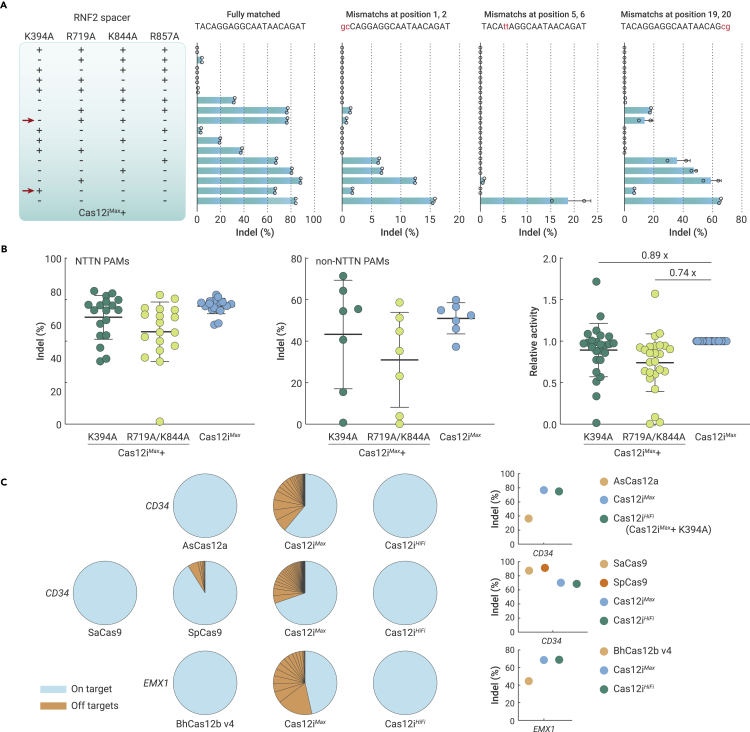
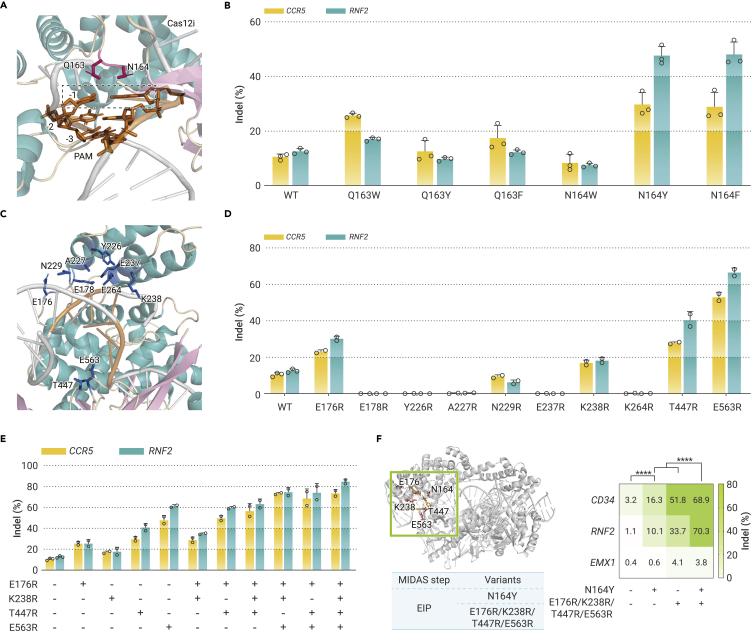
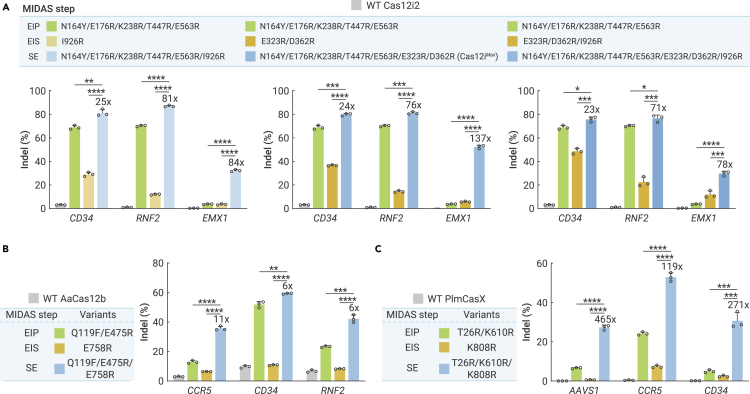
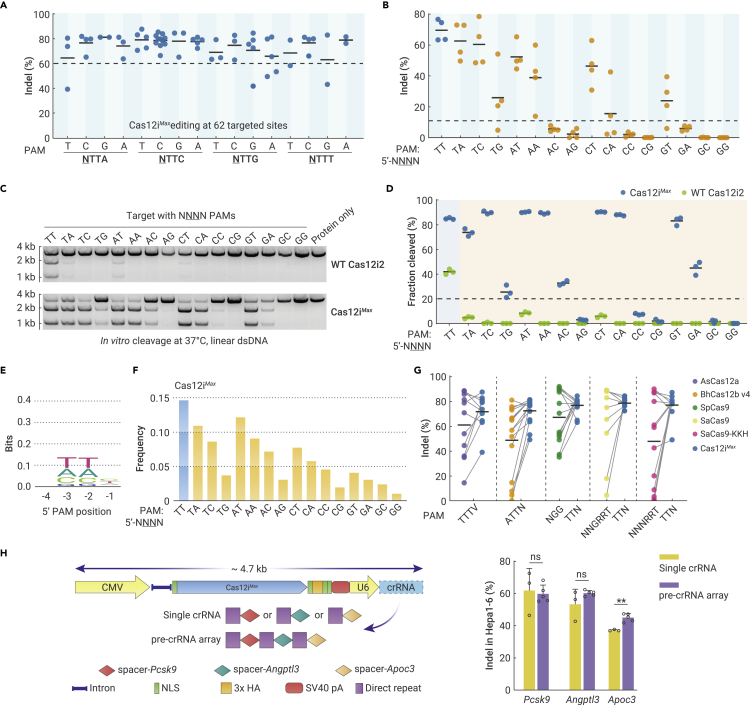
The naturally occurring prokaryotic CRISPR-Cas systems provide valuable resources for the development of new genome-editing tools. However, the majority of prokaryotic Cas nucleases exhibit poor editing efficiency in mammalian cells, which significantly limits their utility. Here, we have developed a method termed Improving Editing Activity by Synergistic Engineering (MIDAS). This method exerts a synergistic effect to improve mammalian genome-editing efficiency of a wide range of CRISPR-Cas systems by enhancing the interactions between Cas nuclease with the protospacer adjacent motif (PAM) and the single-stranded DNA (ssDNA) substrate in the catalytic pocket simultaneously. MIDAS robustly and significantly increased the gene-editing efficiency of Cas12i, Cas12b, and CasX in human cells. Notably, a Cas12i variant, Cas12i , exhibited robust activity with a very broad PAM range (NTNN, NNTN, NAAN, and NCAN) and higher efficiency than the current widely used Cas nucleases. A high-fidelity version of Cas12i (Cas12i ) has been further engineered to minimize off-target effects. Our work provides an expandable and efficacious method for engineering Cas nucleases for robust mammalian genome editing.
天然存在的原核生物CRISPR-Cas系统为开发新的基因组编辑工具提供了宝贵资源。然而,大多数原核生物Cas核酸酶在哺乳动物细胞中的编辑效率较低,这显著限制了它们的实用性。在此,我们开发了一种名为“通过协同工程提高编辑活性”(MIDAS)的方法。该方法通过同时增强Cas核酸酶与原间隔序列相邻基序(PAM)以及催化口袋中单链DNA(ssDNA)底物之间的相互作用,发挥协同效应来提高多种CRISPR-Cas系统在哺乳动物中的基因组编辑效率。MIDAS显著且有力地提高了人细胞中Cas12i、Cas12b和CasX的基因编辑效率。值得注意的是,一种Cas12i变体Cas12i 具有很强的活性,其PAM范围非常广泛(NTNN、NNTN、NAAN和NCAN),且效率高于目前广泛使用的Cas核酸酶。我们进一步构建了高保真版本的Cas12i (Cas12i )以尽量减少脱靶效应。我们的工作为构建用于高效哺乳动物基因组编辑的Cas核酸酶提供了一种可扩展且有效的方法。