Ohira Ryosuke, Yanagawa Masahiro, Suzuki Yuki, Hata Akinori, Miyata Tomo, Kikuchi Noriko, Yoshida Yuriko, Yamagata Kazuki, Doi Shuhei, Ninomiya Keisuke, Tomiyama Noriyuki
Department of Radiology, Osaka University Graduate School of Medicine, Osaka, Japan.
Department of Artificial Intelligence Diagnostic Radiology, Osaka University Graduate School of Medicine, Osaka, Japan.
J Thorac Dis. 2022 May;14(5):1342-1352. doi: 10.21037/jtd-21-1948.
The purpose of our study was to differentiate between thymoma and thymic carcinoma using a radiomics analysis based on the computed tomography (CT) image features.
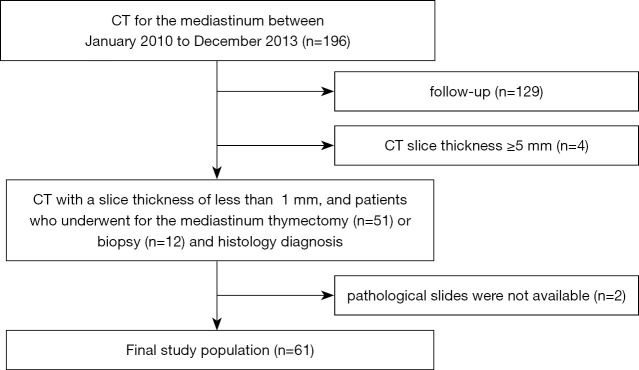
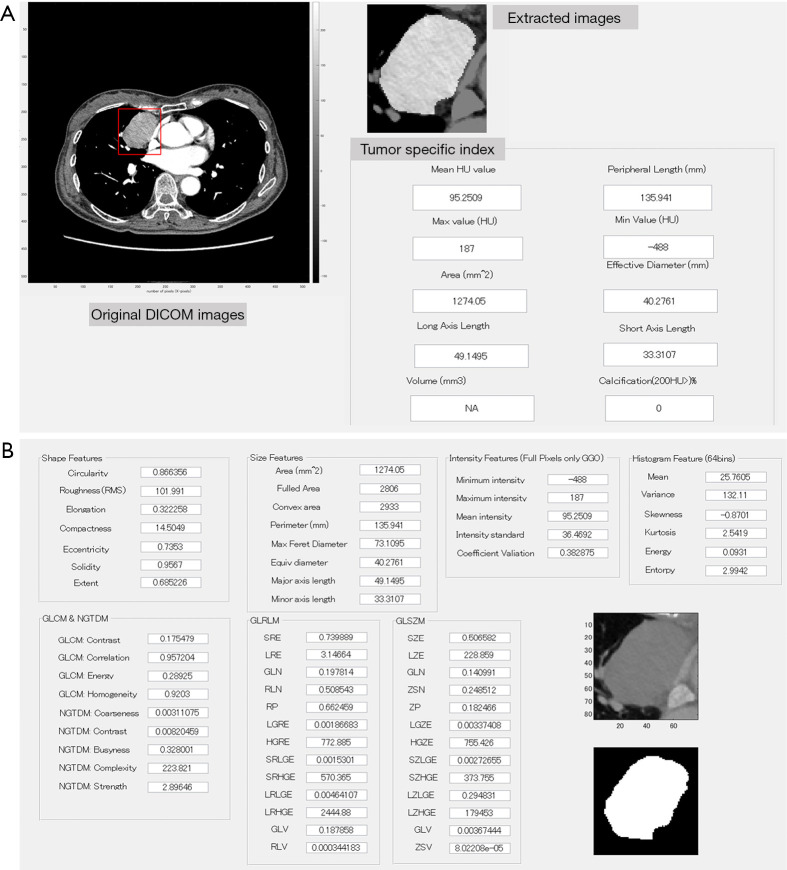
The CT images of 61 patients with thymic epithelial tumors (TETs) who underwent contrast-enhanced CT with slice thickness <1 mm were analyzed. Pathological examination of the surgical specimens revealed thymoma in 45 and thymic carcinoma in 16. Tumor volume and the ratio of major axis to minor axis were calculated using a computer-aided diagnostic software. Sixty-one different radiomics features in the segmented CT images were extracted, then filtered and minimized by least absolute shrinkage and selection operator (LASSO) regression to select the optimal radiomics features for predicting thymic carcinoma. The association between the quantitative values and a diagnosis of thymic carcinoma were analyzed with logistic regression models. Parameters identified as significant in univariate analysis were included in multiple analyses. Receiver-operating characteristic (ROC) curves were assessed to evaluate the diagnostic performance.
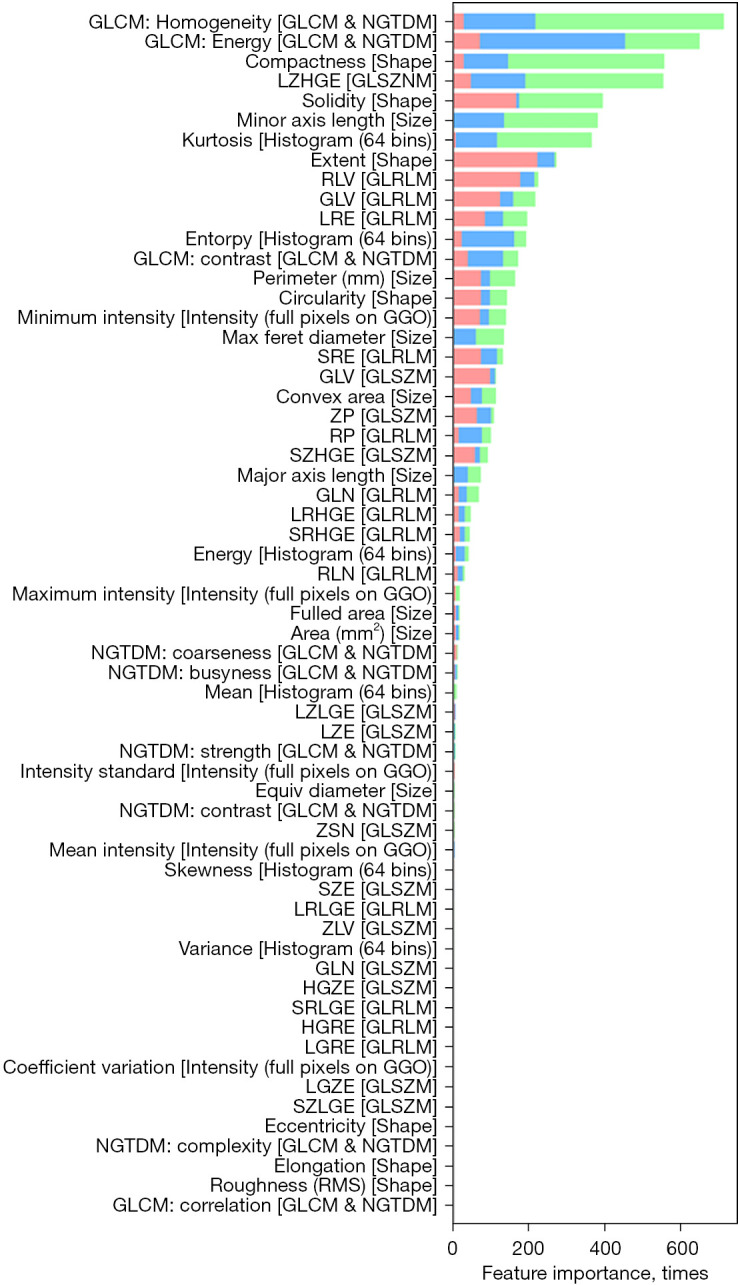
Thymic carcinoma was significantly predominant in men (P=0.001). Optimal radiomics features for predicting thymic carcinoma were as follows: gray-level co-occurrence matrix (GLCM)-homogeneity, GLCM-energy, compactness, large zone high gray-level emphasis (LZHGE), solidity, size of minor axis, and kurtosis. Multiple logistic regression analysis of these features revealed solidity and GLCM-energy as independent indicators associated with thymic carcinoma [odds ratio, 14.7 and 14.3; 95% confidence interval (CI): 1.6-139.0 and 3.0-68.7; and P=0.045 and 0.002, respectively]. Area under the curve (AUC) for diagnosing thymic carcinoma was 0.882 (sensitivity, 81.2%; specificity, 91.1%). Multivariate analysis adjusted for sex similarly revealed two features (solidity and GLCM-energy) as independent indicators associated with thymic carcinoma (odds ratio, 14.6 and 23.9; 95% CI: 2.4-89.2 and 1.9-302.8; P=0.004 and 0.014, respectively). Adjusted AUC for diagnosing thymic carcinoma was 0.921 (95% CI: 0.82-0.97): sensitivity, 62.5% and specificity, 100%.
Two texture features (GLCM-energy and solidity) were significant predictors of thymic carcinoma.
我们研究的目的是基于计算机断层扫描(CT)图像特征,通过放射组学分析区分胸腺瘤和胸腺癌。
分析了61例接受层厚<1mm的增强CT检查的胸腺上皮肿瘤(TET)患者的CT图像。手术标本的病理检查显示45例为胸腺瘤,16例为胸腺癌。使用计算机辅助诊断软件计算肿瘤体积和长轴与短轴之比。在分割的CT图像中提取61种不同的放射组学特征,然后通过最小绝对收缩和选择算子(LASSO)回归进行过滤和最小化,以选择预测胸腺癌的最佳放射组学特征。使用逻辑回归模型分析定量值与胸腺癌诊断之间的关联。在单变量分析中确定为显著的参数纳入多变量分析。评估受试者操作特征(ROC)曲线以评估诊断性能。
胸腺癌在男性中显著居多(P=0.001)。预测胸腺癌的最佳放射组学特征如下:灰度共生矩阵(GLCM)-同质性、GLCM-能量、紧密度、大区域高灰度强调(LZHGE)、实性、短轴大小和峰度。对这些特征进行多变量逻辑回归分析,结果显示实性和GLCM-能量是与胸腺癌相关的独立指标[比值比分别为14.7和14.3;95%置信区间(CI):1.6-139.0和3.0-68.7;P分别为0.045和0.002]。诊断胸腺癌的曲线下面积(AUC)为0.882(敏感性为81.2%;特异性为91.1%)。对性别进行校正的多变量分析同样显示两个特征(实性和GLCM-能量)是与胸腺癌相关的独立指标(比值比分别为14.6和23.9;95%CI:2.4-89.2和1.9-302.8;P分别为0.004和0.014)。校正后诊断胸腺癌的AUC为0.921(95%CI:0.82-0.97):敏感性为62.5%,特异性为100%。
两个纹理特征(GLCM-能量和实性)是胸腺癌的重要预测指标。