Khan Ikram, Khan Imran, Kakakhel Mian Adnan, Xiaowei Zhang, Ting Mao, Ali Ikram, Fei Yu, Jianye Zhou, Zhiqiang Li, Lizhe An
School of Life Sciences, Lanzhou University, Lanzhou, China.
School of Stomatology, Northwest Minzu University, Lanzhou, China.
Front Microbiol. 2022 May 25;13:845038. doi: 10.3389/fmicb.2022.845038. eCollection 2022.
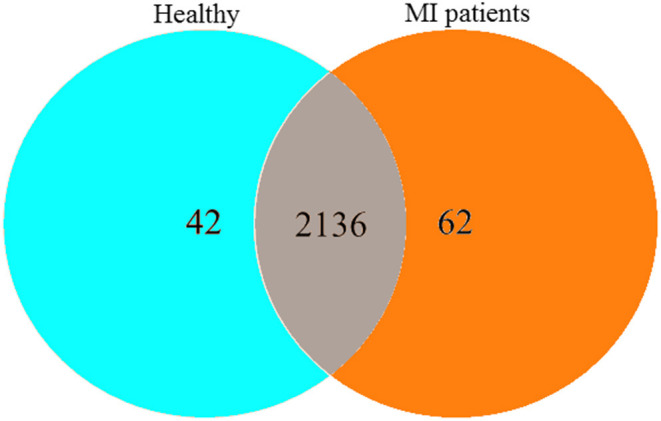
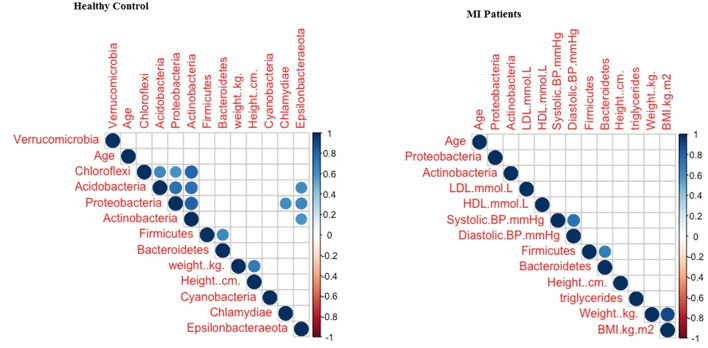
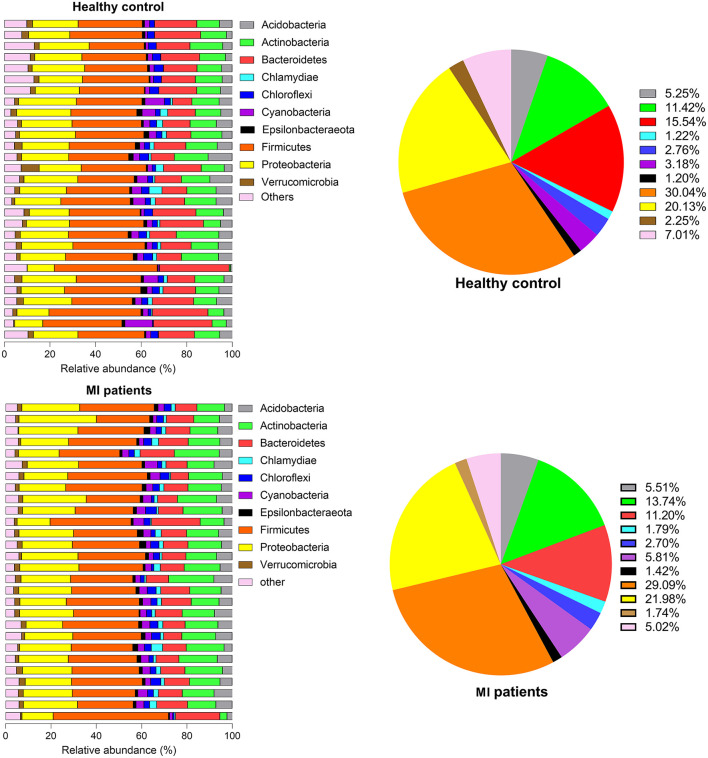
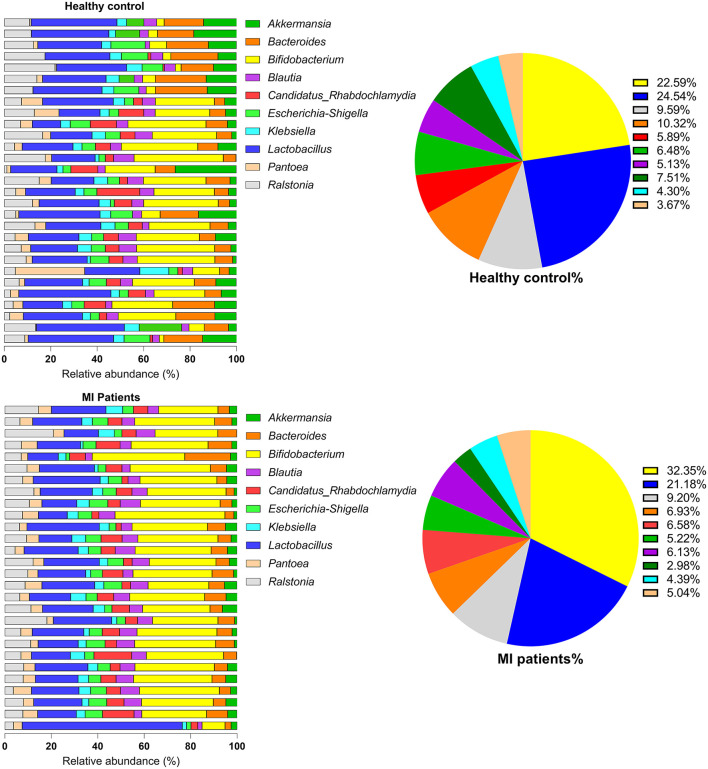
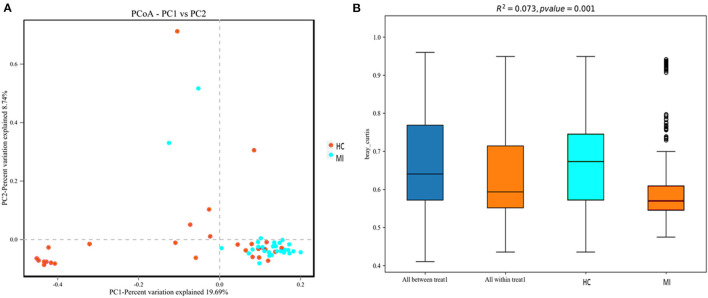
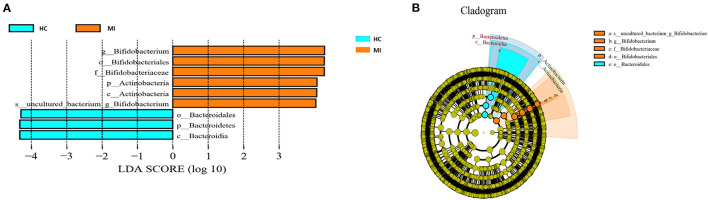
Increased bacterial translocation in the gut and bloodstream infections are both major comorbidities of heart failure and myocardial infarction (MI). However, the alterations in the microbiome of the blood of patients with MI remain unclear. To test this hypothesis, we conducted this case-control study to explore the microbiota compositions in the blood of Chinese patients with MI. Using high-throughput Illumina HiSeq sequencing targeting the V3-V4 region of the 16S ribosomal RNA (rRNA) gene, the microbiota communities in the blood of 29 patients with MI and 29 healthy controls were examined. In addition, the relationship between the blood microbiome and clinical features of MI was investigated. This study revealed a significant reduction in alpha diversity (Shannon index) in the MI group compared with the healthy controls. Also, a significant difference was detected in the structure and richness between the patients with MI and healthy controls. The members of the phylum Actinobacteria, class Actinobacteria, order Bifdobacteriales, family Bifidobacteriaceae, and genus were significantly abundant in the MI group, while the members of the phylum Bacteroidetes, class Bacteroidia, and order Bacteroidales were significantly enriched in the healthy controls ( < 0.05). Moreover, the functional analysis revealed a significant variation between both groups. For instance, the enrichment of genes involved in the metabolism pathways of three amino acids decreased, that is, nucleotide transport and metabolism, coenzyme transport and metabolism, and lipid transport and metabolism, among others. Our study will contribute to a better knowledge of the microbiota of blood, which will further lead to improved MI diagnosis and therapy. Further study is needed to determine the role of the blood microbiota in human health and disease.
肠道细菌易位增加和血流感染都是心力衰竭和心肌梗死(MI)的主要合并症。然而,MI患者血液中微生物群的变化仍不清楚。为了验证这一假设,我们进行了这项病例对照研究,以探索中国MI患者血液中的微生物群组成。使用针对16S核糖体RNA(rRNA)基因V3-V4区域的高通量Illumina HiSeq测序,检测了29例MI患者和29例健康对照者血液中的微生物群落。此外,还研究了血液微生物群与MI临床特征之间的关系。本研究显示,与健康对照相比,MI组的α多样性(香农指数)显著降低。此外,在MI患者和健康对照者之间检测到结构和丰富度的显著差异。放线菌门、放线菌纲、双歧杆菌目、双歧杆菌科和属的成员在MI组中显著丰富,而拟杆菌门、拟杆菌纲和拟杆菌目的成员在健康对照中显著富集(<0.05)。此外,功能分析显示两组之间存在显著差异。例如,参与三种氨基酸代谢途径的基因富集减少,即核苷酸转运和代谢、辅酶转运和代谢以及脂质转运和代谢等。我们的研究将有助于更好地了解血液微生物群,这将进一步改善MI的诊断和治疗。需要进一步研究以确定血液微生物群在人类健康和疾病中的作用。