Department of Radiology, Tongji Hospital, Tongji Medical College, Huazhong University of Science and Technology, Wuhan, China.
Department of Artificial Intelligence, Julei Technology, Wuhan, China.
Korean J Radiol. 2022 Aug;23(8):811-820. doi: 10.3348/kjr.2022.0160. Epub 2022 May 27.
To develop a model incorporating radiomic features and clinical factors to accurately predict acute ischemic stroke (AIS) outcomes.
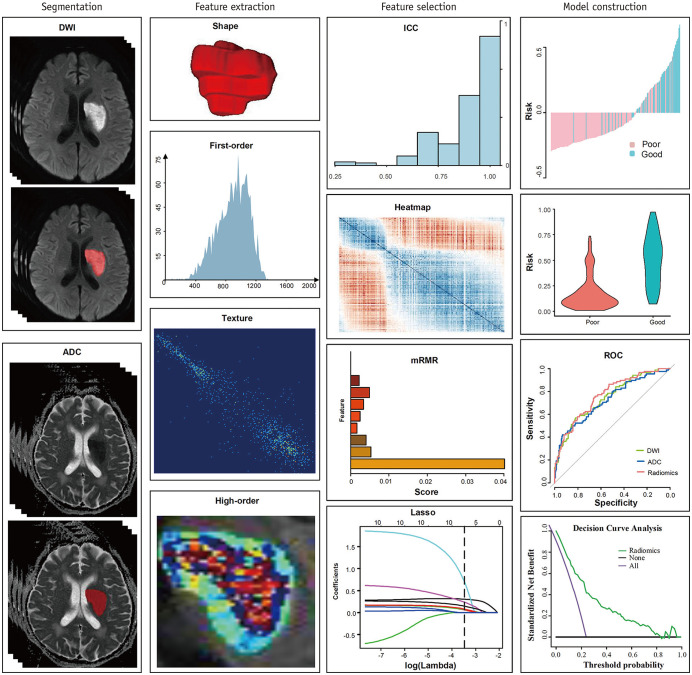
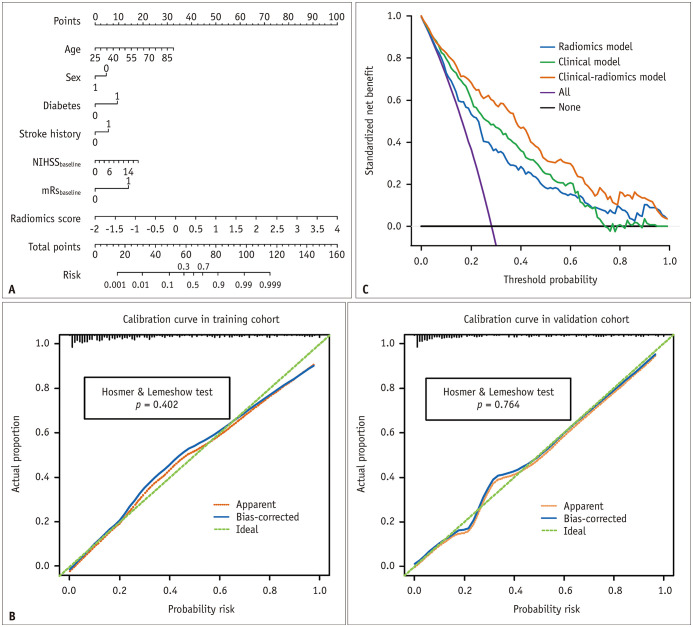
Data from 522 AIS patients (382 male [73.2%]; mean age ± standard deviation, 58.9 ± 11.5 years) were randomly divided into the training (n = 311) and validation cohorts (n = 211). According to the modified Rankin Scale (mRS) at 6 months after hospital discharge, prognosis was dichotomized into good (mRS ≤ 2) and poor (mRS > 2); 1310 radiomics features were extracted from diffusion-weighted imaging and apparent diffusion coefficient maps. The minimum redundancy maximum relevance algorithm and the least absolute shrinkage and selection operator logistic regression method were implemented to select the features and establish a radiomics model. Univariable and multivariable logistic regression analyses were performed to identify the clinical factors and construct a clinical model. Ultimately, a multivariable logistic regression analysis incorporating independent clinical factors and radiomics score was implemented to establish the final combined prediction model using a backward step-down selection procedure, and a clinical-radiomics nomogram was developed. The models were evaluated using calibration, receiver operating characteristic (ROC), and decision curve analyses.
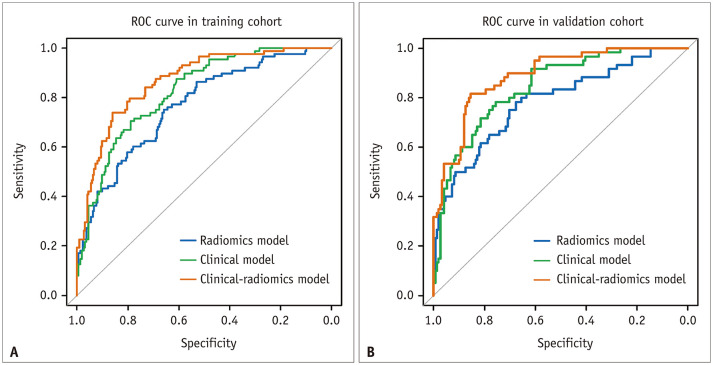
Age, sex, stroke history, diabetes, baseline mRS, baseline National Institutes of Health Stroke Scale score, and radiomics score were independent predictors of AIS outcomes. The area under the ROC curve of the clinical-radiomics model was 0.868 (95% confidence interval, 0.825-0.910) in the training cohort and 0.890 (0.844-0.936) in the validation cohort, which was significantly larger than that of the clinical or radiomics models. The clinical radiomics nomogram was well calibrated ( > 0.05). The decision curve analysis indicated its clinical usefulness.
The clinical-radiomics model outperformed individual clinical or radiomics models and achieved satisfactory performance in predicting AIS outcomes.
开发一种结合放射组学特征和临床因素的模型,以准确预测急性缺血性脑卒中(AIS)的结局。
将 522 例 AIS 患者(男 382 例[73.2%];平均年龄±标准差,58.9±11.5 岁)的数据随机分为训练队列(n=311)和验证队列(n=211)。根据出院后 6 个月的改良 Rankin 量表(mRS)评分,预后分为良好(mRS≤2)和不良(mRS>2);从弥散加权成像和表观弥散系数图中提取 1310 个放射组学特征。采用最小冗余最大相关性算法和最小绝对收缩和选择算子逻辑回归方法选择特征并建立放射组学模型。进行单变量和多变量逻辑回归分析,以确定临床因素并构建临床模型。最后,采用向后逐步选择程序进行多变量逻辑回归分析,纳入独立的临床因素和放射组学评分,建立最终的联合预测模型,并开发临床-放射组学列线图。采用校准、受试者工作特征(ROC)和决策曲线分析评估模型。
年龄、性别、卒中史、糖尿病、基线 mRS、基线国立卫生研究院卒中量表评分和放射组学评分是 AIS 结局的独立预测因素。在训练队列中,临床-放射组学模型的 ROC 曲线下面积为 0.868(95%置信区间,0.825-0.910),在验证队列中为 0.890(0.844-0.936),明显大于临床或放射组学模型。临床-放射组学列线图具有良好的校准度(>0.05)。决策曲线分析表明其具有临床应用价值。
临床-放射组学模型优于单独的临床或放射组学模型,在预测 AIS 结局方面表现出令人满意的性能。