Haghighi Fatemeh, Hosseinzadeh Taher Mohammad Reza, Zhou Zongwei, Gotway Michael B, Liang Jianming
Arizona State University, Tempe AZ 85281, USA.
Mayo Clinic, Scottsdale AZ 85259, USA.
Med Image Comput Comput Assist Interv. 2020 Oct;12261:137-147. doi: 10.1007/978-3-030-59710-8_14. Epub 2020 Sep 29.
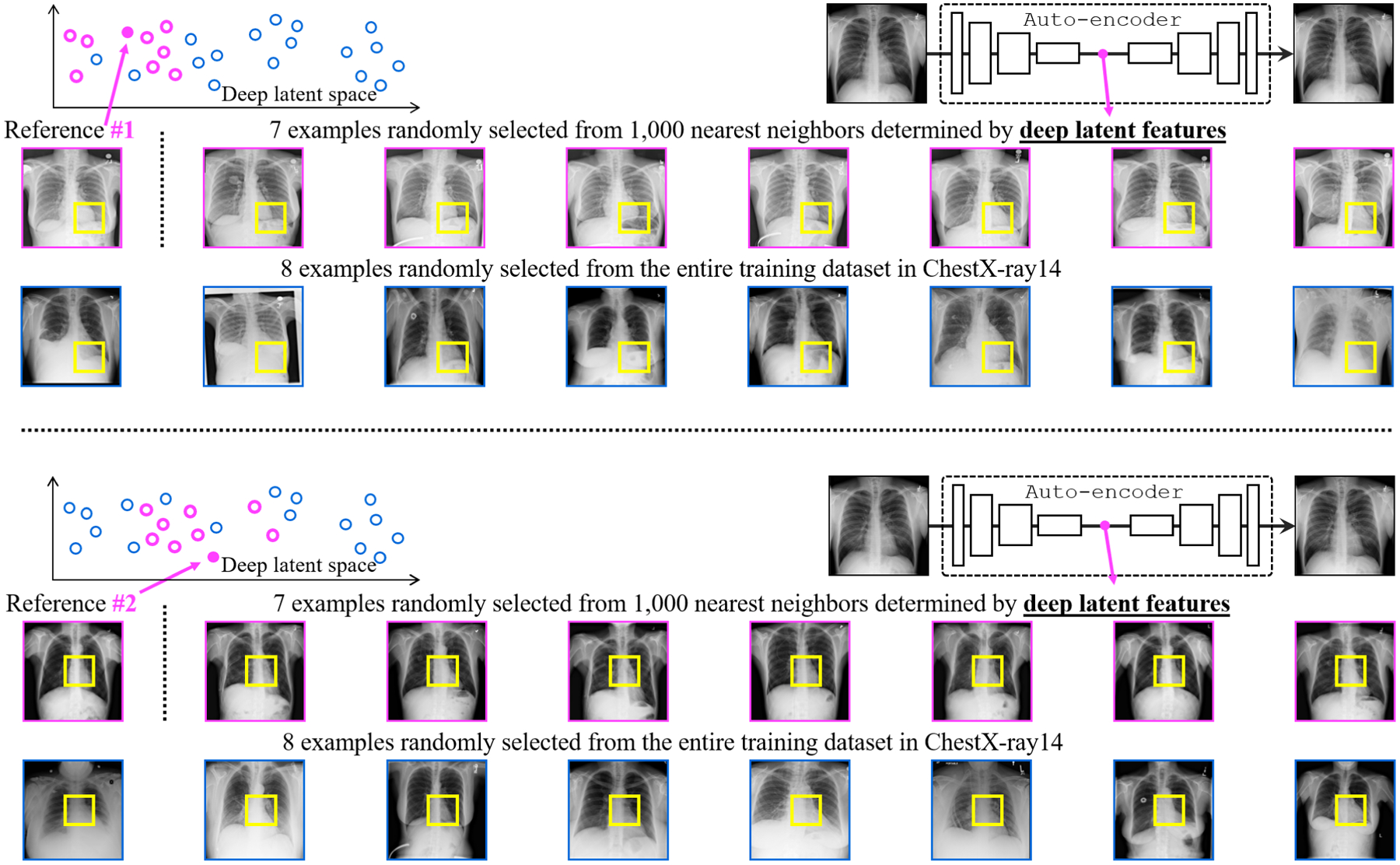
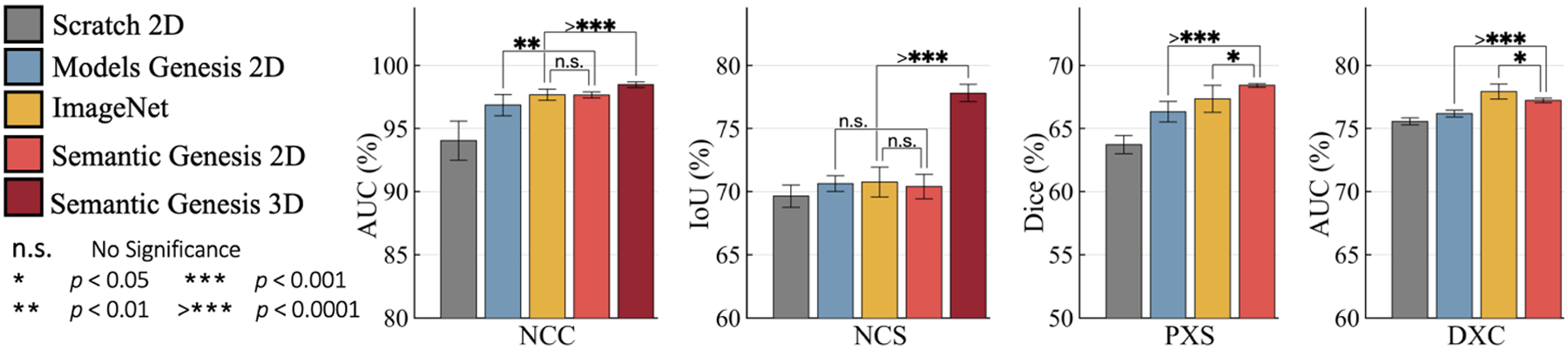
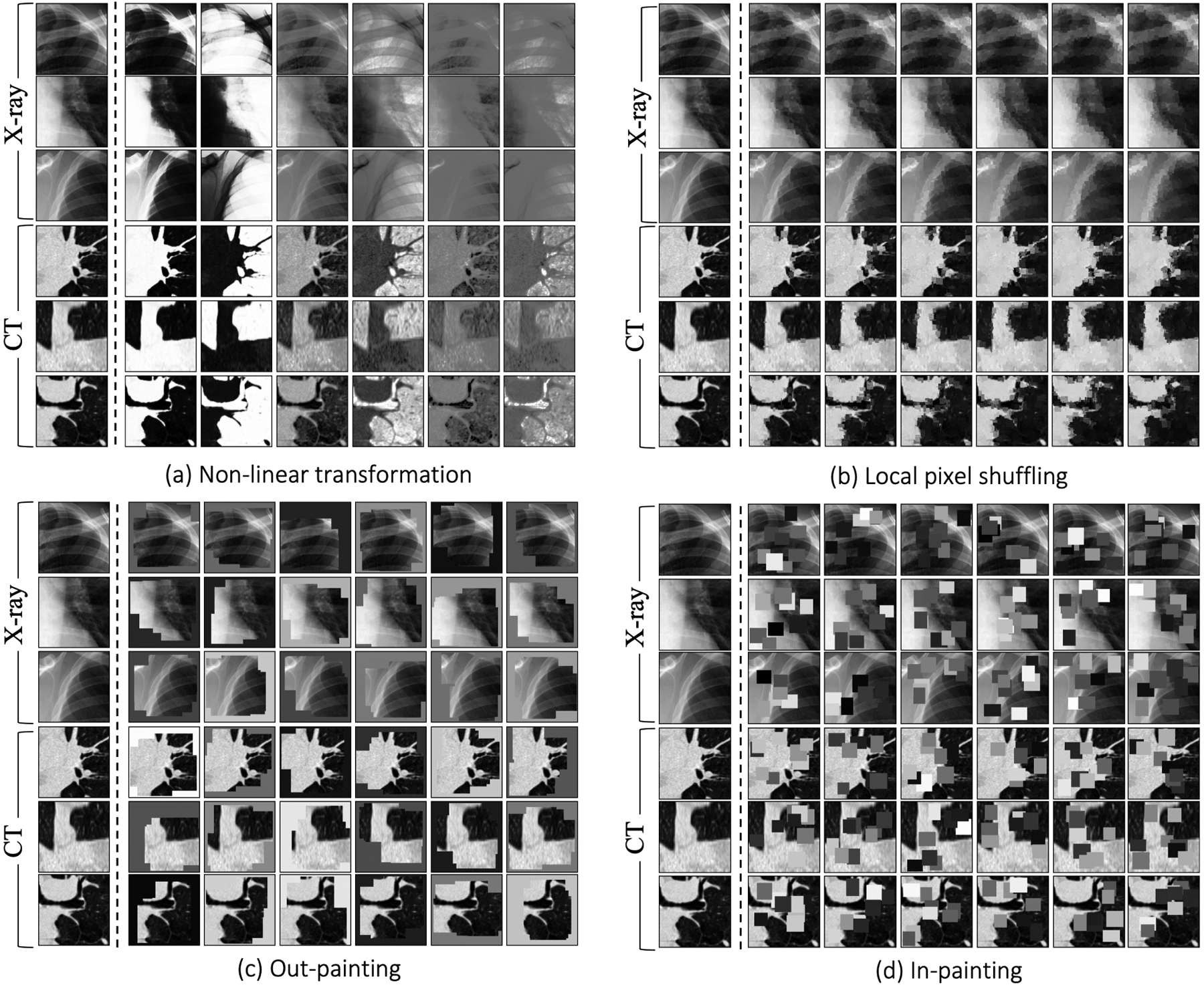
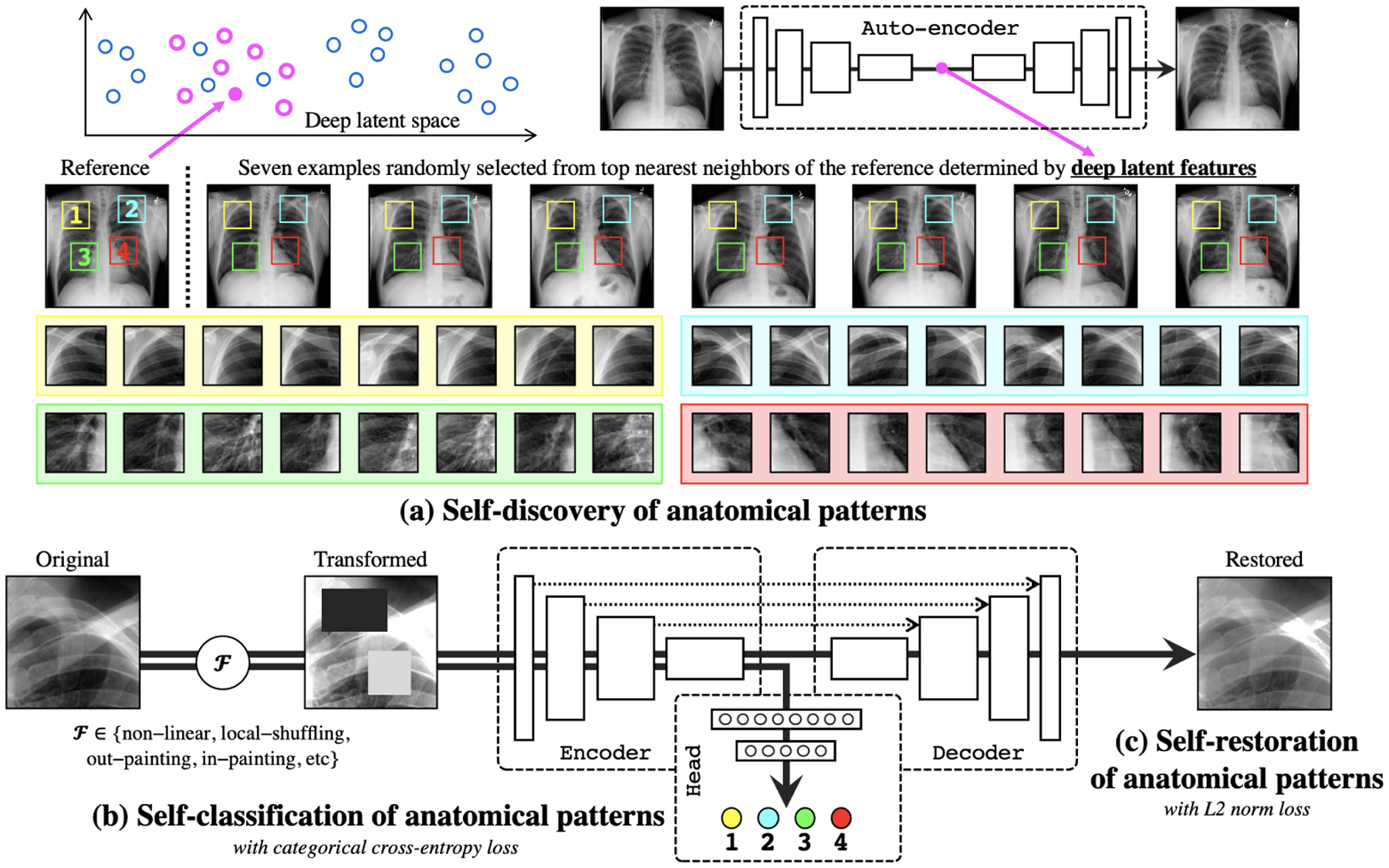
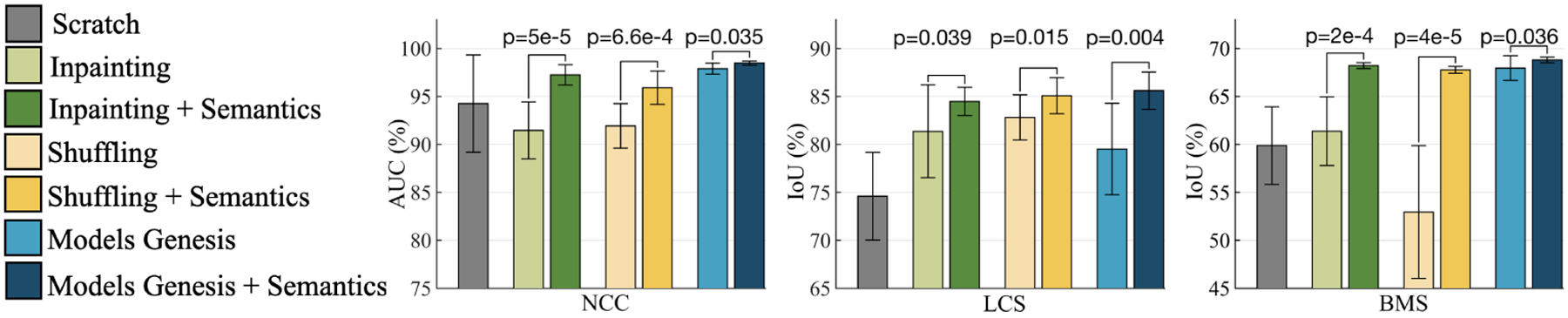
Medical images are naturally associated with rich semantics about the human anatomy, reflected in an abundance of recurring anatomical patterns, offering unique potential to foster deep semantic representation learning and yield semantically more powerful models for different medical applications. But how exactly such strong yet free semantics embedded in medical images can be harnessed for self-supervised learning remains largely unexplored. To this end, we train deep models to learn semantically enriched visual representation by self-discovery, self-classification, and self-restoration of the anatomy underneath medical images, resulting in a semantics-enriched, general-purpose, pre-trained 3D model, named Semantic Genesis. We examine our Semantic Genesis with all the publicly-available pre-trained models, by either self-supervision or fully supervision, on the six distinct target tasks, covering both classification and segmentation in various medical modalities (., CT, MRI, and X-ray). Our extensive experiments demonstrate that Semantic Genesis significantly exceeds all of its 3D counterparts as well as the ImageNet-based transfer learning in 2D. This performance is attributed to our novel self-supervised learning framework, encouraging deep models to learn compelling semantic representation from abundant anatomical patterns resulting from consistent anatomies embedded in medical images. Code and pre-trained Semantic Genesis are available at https://github.com/JLiangLab/SemanticGenesis.
医学图像自然地与有关人体解剖结构的丰富语义相关联,这体现在大量反复出现的解剖模式中,为促进深度语义表征学习以及为不同医学应用生成语义更强大的模型提供了独特潜力。但是,如何确切地利用医学图像中嵌入的这种强大而自由的语义进行自监督学习,在很大程度上仍未得到探索。为此,我们训练深度模型,通过对医学图像下方解剖结构的自我发现、自我分类和自我恢复来学习语义丰富的视觉表征,从而得到一个名为语义起源(Semantic Genesis)的语义丰富、通用的预训练3D模型。我们在六个不同的目标任务上,通过自监督或完全监督,将我们的语义起源模型与所有公开可用的预训练模型进行比较,这些任务涵盖了各种医学模态(如CT、MRI和X射线)中的分类和分割。我们广泛的实验表明,语义起源模型显著超越了所有其他3D对应模型以及基于ImageNet的2D迁移学习。这种性能归因于我们新颖的自监督学习框架,该框架鼓励深度模型从医学图像中嵌入的一致解剖结构所产生的丰富解剖模式中学习引人注目的语义表征。代码和预训练的语义起源模型可在https://github.com/JLiangLab/SemanticGenesis获取。