He Yue, Wen Cong-Ying, Guo Zhi-Jun, Huang Yu-Fen
Laboratory of Quality & Safety Risk Assessment for Citrus Products (Chongqing), Ministry of Agriculture, Citrus Research Institute, Southwest University, Chongqing, 400712, PR China.
College of Science, China University of Petroleum (East China), Qingdao, 266580, PR China.
J Food Drug Anal. 2020 Dec 15;28(4):508-520. doi: 10.38212/2224-6614.1155.
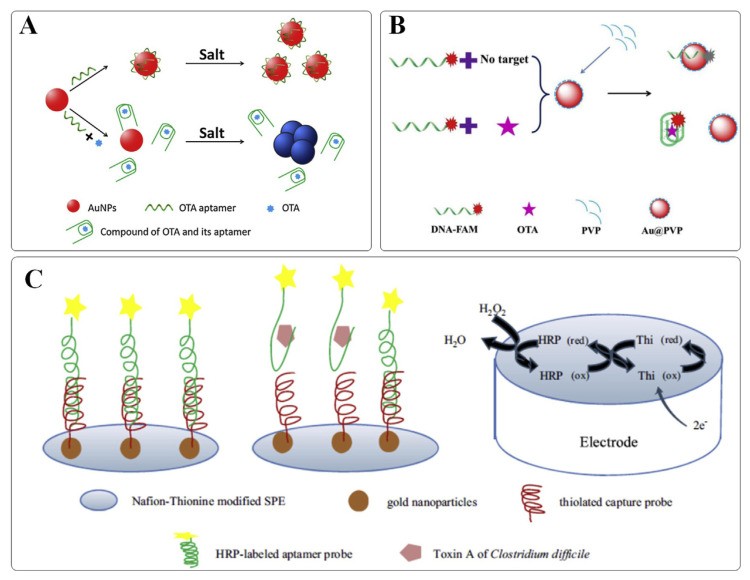
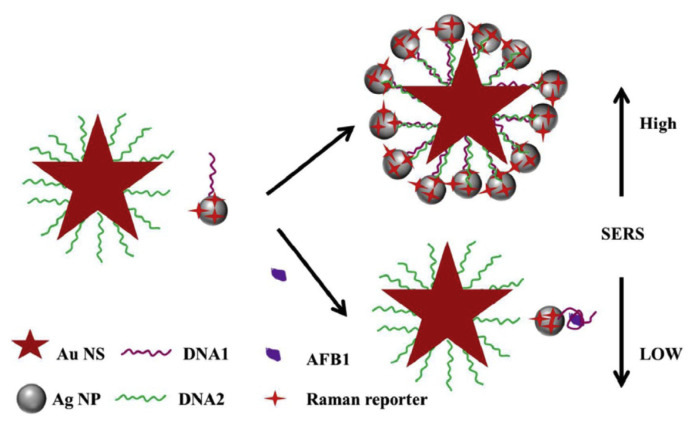
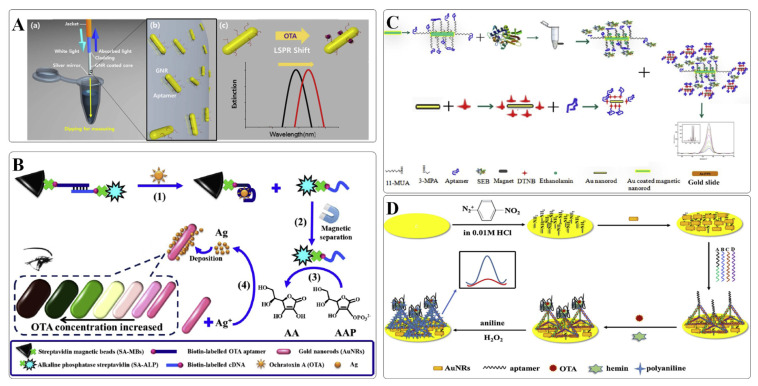
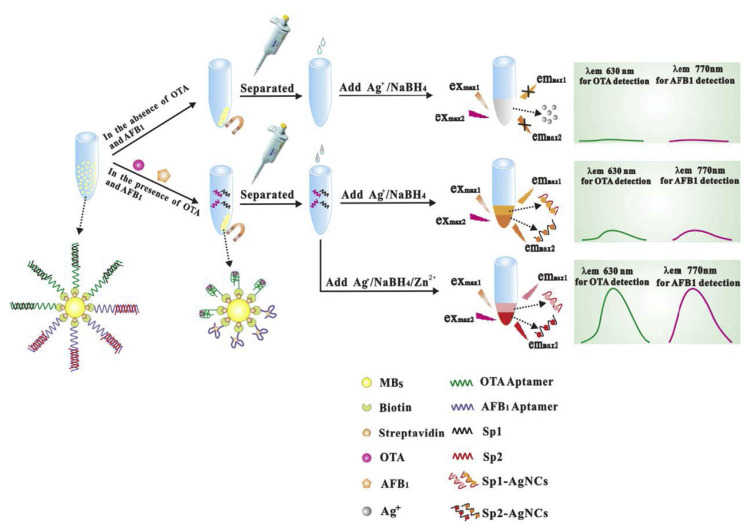
Microbial toxins generated by bacteria, fungi and algae cause serious food-safety problems due to the frequent contamination of foodstuffs and their poisonous nature. Becoming acquainted with the contamination condition of foodstuffs is highly dependent on developing sensitive, specific, and accurate methods for targeting microbial toxins. Aptamers, obtained from systematic evolution of ligands by exponential enrichment (SELEX), have significant advantages for microbial toxin analysis, such as small size, reproducible chemical synthesis, and modification, as well as high binding affinity, specificity, and stability. Besides, aptamers have a predictable structure and can be tailored using biomolecular tools (e.g., ligase, endonuclease, exonuclease, polymerase, and so on), which is conducive to the development of flexible and variable amplification methods. Recent studies revealed that the combination of aptamers and noble metal nanomaterials offers unprecedented opportunities for microbial toxin detection. Noble metal nanomaterials with outstanding physical and chemical properties facilitate the detection process and improve the sensitivity and specificity. In this review, we discuss current progress in the development of various noble metal nanomaterial-based aptasensors for microbial toxin detection. These noble metal nanomaterials include gold nanoparticles, gold nanorods, gold nanoclusters, silver nanoparticles, silver nanoclusters, and bimetallic nanomaterials. Aptasensors based on noble metal nanomaterials exhibiting high selectivity and sensitivity represent a promising tool for microbial toxin detection.
细菌、真菌和藻类产生的微生物毒素,由于食品经常受到污染及其有毒性质,会导致严重的食品安全问题。了解食品的污染状况高度依赖于开发针对微生物毒素的灵敏、特异且准确的方法。通过指数富集配体系统进化技术(SELEX)获得的适配体,在微生物毒素分析方面具有显著优势,如尺寸小、可重复化学合成与修饰,以及高结合亲和力、特异性和稳定性。此外,适配体具有可预测的结构,可使用生物分子工具(如连接酶、内切核酸酶、外切核酸酶、聚合酶等)进行定制,这有利于开发灵活多变的扩增方法。最近的研究表明,适配体与贵金属纳米材料的结合为微生物毒素检测提供了前所未有的机遇。具有出色物理和化学性质的贵金属纳米材料有助于检测过程,并提高灵敏度和特异性。在本综述中,我们讨论了用于微生物毒素检测的各种基于贵金属纳米材料的适配体传感器开发的当前进展。这些贵金属纳米材料包括金纳米颗粒、金纳米棒、金纳米簇、银纳米颗粒、银纳米簇和双金属纳米材料。基于贵金属纳米材料的适配体传感器具有高选择性和灵敏度,是微生物毒素检测的一种有前途的工具。