Department of Gastroenterology and Hepatology, Osaka University Graduate School of Medicine, Osaka, Japan.
Department of Gastroenterological Surgery, Osaka University Graduate School of Medicine, Osaka, Japan.
Cancer Res. 2022 Aug 16;82(16):2860-2873. doi: 10.1158/0008-5472.CAN-21-4390.
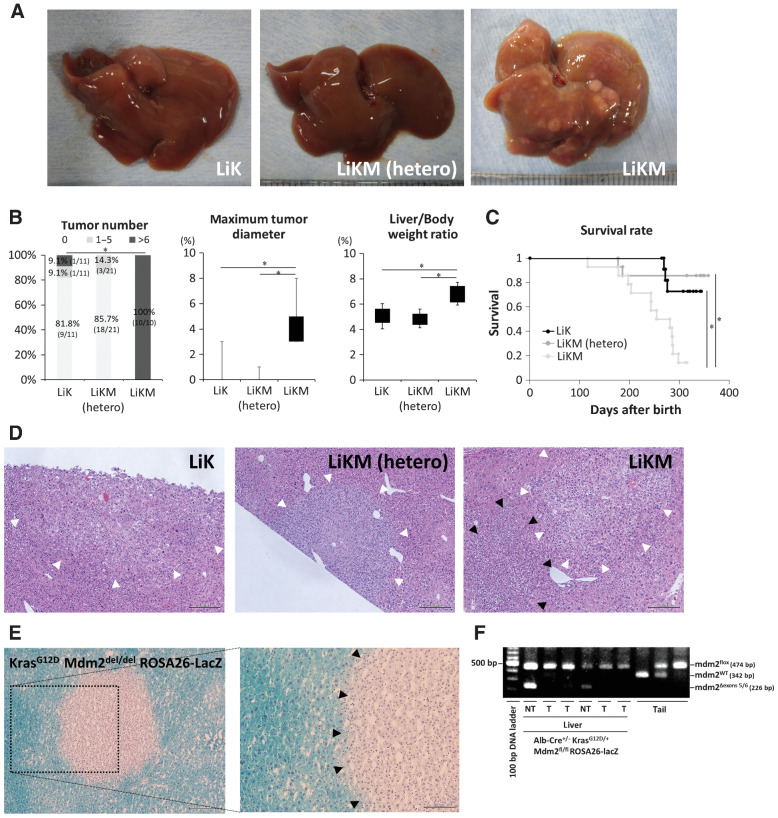
In chronic liver diseases (CLD), p53 is constitutively activated in hepatocytes due to various etiologies as viral infection, ethanol exposure, or lipid accumulation. This study was aimed to clarify the significance of p53 activation on the pathophysiology of CLDs. In Kras-mutant liver cancer model, murine double minute 2 (Mdm2), a negative regulator of p53, was specifically deleted in hepatocytes [Alb-Cre KrasLSL-G12D Mdm2fl/fl (LiKM; KrasG12D mutation and Mdm2 loss in the liver)]. Accumulation of p53 and upregulation of its downstream genes were observed in hepatocytes in LiKM mice. LiKM mice showed liver inflammation accompanied by hepatocyte apoptosis, senescence-associated secretory phenotype (SASP), and the emergence of hepatic progenitor cells (HPC). More importantly, Mdm2 deletion promoted non-cell autonomous development of liver tumors. Organoids generated from HPCs harbored tumor-formation ability when subcutaneously inoculated into NOD/Shi-scid/IL2Rγ (null) mice. Treatment with acyclic retinoid suppressed growth of HPCs in vitro and inhibited tumorigenesis in LiKM mice. All of the phenotypes in LiKM mice, including accelerated liver tumorigenesis, were negated by further deletion of p53 in hepatocytes (Alb-Cre KrasLSL-G12D Mdm2fl/fl p53fl/fl). Activation of hepatic p53 was noted in liver biopsy samples obtained from 182 patients with CLD, in comparison with 23 normal liver samples without background liver diseases. In patients with CLD, activity of hepatic p53 was positively correlated with the expression of apoptosis, SASP, HPC-associated genes and tumor incidence in the liver after biopsy. In conclusion, activation of hepatocyte p53 creates a microenvironment prone to tumor formation from HPCs. Optimization of p53 activity in hepatocytes is important to prevent patients with CLD from hepatocarcinogenesis.
This study reveals that activation of p53 in hepatocytes promotes liver carcinogenesis derived from HPCs, which elucidates a paradoxical aspect of a tumor suppressor p53 and novel mechanism of liver carcinogenesis. See related commentary by Barton and Lozano, p. 2824.
在慢性肝脏疾病(CLD)中,由于各种病因,如病毒感染、乙醇暴露或脂质积累,p53 在肝细胞中持续激活。本研究旨在阐明 p53 激活对 CLD 病理生理学的意义。在 Kras 突变肝癌模型中,特异性地在肝细胞中缺失 p53 的负调节剂——鼠双微体 2(Mdm2)[Alb-Cre KrasLSL-G12D Mdm2fl/fl(LiKM;肝中 KrasG12D 突变和 Mdm2 缺失)]。LiKM 小鼠的肝细胞中观察到 p53 积累和其下游基因的上调。LiKM 小鼠表现出肝脏炎症伴肝细胞凋亡、衰老相关分泌表型(SASP)和肝祖细胞(HPC)的出现。更重要的是,Mdm2 缺失促进了非细胞自主的肝肿瘤发展。从 HPC 生成的类器官在皮下接种到 NOD/Shi-scid/IL2Rγ(null)小鼠中具有肿瘤形成能力。阿维 A 酸抑制体外 HPC 的生长,并抑制 LiKM 小鼠的肿瘤发生。LiKM 小鼠的所有表型,包括加速肝肿瘤发生,都通过进一步在肝细胞中缺失 p53(Alb-Cre KrasLSL-G12D Mdm2fl/fl p53fl/fl)而被否定。与 23 例无背景肝病的正常肝样本相比,在从 182 例 CLD 患者获得的肝活检样本中观察到肝 p53 的活性。在 CLD 患者中,肝 p53 的活性与凋亡、SASP、HPC 相关基因的表达以及活检后肝脏肿瘤发生率呈正相关。总之,肝细胞 p53 的激活创造了一个有利于 HPC 形成肿瘤的微环境。优化肝细胞中 p53 的活性对于防止 CLD 患者发生肝癌至关重要。
本研究揭示了肝细胞中 p53 的激活促进了源自 HPC 的肝肿瘤发生,这阐明了肿瘤抑制因子 p53 的一个矛盾方面和肝肿瘤发生的新机制。见 Barton 和 Lozano 的相关评论,第 2824 页。