Department of Vascular Surgery, The First Hospital of Hebei Medical University, No. 89 Donggang Street, Yuhua District, Shijiazhuang, 500000, Hebei, China.
J Cardiothorac Surg. 2022 Jun 13;17(1):151. doi: 10.1186/s13019-022-01901-y.
The aim of this study was to explore whether or to what extent metabolic syndrome (METs) and its components were associated with hypoxemia in acute type A aortic dissection (ATAAD) patients after surgery.
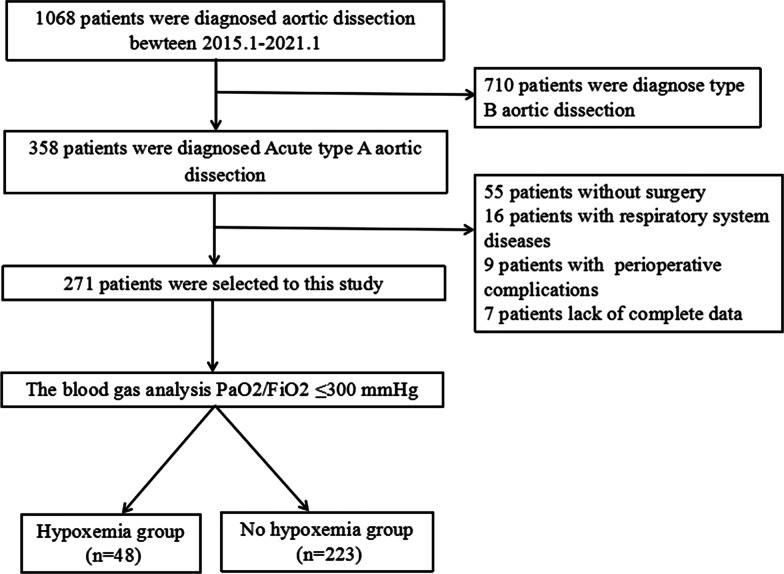
This study involved 271 inpatients who underwent surgery. Demographic and clinical data were collected. Subgroup analysis, mixed model regression analysis, and receiver operating characteristic (ROC) curve analysis were performed, and a scoring system was evaluated.
The 271 inpatients were assigned to the hypoxemia group (n = 48) or no hypoxemia group (n = 223) regardless of METs status. Compared to the no hypoxemia group, the hypoxemia group had a higher incidence of METs. Hypoxemia was present in 0%, 3.7%, 19.8%, 51.5%, 90.0% and 100% in the groups of individuals who met the diagnostic criteria of MetS 0, 1, 2, 3, 4 and 5 times, respectively. In the multivariable logistic regression analysis, BMI quartile was still a risk factor for hypoxemia after adjustment for other risk factors. After adjustment for potential confounding factors, METs was an independent risk factor for hypoxemia in several models. After assigning a score for each METs component present, the AUCs were 0.852 (95% CI 0.789-0.914) in all patients, 0.728 (95% CI 0.573-0.882) in patients with METs and 0.744 (95% CI 0.636-0.853) in patients without METs according to receiver operating characteristic analysis.
METs, especially body mass index, confers a greater risk of hypoxemia in ATAAD after surgery.
本研究旨在探讨代谢综合征(METs)及其组分与急性 A 型主动脉夹层(ATAAD)术后患者低氧血症的关系。
本研究纳入 271 例接受手术的住院患者,收集其人口统计学和临床资料。进行亚组分析、混合模型回归分析和受试者工作特征(ROC)曲线分析,并对评分系统进行评估。
无论 METs 状态如何,271 例住院患者均被分为低氧血症组(n=48)和无低氧血症组(n=223)。与无低氧血症组相比,低氧血症组 METs 的发生率更高。满足 MetS 诊断标准 0、1、2、3、4 和 5 次的个体中,低氧血症的发生率分别为 0%、3.7%、19.8%、51.5%、90.0%和 100%。在多变量逻辑回归分析中,BMI 四分位数仍然是调整其他危险因素后低氧血症的危险因素。调整潜在混杂因素后,METs 是多个模型中低氧血症的独立危险因素。为每个 METs 组分赋值后,根据 ROC 分析,所有患者的 AUC 为 0.852(95%CI 0.789-0.914),METs 患者为 0.728(95%CI 0.573-0.882),无 METs 患者为 0.744(95%CI 0.636-0.853)。
METs,尤其是 BMI,增加了 ATAAD 术后低氧血症的风险。