Wang Ziyue, Cryar Adam, Lemke Oliver, Tober-Lau Pinkus, Ludwig Daniela, Helbig Elisa Theresa, Hippenstiel Stefan, Sander Leif-Erik, Blake Daniel, Lane Catherine S, Sayers Rebekah L, Mueller Christoph, Zeiser Johannes, Townsend StJohn, Demichev Vadim, Mülleder Michael, Kurth Florian, Sirka Ernestas, Hartl Johannes, Ralser Markus
Department of Biochemistry, Charité - Universitätsmedizin Berlin, Corporate Member of Freie Universität Berlin and Humboldt-Universität zu Berlin, Am Chariteplatz 1, 10117 Berlin, Germany.
Inoviv, Mappin House, 4 Winsley St, London, United Kingdom.
EClinicalMedicine. 2022 Jul;49:101495. doi: 10.1016/j.eclinm.2022.101495. Epub 2022 Jun 9.
Global healthcare systems continue to be challenged by the COVID-19 pandemic, and there is a need for clinical assays that can help optimise resource allocation, support treatment decisions, and accelerate the development and evaluation of new therapies.
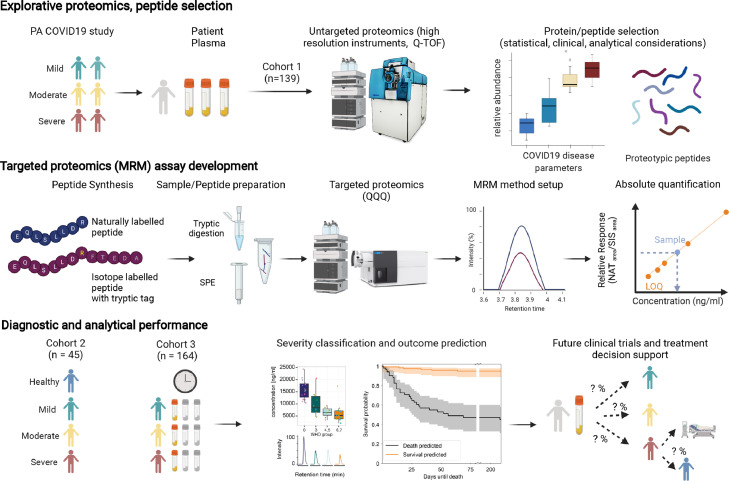
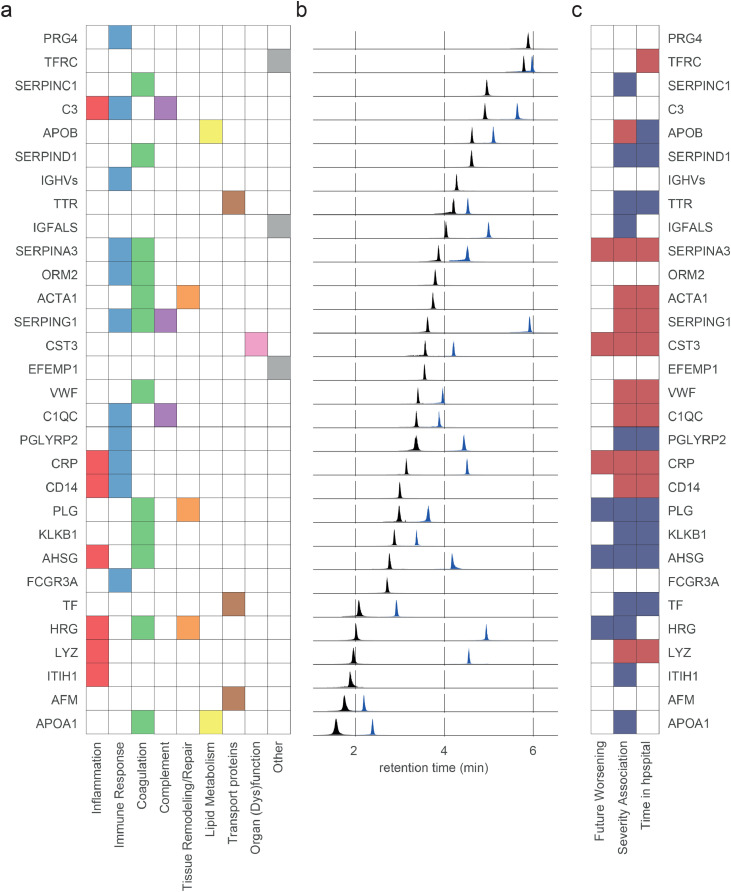
We developed a multiplexed proteomics assay for determining disease severity and prognosis in COVID-19. The assay quantifies up to 50 peptides, derived from 30 known and newly introduced COVID-19-related protein markers, in a single measurement using routine-lab compatible analytical flow rate liquid chromatography and multiple reaction monitoring (LC-MRM). We conducted two observational studies in patients with COVID-19 hospitalised at Charité - Universitätsmedizin Berlin, Germany before (from March 1 to 26, 2020, n=30) and after (from April 4 to November 19, 2020, n=164) dexamethasone became standard of care. The study is registered in the German and the WHO International Clinical Trials Registry (DRKS00021688).
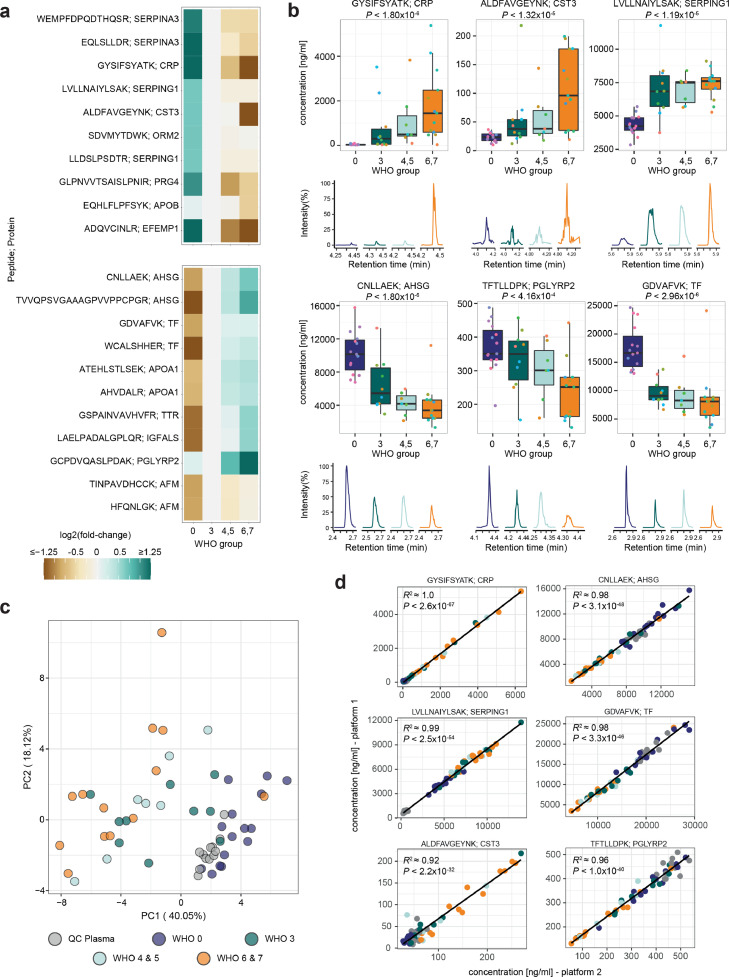
The assay produces reproducible (median inter-batch CV of 10.9%) absolute quantification of 47 peptides with high sensitivity (median LLOQ of 143 ng/ml) and accuracy (median 96.8%). In both studies, the assay reproducibly captured hallmarks of COVID-19 infection and severity, as it distinguished healthy individuals, mild, moderate, and severe COVID-19. In the post-dexamethasone cohort, the assay predicted survival with an accuracy of 0.83 (108/130), and death with an accuracy of 0.76 (26/34) in the median 2.5 weeks before the outcome, thereby outperforming compound clinical risk assessments such as SOFA, APACHE II, and ABCS scores.
Disease severity and clinical outcomes of patients with COVID-19 can be stratified and predicted by the routine-applicable panel assay that combines known and novel COVID-19 biomarkers. The prognostic value of this assay should be prospectively assessed in larger patient cohorts for future support of clinical decisions, including evaluation of sample flow in routine setting. The possibility to objectively classify COVID-19 severity can be helpful for monitoring of novel therapies, especially in early clinical trials.
This research was funded in part by the European Research Council (ERC) under grant agreement ERC-SyG-2020 951475 (to M.R) and by the Wellcome Trust (IA 200829/Z/16/Z to M.R.). The work was further supported by the Ministry of Education and Research (BMBF) as part of the National Research Node 'Mass Spectrometry in Systems Medicine (MSCoresys)', under grant agreements 031L0220 and 161L0221. J.H. was supported by a Swiss National Science Foundation (SNSF) Postdoc Mobility fellowship (project number 191052). This study was further supported by the BMBF grant NaFoUniMedCOVID-19 - NUM-NAPKON, FKZ: 01KX2021. The study was co-funded by the UK's innovation agency, Innovate UK, under project numbers 75594 and 56328.
全球医疗保健系统仍受到新冠疫情的挑战,需要能够帮助优化资源分配、支持治疗决策并加速新疗法研发与评估的临床检测方法。
我们开发了一种用于确定新冠患者疾病严重程度和预后的多重蛋白质组学检测方法。该检测方法使用常规实验室兼容的分析流速液相色谱和多反应监测(LC-MRM),在单次测量中对多达50种肽进行定量,这些肽源自30种已知和新引入的与新冠相关的蛋白质标志物。我们在德国柏林夏里特大学医学中心住院的新冠患者中进行了两项观察性研究,一项在(2020年3月1日至26日,n = 30)地塞米松成为标准治疗方法之前,另一项在(2020年4月4日至11月19日,n = 164)之后。该研究已在德国和世界卫生组织国际临床试验注册中心注册(DRKS00021688)。
该检测方法可对47种肽进行具有可重复性(批次间中位数变异系数为10.9%)的绝对定量,具有高灵敏度(中位数定量下限为143 ng/ml)和准确性(中位数为96.8%)。在两项研究中,该检测方法均可重复性地捕捉到新冠感染和严重程度的特征,因为它能够区分健康个体、轻症、中症和重症新冠患者。在地塞米松治疗后的队列中,该检测方法在结局出现前的中位2.5周内预测生存的准确率为0.83(108/130),预测死亡的准确率为0.76(26/34),从而优于序贯器官衰竭评估(SOFA)、急性生理与慢性健康状况评分系统II(APACHE II)和ABCS评分等复合临床风险评估方法。
新冠患者的疾病严重程度和临床结局可通过结合已知和新型新冠生物标志物的常规适用的检测方法进行分层和预测。该检测方法的预后价值应在更大的患者队列中进行前瞻性评估,以支持未来的临床决策,包括评估常规环境下的样本流程。客观分类新冠严重程度的可能性有助于监测新疗法,尤其是在早期临床试验中。
本研究部分由欧洲研究理事会(ERC)根据资助协议ERC-SyG-2020 951475(授予M.R.)以及惠康信托基金会(IA 200829/Z/16/Z授予M.R.)资助。该工作还得到了德国教育与研究部(BMBF)作为国家研究节点“系统医学中的质谱分析(MSCoresys)”的一部分,根据资助协议031L0220和161L0221提供的支持。J.H.得到了瑞士国家科学基金会(SNSF)博士后流动奖学金(项目编号191052)的支持。本研究还得到了BMBF资助项目NaFoUniMedCOVID-19 - NUM-NAPKON,项目编号:01KX2021的支持。该研究由英国创新机构英国创新署共同资助,项目编号分别为75594和56328。