Cancer Center, Beijing Ditan Hospital, Capital Medical University, Beijing, People's Republic of China.
Cancer Med. 2023 Jan;12(1):38-48. doi: 10.1002/cam4.4940. Epub 2022 Jun 15.
The association between Glasgow Prognostic Score (GPS) and the modified Glasgow Prognostic Score (mGPS) and clinical outcomes in patients receiving immune checkpoint inhibitors (ICIs) remains controversial. Thus, this meta-analysis aimed to examine the prognostic performance of GPS and mGPS in patients treated with ICIs.
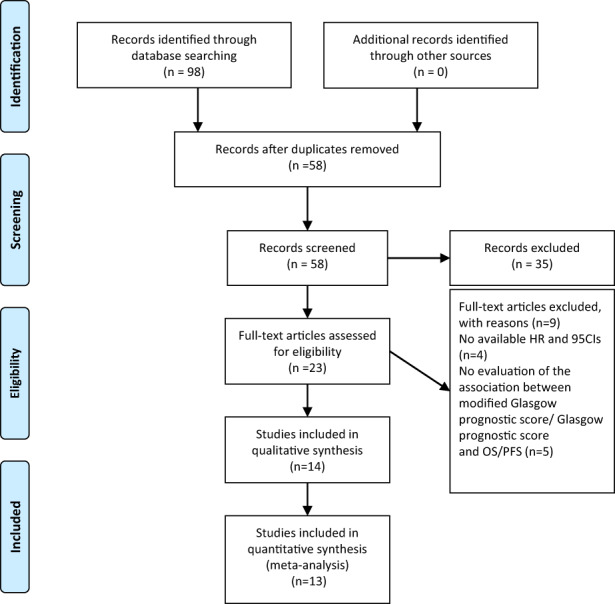
Eligible studies were retrieved from searches of EMBASE, PubMed, Web of Science, and Cochrane Library until July 2021. The hazard ratio (HR) and 95% confidence intervals (CIs) were pooled by using fixed-effect or random-effects model to evaluate the influence of GPS/mGPS on overall survival (OS) and progression-free survival (PFS).
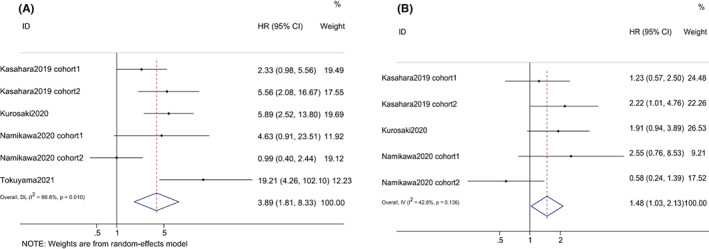
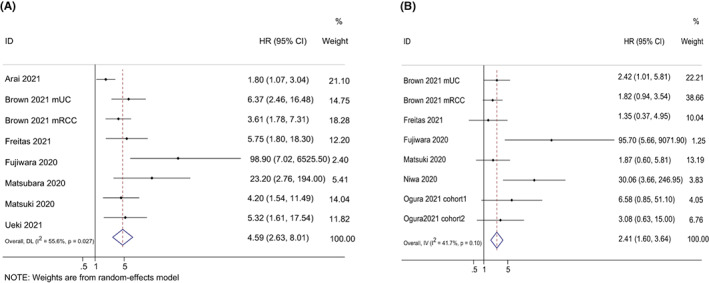
A total of 1164 patients were included. Overall, mGPS score of 2 and 1 were related to inferior OS (p < 0.001) and PFS (p < 0.001). Subgroup analyses showed no significant association between mGPS score of 1 and OS in patients with non-small cell lung cancer (NSCLC), while this score was significantly associated with poor PFS in patients with NSCLC and head and neck squamous cell carcinoma. Higher GPS (score of 1 or 2) were associated with poor clinical outcomes (OS: p < 0.001; PFS: p = 0.036). Subgroup analysis showed high GPS levels were linked to worse OS in patients with NSCLC and gastric cancer, but not for PFS in these patients. Regarding test time point, GPS was related to worse OS and PFS in pre-treatment GPS group, but not in post-treatment GPS group.
GPS and mGPS showed great potential to predict survival in patients treated with ICIs. Large and perspective trial are warranted to further validate these findings.
格拉斯哥预后评分(GPS)和改良的格拉斯哥预后评分(mGPS)与接受免疫检查点抑制剂(ICI)治疗的患者的临床结局之间的关联仍存在争议。因此,本荟萃分析旨在研究 GPS 和 mGPS 在接受 ICI 治疗的患者中的预后表现。
从 EMBASE、PubMed、Web of Science 和 Cochrane Library 中检索符合条件的研究,检索时间截至 2021 年 7 月。使用固定效应或随机效应模型汇总风险比(HR)和 95%置信区间(CI),以评估 GPS/mGPS 对总生存期(OS)和无进展生存期(PFS)的影响。
共纳入 1164 名患者。总体而言,mGPS 评分为 2 分和 1 分与较差的 OS(p<0.001)和 PFS(p<0.001)相关。亚组分析显示,mGPS 评分为 1 分与非小细胞肺癌(NSCLC)患者的 OS 无显著相关性,但与 NSCLC 和头颈部鳞状细胞癌患者的不良 PFS 相关。较高的 GPS(评分为 1 或 2)与较差的临床结局相关(OS:p<0.001;PFS:p=0.036)。亚组分析显示,高 GPS 水平与 NSCLC 和胃癌患者的 OS 较差相关,但对这些患者的 PFS 无影响。关于检测时间点,GPS 在治疗前 GPS 组与 OS 和 PFS 相关,但在治疗后 GPS 组中则不相关。
GPS 和 mGPS 显示出在接受 ICI 治疗的患者中预测生存的巨大潜力。需要进行大型前瞻性试验来进一步验证这些发现。