Division of Kinesiology, School of Kinesiology and Physical Therapy, University of Central Florida, Orlando, Florida.
Florida Space Institute, University of Central Florida, Orlando, Florida.
J Neurophysiol. 2022 Jul 1;128(1):73-85. doi: 10.1152/jn.00028.2022. Epub 2022 Jun 15.
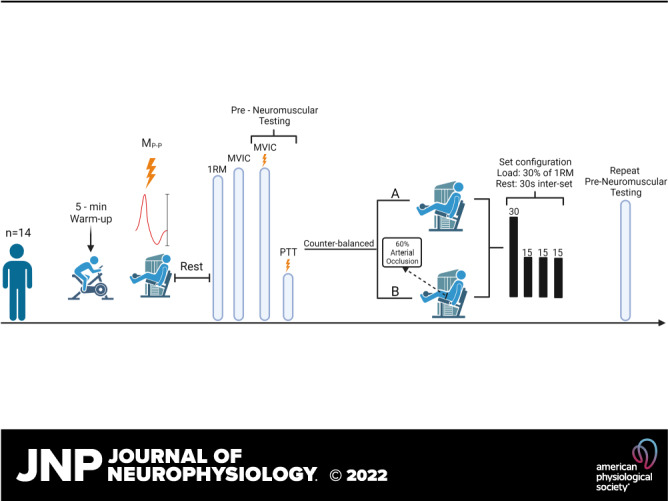
The purpose of this study was to examine the acute effects of low-load blood flow restriction (LLBFR) and low-load non-BFR (LL) on neuromuscular function after a bout of standardized fatiguing leg extension muscle actions. Fourteen men (mean age ± SD = 23 ± 4 yr) volunteered to participate in this investigation and randomly performed LLBFR and LL on separate days. Resistance exercise consisted of 75 isotonic unilateral leg extension muscle actions performed at 30% of one-repetition maximum. Before (pretest) and after (posttest) performance of each bout of exercise, strength and neural assessments were determined. There were no pretest to posttest differences between LLBFR and LL for maximal voluntary isometric contraction (MVIC) torque or V wave/M wave responses (muscle compound action potentials assessed during a superimposed MVIC muscle action), which exhibited decreases (collapsed across condition) of 41.2% and 26.2%, respectively. There were pretest to posttest decreases in peak twitch torque (36.0%) and surface electromyography amplitude (sEMG) (29.5%) for LLBFR but not LL and larger decreases in voluntary activation for LLBFR (11.3%) than for LL (4.5%). These findings suggested that LLBFR elicited greater fatigue-induced decreases in several indexes of neuromuscular function relative to LL. Despite this, both LLBFR and LL resulted in similar decrements in performance as assessed by maximal strength. The application of blood flow restriction induces greater acute neuromuscular fatigue relative to nonrestricted conditions. Resistance exercise with blood flow restriction elicited a greater reduction in twitch responses. These neuromuscular differences might explain the more favorable adaptations achieved with blood flow restriction that are likely a function of metabolic stress and subsequent changes in efferent neural drive.
本研究旨在探讨单次标准化疲劳腿部伸展肌肉活动后,低负荷血流限制(LLBFR)和低负荷非血流限制(LL)对神经肌肉功能的急性影响。14 名男性(平均年龄 ± 标准差=23±4 岁)自愿参与本研究,并分别在不同天进行 LLBFR 和 LL。阻力运动由 75 次等长单侧腿部伸展肌肉动作组成,动作强度为 1 次最大重复值的 30%。在每次运动的预测试(pretest)和后测试(posttest)前,进行力量和神经评估。LLBFR 和 LL 之间在最大等长等速收缩(MVIC)扭矩或 V 波/M 波反应(在叠加 MVIC 肌肉动作期间评估肌肉复合动作电位)方面没有预测试到后测试的差异,这两种反应均显示出 41.2%和 26.2%的下降(条件叠加)。在 LLBFR 中,峰值抽搐扭矩(36.0%)和表面肌电图幅度(sEMG)(29.5%)在前测试到后测试期间下降,但在 LL 中则没有,并且 LLBFR 的自愿激活下降幅度大于 LL(11.3%比 4.5%)。这些发现表明,与 LL 相比,LLBFR 引起了神经肌肉功能多个指标更大的疲劳诱导下降。尽管如此,LLBFR 和 LL 都导致最大力量评估的运动表现相似的下降。血流限制的应用导致相对非限制条件下更大的急性神经肌肉疲劳。血流限制的阻力运动引起抽搐反应的更大减少。这些神经肌肉差异可能解释了血流限制下更有利的适应,这可能是代谢应激和随后传出神经驱动变化的功能。