Division of Psychiatry, Department of Brain Sciences, Imperial College London, 7th Floor, Commonwealth Building, Du Cane Road, London, W12 0NN, UK.
Westminster Children and Adolescents Mental Health Services, Central and North West London NHS Foundation Trust, London, W9 2NW, UK.
Eur Child Adolesc Psychiatry. 2024 Jun;33(6):1621-1651. doi: 10.1007/s00787-022-02012-8. Epub 2022 Jun 16.
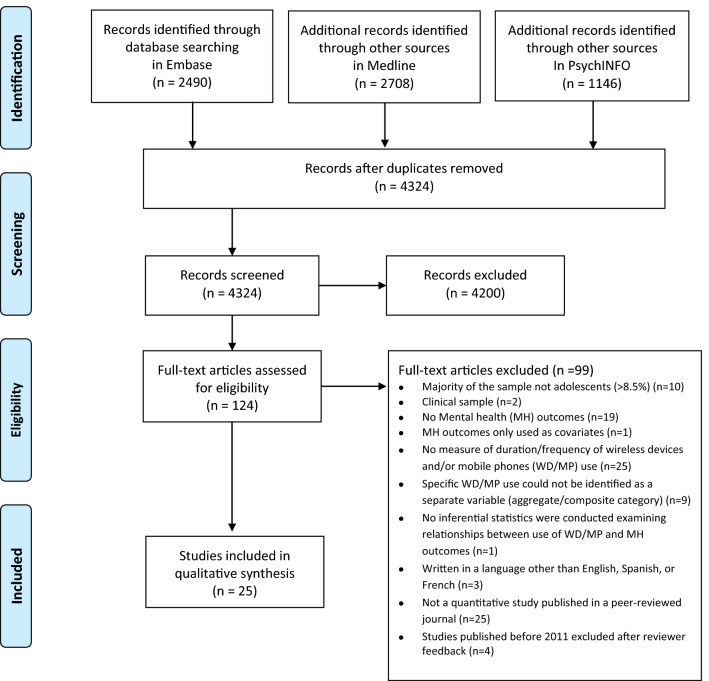
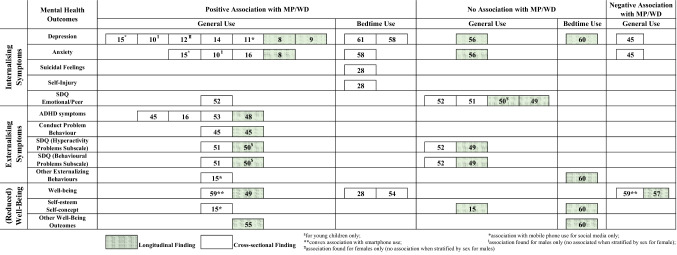
Growing use of mobiles phones (MP) and other wireless devices (WD) has raised concerns about their possible effects on children and adolescents' wellbeing. Understanding whether these technologies affect children and adolescents' mental health in positive or detrimental ways has become more urgent following further increase in use since the COVID-19 outbreak. To review the empirical evidence on associations between use of MP/WD and mental health in children and adolescents. A systematic review of literature was carried out on Medline, Embase and PsycINFO for studies published prior to July 15th 2019, PROSPERO ID: CRD42019146750. 25 observational studies published between January 1st 2011 and 2019 were reviewed (ten were cohort studies, 15 were cross-sectional). Overall estimated participant mean age and proportion female were 14.6 years and 47%, respectively. Substantial between-study heterogeneity in design and measurement of MP/WD usage and mental health outcomes limited our ability to infer general conclusions. Observed effects differed depending on time and type of MP/WD usage. We found suggestive but limited evidence that greater use of MP/WD may be associated with poorer mental health in children and adolescents. Risk of bias was rated as 'high' for 16 studies, 'moderate' for five studies and 'low' for four studies. More high-quality longitudinal studies and mechanistic research are needed to clarify the role of sleep and of type of MP/WD use (e.g. social media) on mental health trajectories in children and adolescents.
移动电话(MP)和其他无线设备(WD)的使用日益增多,引起了人们对其可能对儿童和青少年健康产生影响的关注。自 COVID-19 爆发以来,这些技术的使用进一步增加,因此,了解它们是否以积极或不利的方式影响儿童和青少年的心理健康变得更加紧迫。综述儿童和青少年使用 MP/WD 与心理健康之间关联的实证证据。在 Medline、Embase 和 PsycINFO 上对截至 2019 年 7 月 15 日之前发表的文献进行了系统综述,PROSPERO 注册号:CRD42019146750。共回顾了 25 项观察性研究(10 项为队列研究,15 项为横断面研究),研究参与者的平均年龄和女性比例分别为 14.6 岁和 47%。由于 MP/WD 使用和心理健康结果的设计和测量存在很大的研究间异质性,限制了我们推断普遍结论的能力。观察到的影响因 MP/WD 使用的时间和类型而异。我们发现了一些有限的但有提示性的证据表明,MP/WD 的使用量越大,儿童和青少年的心理健康可能越差。16 项研究的偏倚风险被评为“高”,5 项研究为“中”,4 项研究为“低”。需要更多高质量的纵向研究和机制研究来阐明睡眠以及 MP/WD 使用类型(如社交媒体)在儿童和青少年心理健康轨迹中的作用。