Li Rongkang, Xia Yong, Chen Xuan, Li Xinji, Huang Guocheng, Peng Xiqi, Liu Kaihao, Zhang Chunduo, Li Mingyang, Lin Yu, Dong Jing, Ji Ling, Lai Yongqing
Department of Urology, Guangdong and Shenzhen Key Laboratory of Male Reproductive Medicine and Genetics, Peking University Shenzhen Hospital, Clinical College of Anhui Medical University, Shenzhen, China.
The Fifth Clinical Medical College of Anhui Medical University, Hefei, China.
Transl Cancer Res. 2022 May;11(5):1005-1016. doi: 10.21037/tcr-21-2611.
Bladder cancer (BC) is the tenth most common cancer in the world. Serum microRNA (miRNA) profiles previously have been reported as non-invasive biomarkers in cancer screening. The non-invasive and reliable diagnostic biomarkers are urgently needed for detecting BC, while cystoscopy is invasive. Our study aimed to identify candidate miRNAs in serum as potential diagnostic biomarkers for BC detection.
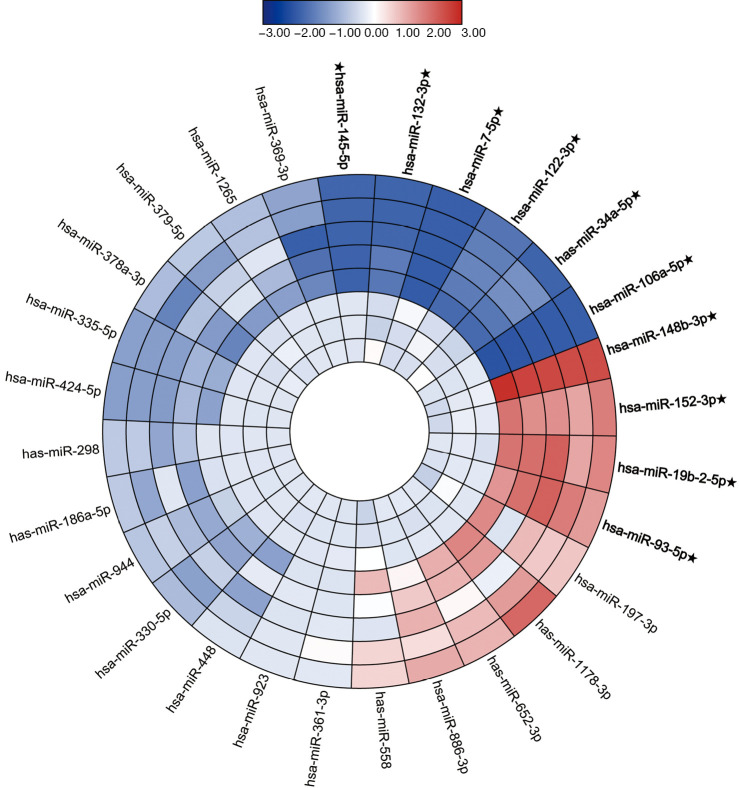
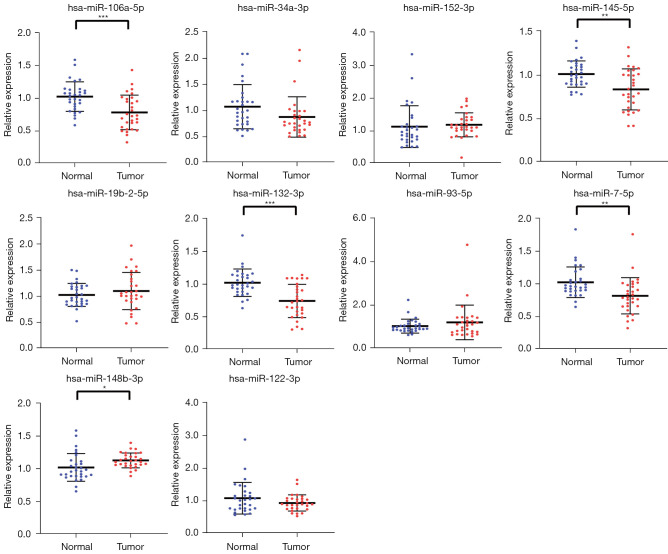
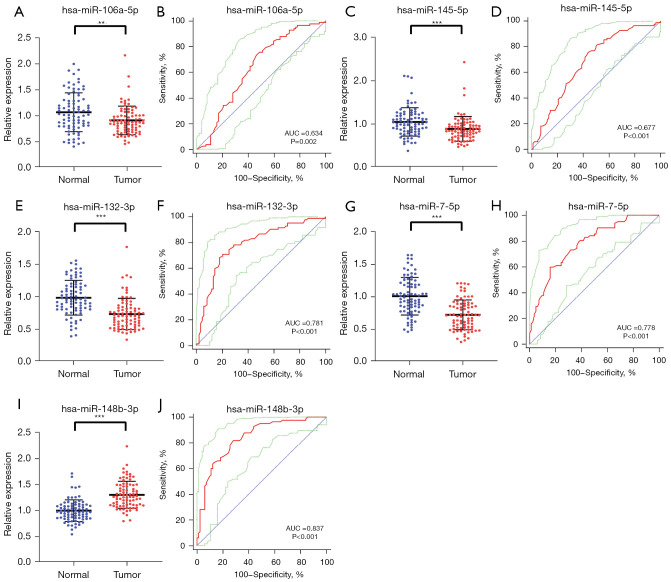
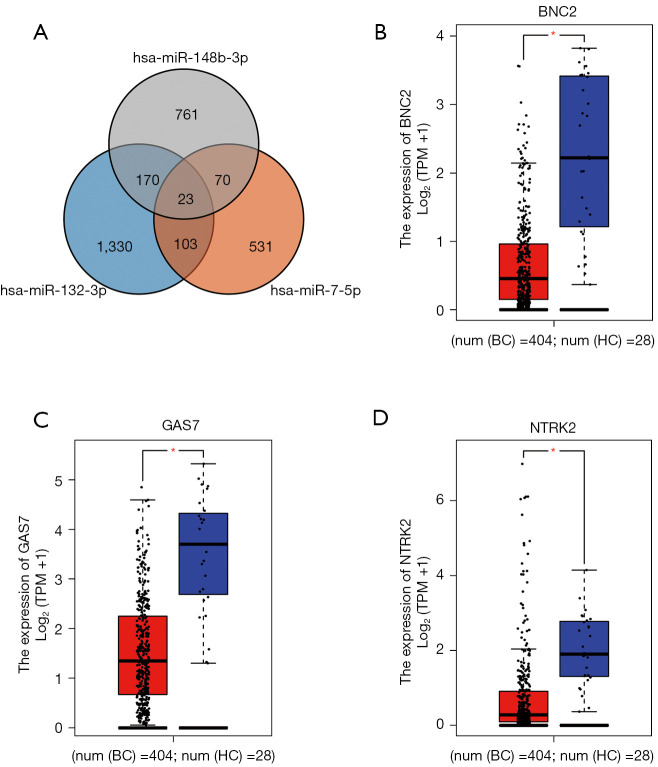
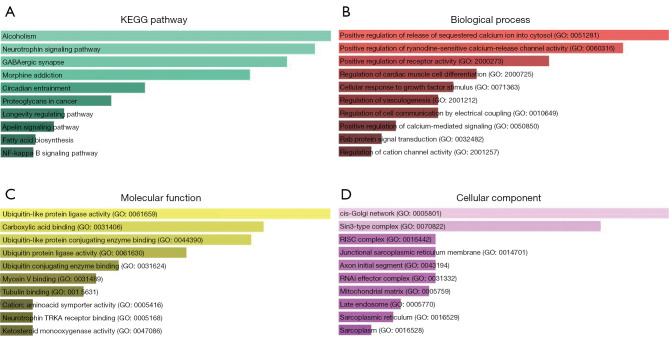
This study was including the screening stage, training stage, and validation stage with 137 BC patients and 127 healthy controls (HCs). We identified the expression of 28 serum miRNAs from 5 BC pools and 3 HC pools in the initial screening stage. The other 112 BC patients and 112 HCs were randomly divided into training stage with 30 BC patients and 30 HCs and validation stages with 82 BC patients and 82 HCs. These HCs matched BC patients based on age and gender with P value >0.05. Identified dysregulated miRNAs were further confirmed in the training stage, and validation stages by quantitative reverse transcription-polymerase chain reaction (qRT-PCR). The diagnostic value of miRNAs was assessed by receiver operating characteristic (ROC) curves and the area under the ROC curve (AUC). Target genes of 3 candidate miRNAs were predicted by bioinformatic analysis.
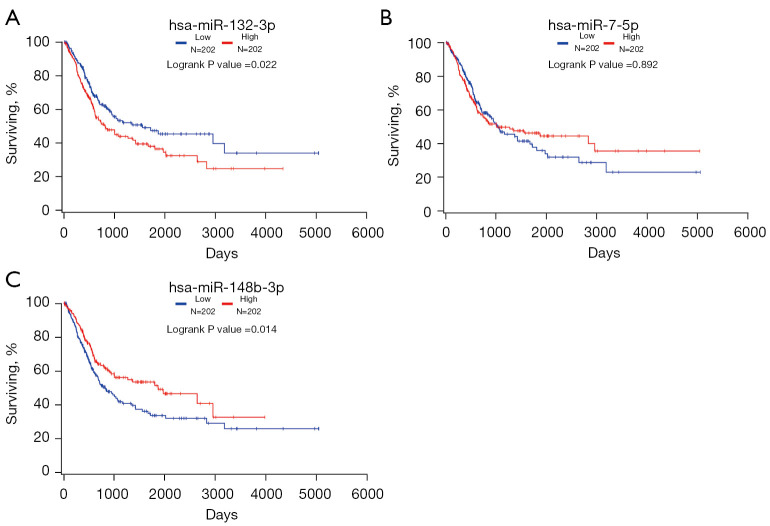
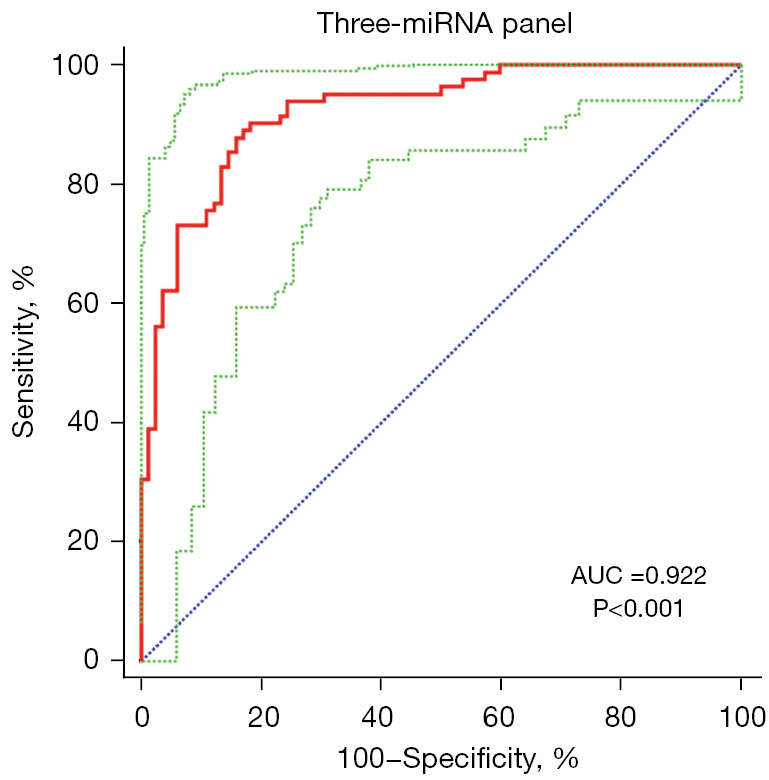
Five miRNAs (miR-106a-5p, miR-145-5p, miR-132-3p, miR-7-5p and miR-148b-3p) in serum were obviously dysregulated in BC patients compared to HCs. The ability to diagnose BC of 3 candidate miRNAs was estimated by AUC, with miR-132-3p (AUC =0.781; sensitivity =68.29%, specificity =81.71%), miR-7-5p (AUC =0.778; sensitivity =59.76%, specificity =84.15%) and miR-148b-3p (AUC =0.837; sensitivity =81.71%, specificity =71.95%). Combined application of these candidate miRNAs with parallel test could improve the diagnostic value (AUC =0.922; sensitivity =90.24%, specificity =81.71%). , and , considered as target genes of the three-miRNA panel, may play an important role in the process of BC development.
A three-miRNA panel in serum was identified for BC diagnosis in our study, which HCs were used for differential diagnosis. The three-miRNA panel (miR-132-3p, miR-7-5p, and miR-148b-3p) might be performed as a non-invasive and convenient diagnostic tool for BC screening and diagnosis.
膀胱癌(BC)是全球第十大常见癌症。血清微小RNA(miRNA)谱先前已被报道为癌症筛查中的非侵入性生物标志物。由于膀胱镜检查具有侵入性,因此迫切需要用于检测膀胱癌的非侵入性且可靠的诊断生物标志物。我们的研究旨在鉴定血清中的候选miRNA,作为检测膀胱癌的潜在诊断生物标志物。
本研究包括筛查阶段、训练阶段和验证阶段,共纳入137例膀胱癌患者和127例健康对照(HCs)。在初始筛查阶段,我们从5个膀胱癌样本库和3个健康对照样本库中鉴定了28种血清miRNA的表达。将另外112例膀胱癌患者和112例健康对照随机分为训练阶段(30例膀胱癌患者和30例健康对照)和验证阶段(82例膀胱癌患者和82例健康对照)。这些健康对照在年龄和性别上与膀胱癌患者匹配,P值>0.05。在训练阶段和验证阶段,通过定量逆转录-聚合酶链反应(qRT-PCR)进一步确认鉴定出的失调miRNA。通过受试者工作特征(ROC)曲线和ROC曲线下面积(AUC)评估miRNA的诊断价值。通过生物信息学分析预测3种候选miRNA的靶基因。
与健康对照相比,膀胱癌患者血清中的5种miRNA(miR-106a-5p、miR-145-5p、miR-132-3p、miR-7-5p和miR-148b-3p)明显失调。通过AUC评估3种候选miRNA诊断膀胱癌的能力,其中miR-132-3p(AUC =0.781;灵敏度 =68.29%,特异性 =81.71%)、miR-7-5p(AUC =0.778;灵敏度 =59.76%,特异性 =84.15%)和miR-148b-3p(AUC =0.837;灵敏度 =81.71%,特异性 =71.95%)。这些候选miRNA联合平行检测可提高诊断价值(AUC =0.922;灵敏度 =90.24%,特异性 =81.71%)。 和 被认为是三miRNA组合的靶基因,可能在膀胱癌发生过程中起重要作用。
在我们的研究中鉴定了一种用于膀胱癌诊断的血清三miRNA组合,以健康对照作为鉴别诊断对象。三miRNA组合(miR-132-3p、miR-7-5p和miR-148b-3p)可能作为一种非侵入性且便捷的诊断工具用于膀胱癌的筛查和诊断。