Karimi Abbas, Mohebbi Elham, Mckay-Chopin Sandrine, Rashidian Hamideh, Hadji Maryam, Peyghambari Vahideh, Marzban Maryam, Naghibzadeh-Tahami Ahmad, Gholipour Mahin, Kamangar Farin, Tommasino Massimo, Gheit Tarik, Zendehdel Kazem
Department of Molecular Medicine, Faculty of Advanced Medical Sciences, Tabriz University of Medical Sciences, Tabriz, Iran.
Early Detection, Prevention and Infections Branch, International Agency for Research on Cancer (IARC), Lyon, France.
Microbiol Spectr. 2022 Aug 31;10(4):e0011722. doi: 10.1128/spectrum.00117-22. Epub 2022 Jun 16.
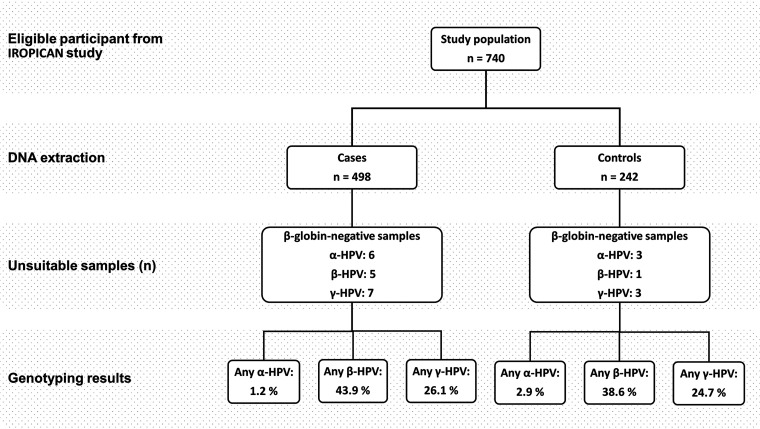
Human papillomavirus (HPV) causes a subset of head and neck squamous cell carcinoma (HNSCC). Knowledge of determinants of α-, β-, and γ-HPVs types in the oral cavity is required for a better understanding of HNSCC development. Oral rinse samples of 498 HNSCC cases and 242 controls from the IROPICAN study-a large multicenter case-control study in Iran-were screened for 21 α-HPV, 46 β-HPVs, and 52 γ-HPVs using bead-based HPV genotyping assays. α-HPVs were detected only in 1.2% of the patients and 2.9% of the controls from which HPV16 was the most prevalent type among participants. β-HPVs were detected in 43.8% of the patients and 38.6% of the controls where the lip and oral cavity (45.5%) had the highest positivity. Values for γ-HPV prevalence in patients and controls were 26.1% and 24.7%, respectively. The highest percentage of γ-HPV positivity was found in the larynx (30.4%). Concerning the β genus, HPV23 and HPV38 were the most prevalent types among the patients and controls, respectively. For the γ genus, SD2 in cases and HPV134 in controls were the most prevalent types. Overall, detection of α-HPVs (aOR, 0.40; 95% CI = 0.1 to 1.2; = 0.11), β-HPVs (aOR, 1.9; 95% CI = 0.9 to 1.6; = 0.29), and γ-HPVs infections (aOR, 1.04; 95% CI = 0.7 to 1.5; = 0.83) was not associated with the HNSCC development. Our data did not suggest an HPV-related etiology for HNSCC pathogenesis. Nonetheless, this study provides novel insights into the diversity of β-, and γ-HPVs in different HNSCC anatomical subsites. Infection with human papillomavirus (HPV) is responsible for a subset of neck squamous cell carcinoma (HNSCC), but knowledge of the prevalence of and risk factors for oral HPV infection, especially cutaneous types in Iran, remains unknown. In a large retrospective study, the authors used a sensitive assay for the detection of α-, β-, and γ-HPVs in oral rinse samples of HNSCC and matched controls. They find that the α-HPV contribution to HNSCC in Iran is lower than global prevalence. High-risk α-HPVs or cutaneous β- and γ-HPVs were not associated with the HNSCC development. Besides, this study provides novel insights into the diversity of β- and γ-HPVs in different HNSCC anatomical subsites.
人乳头瘤病毒(HPV)可引发一部分头颈部鳞状细胞癌(HNSCC)。为了更好地理解HNSCC的发病机制,需要了解口腔中α、β和γ-HPVs类型的决定因素。在伊朗进行的一项大型多中心病例对照研究——IROPICAN研究中,对498例HNSCC病例和242例对照的口腔冲洗样本进行了检测,使用基于珠子的HPV基因分型检测方法检测了21种α-HPV、46种β-HPV和52种γ-HPV。仅在1.2%的患者和2.9%的对照中检测到α-HPV,其中HPV16是参与者中最常见的类型。43.8%的患者和38.6%的对照中检测到β-HPV,其中唇部和口腔(45.5%)的阳性率最高。患者和对照中γ-HPV的流行率分别为26.1%和24.7%。γ-HPV阳性率最高的部位是喉部(30.4%)。关于β属,HPV23和HPV38分别是患者和对照中最常见的类型。对于γ属,病例中的SD2和对照中的HPV134是最常见的类型。总体而言,检测到α-HPV(优势比,0.40;95%置信区间=0.1至1.2;P=0.11)、β-HPV(优势比,1.9;95%置信区间=0.9至1.6;P=0.29)和γ-HPV感染(优势比,1.04;95%置信区间=0.7至1.5;P=0.83)与HNSCC的发生无关。我们的数据并未表明HNSCC发病机制与HPV相关的病因。尽管如此,本研究为不同HNSCC解剖亚部位中β和γ-HPVs的多样性提供了新的见解。人乳头瘤病毒(HPV)感染是一部分颈部鳞状细胞癌(HNSCC)的病因,但伊朗口腔HPV感染的流行率和危险因素,尤其是皮肤型HPV感染的相关情况仍不清楚。在一项大型回顾性研究中,作者使用一种灵敏的检测方法,检测HNSCC患者和匹配对照的口腔冲洗样本中的α、β和γ-HPVs。他们发现,在伊朗,α-HPV对HNSCC的影响低于全球流行率。高危α-HPV或皮肤β和γ-HPV与HNSCC的发生无关。此外,本研究为不同HNSCC解剖亚部位中β和γ-HPVs的多样性提供了新的见解。