Faculty of Medicine and Healthcare Sciences, Department of Rehabilitation Sciences, Occupational Therapy Program, Ghent University, Ghent, Belgium.
Faculty of Medicine and Healthcare Sciences, Department of Rehabilitation Sciences, Ghent University, Ghent, Belgium.
PLoS One. 2022 Jun 16;17(6):e0269608. doi: 10.1371/journal.pone.0269608. eCollection 2022.
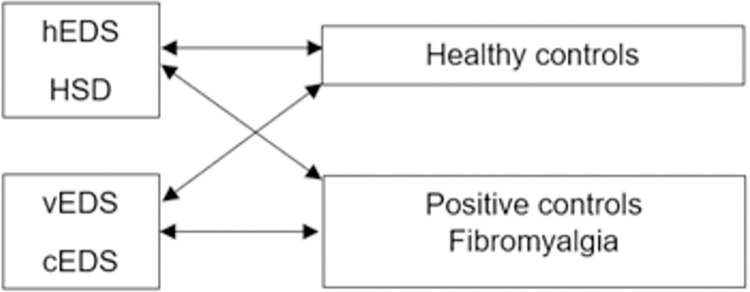
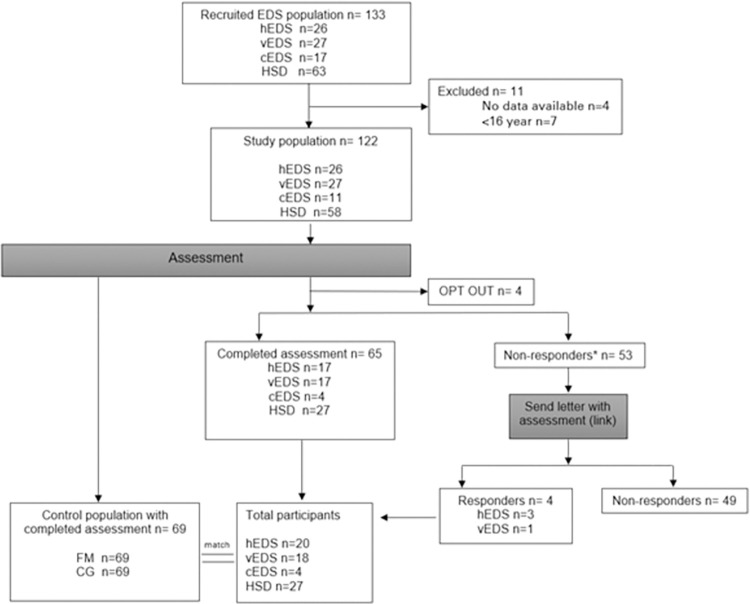
Ehlers-Danlos syndrome and hypermobility spectrum disorder affect daily life. There is a lack of research that investigates how the disease affects aspects of participation. This study investigates whether there is a difference in the level of participation in society in persons with vascular EDS (N = 18), hypermobile EDS (N = 20), classical EDS (N = 4) and Hypermobility Spectrum Disorder (N = 27), compared to a healthy control group (N = 69) and fibromyalgia (N = 69). In this retrospective case-control study, the Ghent Participation Scale was completed by all participants. Each patient with EDS and HSD was matched by age and sex to healthy controls. The hEDS and HSD group were compared with the healthy control group and a positive control group (persons with fibromyalgia). The results show that there was a significant lower overall participation score for persons with hEDS/HSD compared to the healthy control group. In addition, significant differences were observed in the subscores self-performed activities and delegated activities in the hEDS/HSD group compared to healthy controls, being HEDS/HSD patients who obtained the lower scores. Further research is needed to obtain representative results of the participation level for the EDS/HSD population. In this way, interventions can be set up for patients with EDS in an evidence-based way and that are appropriate to the patient's level of participation.
埃勒斯-当洛斯综合征和高机动性谱系障碍会影响日常生活。目前缺乏研究调查疾病如何影响参与度的各个方面。本研究旨在调查血管型 EDS(N=18)、高机动性 EDS(N=20)、经典型 EDS(N=4)和高机动性谱系障碍(N=27)患者在社会参与度方面是否与健康对照组(N=69)和纤维肌痛症(N=69)患者存在差异。在这项回顾性病例对照研究中,所有参与者都完成了根特参与量表。将每位 EDS 和 HSD 患者与健康对照者按年龄和性别进行匹配。将 hEDS 和 HSD 组与健康对照组和阳性对照组(纤维肌痛症患者)进行比较。结果表明,hEDS/HSD 患者的总体参与评分明显低于健康对照组。此外,与健康对照组相比,hEDS/HSD 组在自我执行活动和委托活动的子分数中观察到显著差异,即 hEDS/HSD 患者的得分较低。需要进一步的研究来获得 EDS/HSD 人群的参与水平的代表性结果。通过这种方式,可以为 EDS 患者制定基于证据的、适合患者参与度的干预措施。