
生物安保领域国际文书的互补性。
Complementarity of International Instruments in the Field of Biosecurity.
机构信息
Centre for Infectious Disease Control, Laboratory for Zoonoses and Environmental Microbiology, National Institute for Public Health and the Environment, Bilthoven, Netherlands.
Biosecurity Office, National Institute for Public Health and the Environment, Bilthoven, Netherlands.
出版信息
Front Public Health. 2022 May 27;10:894389. doi: 10.3389/fpubh.2022.894389. eCollection 2022.
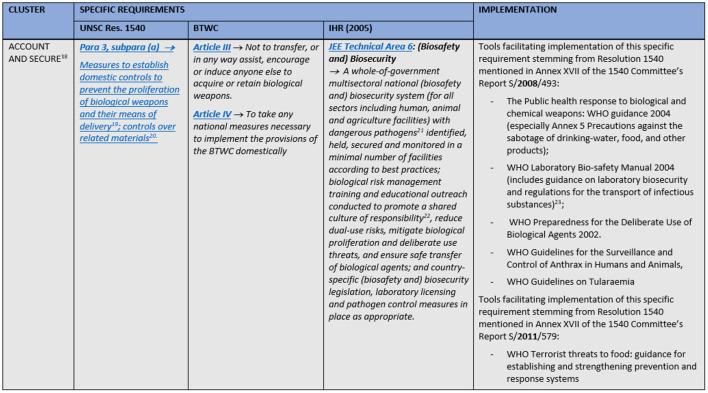
The COVID-19 pandemic has demonstrated the devastating impact of infectious disease outbreaks and the threat of emerging and re-emerging dangerous pathogens, independent of their origin. Natural, accidental, and deliberate disease outbreaks all need systems in place for an effective public health response. The best known international instrument in the field of public health is the WHO International Health Regulations (2005). Although the International Health Regulations are mainly focused on natural disease outbreaks, the actions to take to comply with them also contribute to biosecurity and non-proliferation. This paper examines in case of full implementation of the International Health Regulations, what other actions states should take to comply with international biosecurity instruments, including the Biological and Toxin Weapons Convention and United Nations Security Council Resolution 1540, to effectively prevent and defend against intentional biological threats. An overview of international instruments from different disciplines regarding biosecurity is presented. Furthermore, this paper clarifies the similarities between the international biosecurity instruments and addresses the additional requirements that instruments stipulate. From a detailed comparison between the instruments it can be concluded that, to adhere to all legally-binding international biosecurity instruments, specific non-proliferation and export control measures are necessary in addition to full implementation of the International Health Regulations. Additionally, an overview of non-legally binding instruments in the field of biosecurity is presented and practical implementation examples are highlighted. Compliance with legally binding instruments can be improved by precise guidance provided by non-legally binding instruments that are clear and attuned to the situation on the ground. To improve understanding of the existing international instruments, this paper aims to provide an overview of the international legal biosecurity framework to biosecurity experts, policymakers, civil servants, and practitioners. It offers possible practical applications for the politico-legal context and accommodates the enhancement of full employment of biosecurity resources for an improved multidisciplinary capacity to prevent, detect, and respond to infectious disease outbreaks.
新冠疫情大流行表明,传染病爆发具有破坏性影响,新出现和再现的危险病原体构成威胁,而不论其来源如何。无论是自然发生、意外发生还是故意引发的疾病爆发,都需要有系统来进行有效的公共卫生应对。在公共卫生领域,最著名的国际文书是世界卫生组织《国际卫生条例(2005)》。尽管《国际卫生条例》主要侧重于自然疾病爆发,但为遵守这些条例而采取的行动也有助于生物安保和不扩散。本文探讨了在充分实施《国际卫生条例》的情况下,各国还应采取哪些行动来遵守包括《生物和毒素武器公约》和联合国安全理事会第 1540 号决议在内的国际生物安保文书,以有效预防和抵御故意的生物威胁。本文介绍了不同学科领域的国际文书概述,阐述了国际生物安保文书之间的相似之处,并讨论了文书规定的其他要求。通过对文书的详细比较,可以得出结论,为了遵守所有具有法律约束力的国际生物安保文书,除充分实施《国际卫生条例》外,还必须采取具体的不扩散和出口管制措施。此外,本文还介绍了生物安保领域非具有法律约束力的文书概述,并强调了实际执行示例。通过非具有法律约束力的文书提供明确和切合实际的指导,可以改进对具有法律约束力文书的遵守。为了增进对现有国际文书的理解,本文旨在为生物安保专家、政策制定者、公务员和从业人员提供国际法律生物安保框架概述。本文为政治法律背景提供了可能的实际应用,并为充分利用生物安保资源以提高预防、检测和应对传染病爆发的多学科能力提供了便利。
 Zotero 插件