Department of Virology, National Institute of Public Health NIH - National Institute of Research, Warsaw, Poland.
Regional Reference Laboratory for Poliomyelitis, Robert Koch Institute, Berlin, Germany.
Euro Surveill. 2022 Jun;27(24). doi: 10.2807/1560-7917.ES.2022.27.24.2100674.
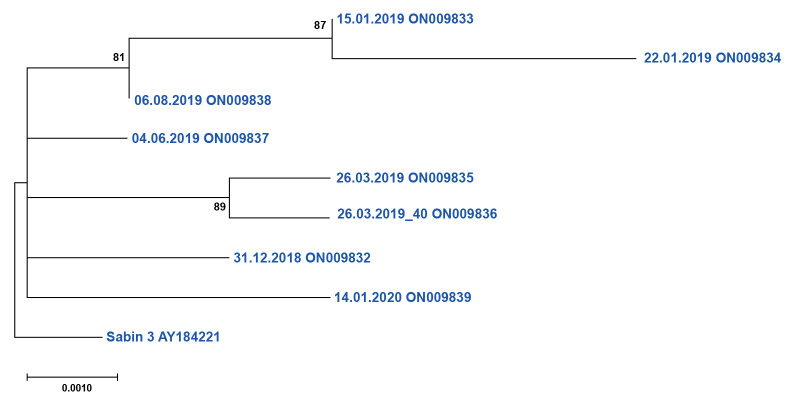
BackgroundPolioviruses are human pathogens which may easily be imported via travellers from endemic areas and countries where oral polio vaccine (OPV) is still routinely used to polio-free countries. Risk of reintroduction strictly depends on polio immunisation coverage. Sustaining a polio-free status requires strategies that allow rapid detection and control of potential poliovirus reintroductions.AimThe aim of this study was to apply environmental surveillance at an international airport in Poland to estimate the probability of poliovirus importation via air transport.MethodsBetween 2017 and 2020, we collected 142 sewage samples at Warsaw Airport. After sewage concentration, virus was isolated in susceptible cell cultures. Poliovirus isolates were characterised by intratypic differentiation and sequencing.ResultsSeven samples were positive for polioviruses. All isolates were characterised as Sabin-like polioviruses type 3 (SL-3). No wild or vaccine-derived polioviruses were found. The number of mutations accumulated in most isolates suggested a limited circulation in humans. Only one SL-3 isolate contained seven mutations, which is compatible with more than half a year of circulation.ConclusionSince OPV was withdrawn from the immunisation schedule in Poland in 2016, detection of SL-3 in airport sewage may indicate the events of importation from a region where OPV is still in use. Our study shows that environmental surveillance, including airport sewage investigation, has the capacity to detect emerging polioviruses and monitor potential exposure to poliovirus importation. Poliovirus detection in sewage samples indicates the need for sustaining a high level of polio immunisation coverage in the population.
脊髓灰质炎病毒是人类病原体,容易通过来自流行地区和仍常规使用口服脊髓灰质炎疫苗(OPV)以实现无脊髓灰质炎国家的旅行者输入。重新引入的风险严格取决于脊髓灰质炎免疫接种覆盖率。维持无脊髓灰质炎状态需要允许快速检测和控制潜在脊髓灰质炎病毒重新引入的策略。
本研究旨在通过在波兰的一个国际机场进行环境监测,估计通过航空运输输入脊髓灰质炎病毒的概率。
2017 年至 2020 年,我们在华沙机场收集了 142 份污水样本。在污水浓缩后,在易感细胞培养物中分离病毒。通过种间分化和测序对脊髓灰质炎病毒分离物进行了特征描述。
有 7 个样本对脊髓灰质炎病毒呈阳性。所有分离物均被描述为类似沙宾型脊髓灰质炎病毒 3 型(SL-3)。未发现野生或疫苗衍生的脊髓灰质炎病毒。大多数分离物中积累的突变数量表明在人类中有限循环。只有一个 SL-3 分离物含有七个突变,这与半年以上的循环相吻合。
由于波兰于 2016 年从免疫接种计划中撤出了 OPV,因此在机场污水中检测到 SL-3 可能表明从仍在使用 OPV 的地区输入了事件。我们的研究表明,包括机场污水调查在内的环境监测具有检测新出现的脊髓灰质炎病毒和监测潜在暴露于脊髓灰质炎病毒输入的能力。在污水样本中检测到脊髓灰质炎病毒表明需要维持高水平的人群脊髓灰质炎免疫接种覆盖率。