Laboratory of Clinical Virology, WHO Reference Laboratory for Poliomyelitis and Measles in the Eastern Mediterranean Region, Pasteur Institute of Tunis, University Tunis El Manar (UTM), Tunis 1068, Tunisia.
Research Laboratory, LR20IPT02, Pasteur Institute of Tunis, Tunis 1006, Tunisia.
Viruses. 2021 Feb 27;13(3):380. doi: 10.3390/v13030380.
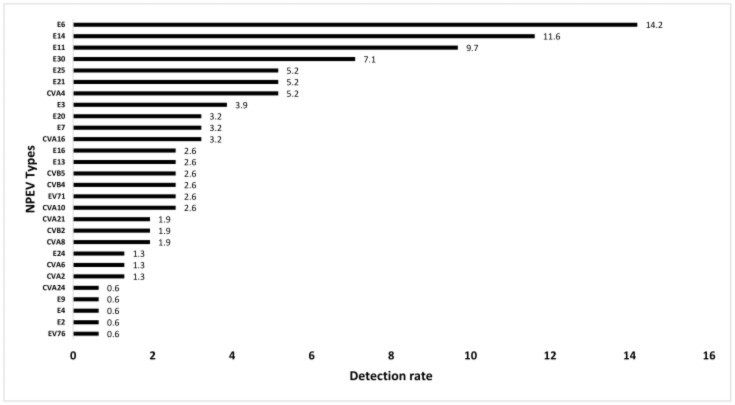
This report is an overview of enterovirus (EV) detection in Tunisian polio-suspected paralytic cases (acute flaccid paralysis (AFP) cases), healthy contacts and patients with primary immunodeficiencies (PID) during an 11-year period. A total of 2735 clinical samples were analyzed for EV isolation and type identification, according to the recommended protocols of the World Health Organization. Three poliovirus (PV) serotypes and 28 different nonpolio enteroviruses (NPEVs) were detected. The NPEV detection rate was 4.3%, 2.8% and 12.4% in AFP cases, healthy contacts and PID patients, respectively. The predominant species was EV-B, and the circulation of viruses from species EV-A was noted since 2011. All PVs detected were of Sabin origin. The PV detection rate was higher in PID patients compared to AFP cases and contacts (6.8%, 1.5% and 1.3% respectively). PV2 was not detected since 2015. Using nucleotide sequencing of the entire VP1 region, 61 strains were characterized as Sabin-like. Among them, six strains of types 1 and 3 PV were identified as pre-vaccine-derived polioviruses (VDPVs). Five type 2 PV, four strains belonging to type 1 PV and two strains belonging to type 3 PV, were classified as iVDPVs. The data presented provide a comprehensive picture of EVs circulating in Tunisia over an 11-year period, reveal changes in their epidemiology as compared to previous studies and highlight the need to set up a warning system to avoid unnoticed PVs.
本报告概述了 11 年间在突尼斯脊灰疑似麻痹病例(急性弛缓性麻痹病例)、健康接触者和原发性免疫缺陷病患者中肠病毒(EV)的检测情况。根据世界卫生组织推荐的方案,对 2735 份临床样本进行了 EV 分离和型别鉴定。共检测到 3 种脊灰病毒(PV)血清型和 28 种不同的非脊灰肠道病毒(NPEV)。在 AFP 病例、健康接触者和 PID 患者中,NPEV 的检出率分别为 4.3%、2.8%和 12.4%。主要流行株为 EV-B,自 2011 年以来,已注意到 EV-A 病毒的流行。所有检测到的 PV 均源自 Sabin 株。与 AFP 病例和接触者相比,PV 在 PID 患者中的检出率更高(分别为 6.8%、1.5%和 1.3%)。自 2015 年以来,未检测到 PV2。通过对整个 VP1 区的核苷酸测序,对 61 株病毒进行了特征描述,均为 Sabin 样病毒。其中,6 株 1 型和 3 型 PV 被鉴定为疫苗衍生脊灰病毒(VDPV)。5 株 2 型 PV、4 株属于 1 型 PV、2 株属于 3 型 PV,被归类为 iVDPV。本研究提供了 11 年间突尼斯肠道病毒流行情况的综合信息,揭示了其流行特征与既往研究的差异,并强调需要建立一个预警系统,以避免未被发现的 PV。