Toxicology Centre, University of Saskatchewan, Saskatoon, SK, Canada.
Department of Civil, Geological and Environmental Engineering, College of Engineering, University of Saskatchewan, Saskatoon, SK, Canada.
Sci Total Environ. 2022 Oct 1;841:156741. doi: 10.1016/j.scitotenv.2022.156741. Epub 2022 Jun 16.
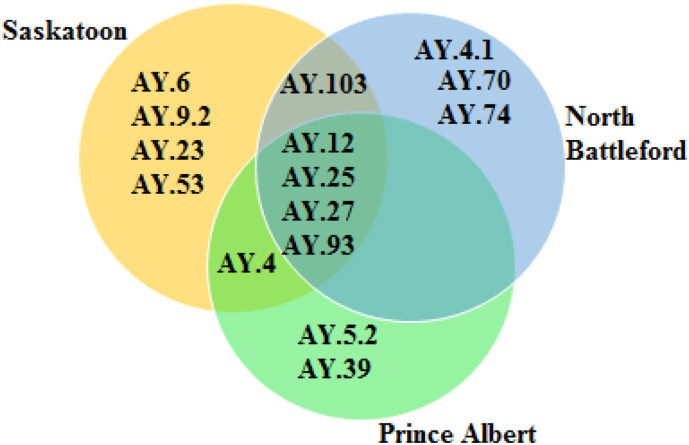
Monitoring the communal incidence of COVID-19 is important for both government and residents of an area to make informed decisions. However, continuous reliance on one means of monitoring might not be accurate because of biases introduced by government policies or behaviours of residents. Wastewater surveillance was employed to monitor concentrations of SARS-CoV-2 RNA in raw influent wastewater from wastewater treatment plants serving three Canadian Prairie cities with different population sizes. Data obtained from wastewater are not directly influenced by government regulations or behaviours of individuals. The means of three weekly samples collected using 24 h composite auto-samplers were determined. Viral loads were determined by RT-qPCR, and whole-genome sequencing was used to charaterize variants of concern (VOC). The dominant VOCs in the three cities were the same but with different proportions of sub-lineages. Sub-lineages of Delta were AY.12, AY.25, AY.27 and AY.93 in 2021, while the major sub-lineage of Omicron was BA.1 in January 2022, and BA.2 subsequently became a trace-level sub-variant then the predominant VOC. When each VOC was first detected varied among cities; However, Saskatoon, with the largest population, was always the first to present new VOCs. Viral loads varied among cities, but there was no direct correlation with population size, possibly because of differences in flow regimes. Population is one of the factors that affects trends in onset and development of local outbreaks during the pandemic. This might be due to demography or the fact that larger populations had greater potential for inter- and intra-country migration. Hence, wastewater surveillance data from larger cities can typically be used to indicate what to expect in smaller communities.
监测 COVID-19 的社区发病率对政府和该地区的居民做出明智决策都很重要。然而,由于政府政策或居民行为带来的偏差,持续依赖单一监测手段可能并不准确。污水监测被用于监测三个加拿大草原城市的污水处理厂原进水废水中 SARS-CoV-2 RNA 的浓度。污水中的数据不受政府法规或个人行为的直接影响。使用 24 小时自动混合采样器每周采集三次样本的方法得到确定。通过 RT-qPCR 确定病毒载量,并使用全基因组测序来对关注的变异株(VOC)进行特征描述。这三个城市的主要 VOC 相同,但亚谱系的比例不同。2021 年,Delta 的亚谱系为 AY.12、AY.25、AY.27 和 AY.93,而 2022 年 1 月,Omicron 的主要亚谱系是 BA.1,随后 BA.2 成为痕量亚变体,然后成为主要 VOC。每个 VOC 的首次检测时间因城市而异;然而,人口最多的萨斯卡通总是第一个出现新的 VOC。病毒载量在不同城市之间有所不同,但与人口规模没有直接关系,这可能是因为流量模式的差异。人口是影响大流行期间当地疫情爆发开始和发展的因素之一。这可能是由于人口统计学原因,或者是因为较大的人口具有更大的国内和国际迁移潜力。因此,来自较大城市的污水监测数据通常可以用于指示较小社区的情况。