Vestergaard Mark B, Frederiksen Jette L, Larsson Henrik B W, Cramer Stig P
Functional Imaging Unit, Department of Clinical Physiology and Nuclear Medicine, Copenhagen University Hospital Rigshospitalet, Glostrup, Denmark.
Danish Multiple Sclerosis Center, Department of Neurology, Copenhagen University Hospital Rigshospitalet, Glostrup, Denmark.
Front Neurol. 2022 Jun 1;13:912828. doi: 10.3389/fneur.2022.912828. eCollection 2022.
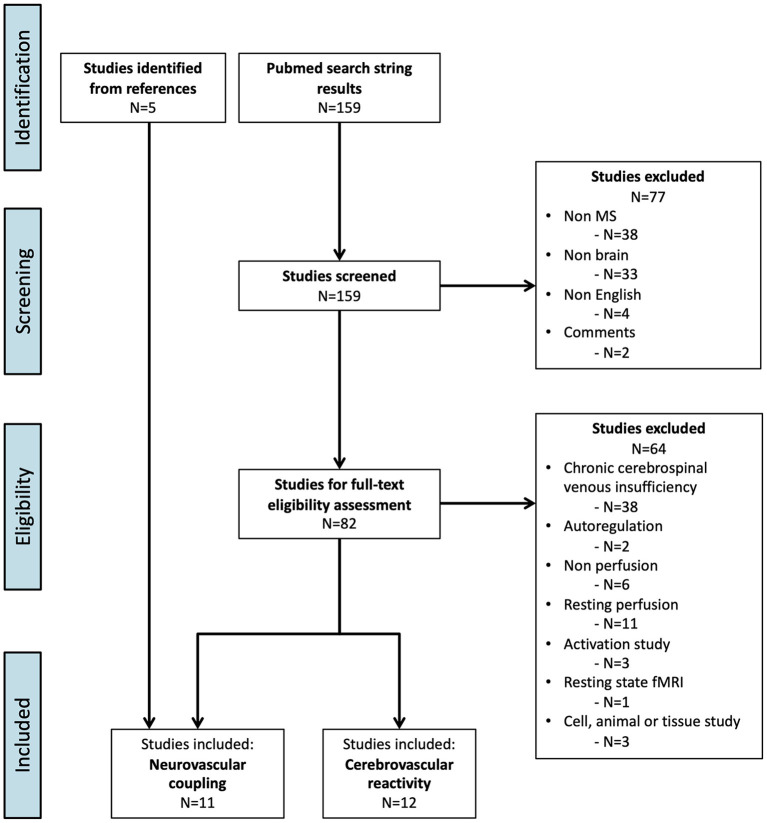
The inflammatory processes observed in the central nervous system in multiple sclerosis (MS) could damage the endothelium of the cerebral vessels and lead to a dysfunctional regulation of vessel tonus and recruitment, potentially impairing cerebrovascular reactivity (CVR) and neurovascular coupling (NVC). Impaired CVR or NVC correlates with declining brain health and potentially plays a causal role in the development of neurodegenerative disease. Therefore, we examined studies on CVR or NVC in MS patients to evaluate the evidence for impaired cerebrovascular function as a contributing disease mechanism in MS. Twenty-three studies were included (12 examined CVR and 11 examined NVC). Six studies found no difference in CVR response between MS patients and healthy controls. Five studies observed reduced CVR in patients. This discrepancy can be because CVR is mainly affected after a long disease duration and therefore is not observed in all patients. All studies used CO as a vasodilating stimulus. The studies on NVC demonstrated diverse results; hence a conclusion that describes all the published observations is difficult to find. Future studies using quantitative techniques and larger study samples are needed to elucidate the discrepancies in the reported results.
在多发性硬化症(MS)中枢神经系统中观察到的炎症过程可能会损害脑血管内皮,导致血管张力和募集的调节功能失调,从而可能损害脑血管反应性(CVR)和神经血管耦合(NVC)。CVR或NVC受损与脑健康下降相关,并可能在神经退行性疾病的发展中起因果作用。因此,我们研究了MS患者中有关CVR或NVC的研究,以评估脑血管功能受损作为MS致病机制的证据。共纳入23项研究(12项研究了CVR,11项研究了NVC)。六项研究发现MS患者与健康对照之间的CVR反应无差异。五项研究观察到患者的CVR降低。这种差异可能是因为CVR主要在病程较长后受到影响,因此并非在所有患者中都能观察到。所有研究均使用CO作为血管舒张刺激物。关于NVC的研究结果各异;因此,很难得出一个能描述所有已发表观察结果的结论。需要使用定量技术和更大样本量的未来研究来阐明报告结果中的差异。