Elayeete Sarah, Nampeera Rose, Nsubuga Edirisa Juniour, Nansikombi Hildah Tendo, Kwesiga Benon, Kadobera Daniel, Amanya Geofrey, Ajambo Miriam, Mwanje Wilbrod, Riolexus Alex Ario, Harris Julie R
Uganda Public Health Fellowship Programme, Kampala, Uganda.
Ministry of Health, Kampala, Uganda.
IJID Reg. 2022 Jun;3:160-167. doi: 10.1016/j.ijregi.2022.03.017. Epub 2022 Mar 24.
Uganda was affected by two major waves of coronavirus disease 2019 (COVID-19). The first wave during late 2020 and the second wave in late April 2021. This study compared epidemiologic characteristics of hospitalized (HP) and non-hospitalized patients (NHP) with COVID-19 during the two waves of COVID-19 in Uganda.
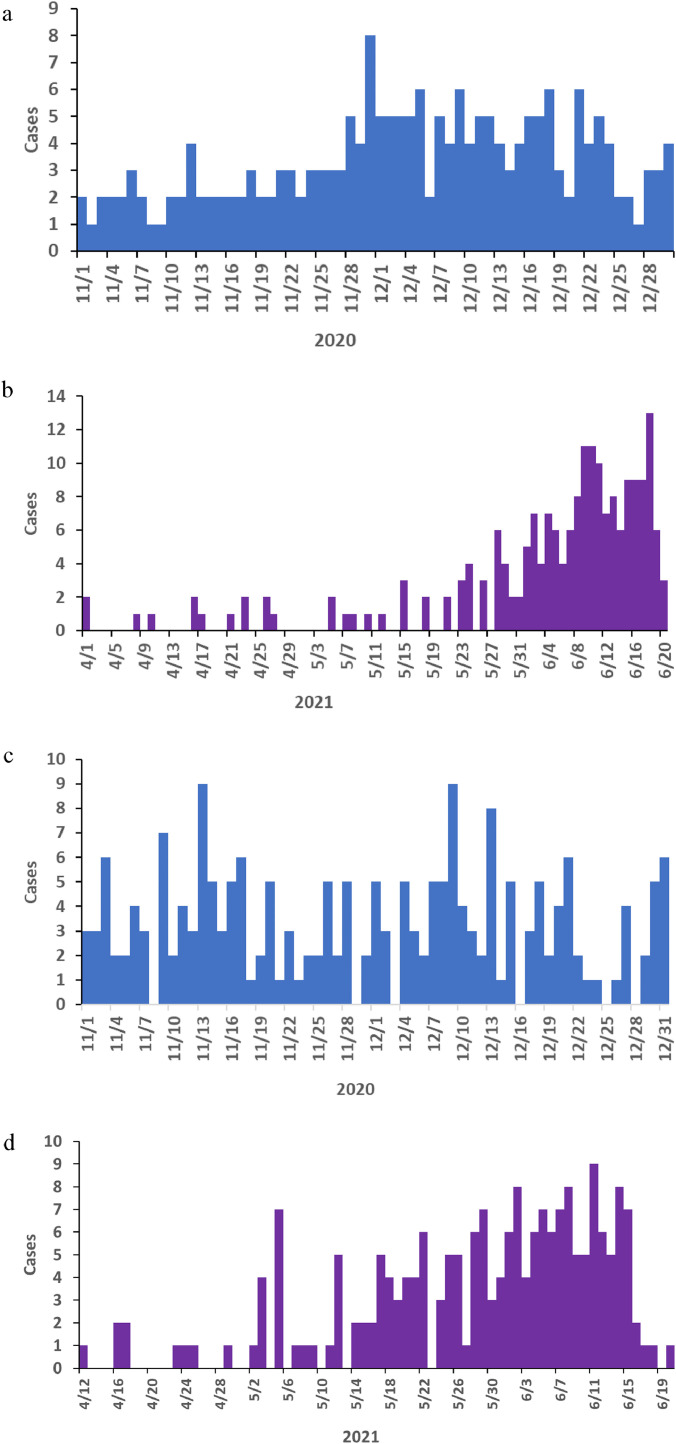
Wave 1 was defined as November-December 2020, and Wave 2 was defined as April-June 2021. In total, 800 patients were included in this study. Medical record data were collected for HP (200 for each wave). Contact information was retrieved for NHP who had polymerase-chain-reaction-confirmed COVID-19 (200 for each wave) from laboratory records; these patients were interviewed by telephone.
A higher proportion of HP were male in Wave 1 compared with Wave 2 (73% vs 54%; =0.0001). More HP had severe disease or died in Wave 2 compared with Wave 1 (65% vs 31%; <0.0001). NHP in Wave 2 were younger than those in Wave 1, but this difference was not significant (mean age 29 vs 36 years; =0.13). HP were significantly older than NHP in Wave 2 (mean age 48 vs 29 years; <0.0001), but not Wave 1 (mean age 48 vs 43 years; =0.31).
Demographic and epidemiologic characteristics of HP and NHP differed between and within Waves 1 and 2 of COVID-19 in Uganda.
乌干达受到了两波2019冠状病毒病(COVID-19)的影响。第一波在2020年末,第二波在2021年4月末。本研究比较了乌干达两波COVID-19疫情期间住院COVID-19患者(HP)和非住院患者(NHP)的流行病学特征。
第一波定义为2020年11月至12月,第二波定义为2021年4月至6月。本研究共纳入800例患者。收集了HP的病历数据(每波200例)。从实验室记录中检索出聚合酶链反应确诊为COVID-19的NHP的联系信息(每波200例);通过电话对这些患者进行访谈。
与第二波相比,第一波中男性HP的比例更高(73%对54%;P=0.0001)。与第一波相比,第二波中患有严重疾病或死亡的HP更多(65%对31%;P<0.0001)。第二波中的NHP比第一波中的NHP更年轻,但差异不显著(平均年龄29岁对36岁;P=0.13)。第二波中HP的年龄显著大于NHP(平均年龄48岁对29岁;P<0.0001),但第一波中并非如此(平均年龄48岁对43岁;P=0.31)。
在乌干达COVID-19疫情的第一波和第二波期间以及各波内部,HP和NHP的人口统计学和流行病学特征存在差异。